 |
Norwegian Lundehund |
|
FCI standard Nº 265 |
||
Origin |
Norway | |
Translation |
Norsk Kennel Club / Original version (En) | |
Group |
Group 5 Spitz and primitive types | |
Section |
Section 2 Nordic Hunting Dogs | |
Working |
Without working trial | |
Acceptance on a definitive basis by the FCI |
Wednesday 06 October 1965 | |
Publication of the official valid standard |
Thursday 10 November 2011 | |
Last update |
Wednesday 22 February 2012 | |
En français, cette race se dit |
 |
Chien norvégien de Macareux |
Diese Norm ist in deutscher Sprache sichtbar |
 |
Norwegischer Lundehund |
En español, esta raza se dice |
 |
Lundehund Noruego |
In het Nederlands, wordt dit ras gezegd |
 |
Noorse Lundehund |
In his country of origin, his name is |
Norsk Lundehund |
Usage |
| By his anatomical peculiarities this dog is predestinated to puffin-hunting on the steep rocks around the fjords and along the shore. |
Brief historical summary |
| The Norwegian Lundehund is an ancient breed used for hunting seabirds on the Norwegian coast. The breed name is a combination of the Norwegian words "lunde" (puffin, i.e. Fratercula arctica) and "hund", dog. Although the age of a breed is difficult to establish, there are descriptions of dogs used for hunting puffins which are more than 400 years old. The Lundehund was important for people in coastal Norway. The dog’s unique anatomy with extra, functional toes, a neck that can bend to touch the back, ears that can close and forelimbs that are ultra flexible, enables the dog to climb near vertical screes and enter the narrow, twisting burrows of the puffins nesting cavities and retrieve the birds alive. Puffin meat was a main part of the diet during winter in costal areas. The down was either used in duvets and pillows or exported. Modern hunting methods and depopulation in northern coastal regions caused a decrease in the Lundehund population. However, at Måstad on the isolated island of Værøy, people kept the hunting traditions alive, using the Lundehunds. Between the World Wars, some dogs were sent to a Mr.& Mrs Christie in southern Norway and bred from. Canine distemper nearly wiped out the entire Lundehund population between the World Wars and immediately after WW II, but the Christie’s in cooperation with people of Værøy and some new breeders, managed to save the breed from extinction. Today the puffin is a protected species and the dogs cannot be used for their original purpose. They are however much treasured and part of the Norwegian cultural heritage. |
General appearance |
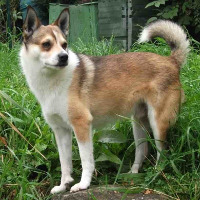
| Spitz type dog, small, rectangular, supple, rather lightly; morphological characteristics different according to sex. |
Behaviour / temperament |
| Alert, energetic, lively. |
Head |
||
Cranial region |
||
Head |
Clean-cut, medium width, wedge shaped. | |
Skull |
Slightly rounded with prominent superciliary arches. | |
Stop |
Pronounced, but without excess. | |
Facial region |
||
Muzzle |
Wedge shaped of medium length. | |
Nasal bridge |
Nasal bridge slightly convex. | |
Jaws and teeth |
Scissor bite preferred, but a pincer bite or a moderate prognathism of the lower jaw is permitted. The absence of premolars on both sides, in each jaw, is accepted. | |
Eyes |
Slightly sloping and not protruding; the iris is yellowish brown; the pupil is encircled by a dark halo. | |
Ears |
Triangular ears of medium size, broad at the base, carried erect and very mobile. The cartilage of the ear lobe has the faculty of being able to retract itself so that the ear folds itself and flops in a specific manner, either backwards or in right angle upwards, so as to close the auditory passage. | |
Neck |
| Clean-cut, of medium length, quite strong with a relatively well furnished collar. |
Body |
||
Body |
Rectangular. | |
Topline |
Straight. | |
Back |
Strong. | |
Croup |
Slightly sloping. | |
Chest |
Long, of medium width, relatively well let down and spacious, not barrel shaped. | |
Underline and belly |
Belly slightly drawn up. | |
Tail |
| Set medium high, medium length, well covered with hair but without flag. Carried either slightly in a ring over the back, or hanging. The tip must not be too much over nor falling to one side. |
Limbs |
Forequarters |
||
Generality |
Moderately angulated. | |
Forearm |
Straight. | |
Forefeet |
Oval shaped, turning slightly outwards, with at least six toes – of which five must rest on the ground. Eight pads on each foot. The two inner toes, formed respectively by 3 and 2 phalanges and endowed with a ligamentary and muscular system, make the foot look solid. | |
Hindquarters |
||
Generality |
The position of the hindquarters is somewhat close. | |
Upper thigh |
Strong and muscular. | |
Lower thigh |
Strong and muscular. | |
Stifle |
Moderately angulated. | |
Hind feet |
Oval shaped, turned slightly outwards, with at least six toes - four of which must rest on the ground. Seven pads on each foot, the one in the middle, the most important by its size, being attached to the inner pads corresponding to the two inner toes. When the dog is standing on a flat surface, the weight of the body must be evenly distributed on the pads. | |
Gait and movement |
| Light and elastic. An external rotary action of the forelegs and somewhat close action behind is characteristic of the breed. |
Coat |
||
Hair |
Dense and rough, soft undercoat. Short on the head and the front of the legs, more abundant at the level of the neck, rear of the buttocks (thighs) and on the tail, but without flag. | |
Colour |
Always combined with white: from red to fawn, coat more or less sprinkled with hairs with black tips; white with dark patches. The adult usually has more marked black tips in the coat than the younger dog. | |
Size and weight |
||
Height at withers |
Males 35 - 38 cms, females:32 - 35 cms. | |
Weight |
Males about 7 kgs, females about 6 kgs. | |
Faults |
| • Any departure from the foregoing points should be considered a fault and the seriousness with which the fault should be regarded should be in exact proportion to its degree and its effect upon the health and welfare of the dog and its ability to perform its traditional work. • Faults listed should be in degree of seriousness. |
Disqualifying faults |
 Aggressive or overly shy dogs. Aggressive or overly shy dogs. |
NB : |
| • Any dog clearly showing physical or behavioural abnormalities shall be disqualified. • The above mentioned faults when occurring to a highly marked degree or frequently are disqualifying. • Male animals should have two apparently normal testicles fully descended into the scrotum. • Only functionally and clinically healthy dogs, with breed typical conformation should be used for breeding. |
Bibliography |
| https://www.fci.be/ |



 English (United Kingdom)

Comments