
 |
Tosa |
|
FCI standard Nº 260 |
||
Origin |
Japan | |
Group |
Group 2 Pinscher and Schnauzer- Molossoid breeds – Swiss Mountain and Cattle Dogs | |
Section |
Section 2.1 Molossoid breeds, Mastiff type | |
Working |
Without working trial | |
Acceptance on a definitive basis by the FCI |
Wednesday 01 April 1964 | |
Publication of the official valid standard |
Tuesday 09 December 1997 | |
Last update |
Tuesday 09 December 1997 | |
En français, cette race se dit |
 |
Tosa |
Diese Norm ist in deutscher Sprache sichtbar |
 |
Tosa |
En español, esta raza se dice |
 |
Tosa |
In het Nederlands, wordt dit ras gezegd |
 |
Tosa |
Usage |
| Formerly fighting dog, nowadays watchdog. |
Brief historical summary |
| Japan has a long history of dog fighting, beginning in the 14th century. With such a history in the background, this breed was produced as a hybrid of Shikoku-ken and Western breeds. Named after the area where they were bred, these dogs are sometimes called "Japanese Mastiffs". The Western dogs used for creating the breed were Bulldogs (1872), Mastiffs (1874), German Pointers (1876) and Great Danes (1924), all of which were used to improve the breed by sequential mating. According to some accounts, St.Bernards and Bull Terriers were also involved, but it is not known in what years they were used. The Tosa's established features of stamina and the fighting instinct typically found in Mastiffs may be attributed to the involvement of such breeds. |
General appearance |
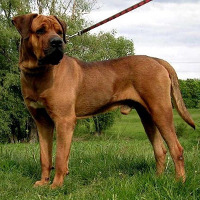
| Large-sized dog with a stately manner and robust build. The dog has hanging ears, short hair, a square muzzle and hanging tail thick at the root. |
Behaviour / temperament |
| The temperament is marked by patience, composure, boldness and courage. |
Head |
||
Cranial region |
||
Skull |
Broad. | |
Stop |
Rather abrupt. | |
Facial region |
||
Nose |
Large and black. | |
Muzzle |
Moderately long. Nasal bridge staight. | |
Jaws and teeth |
Upper and lower jaws strong. Strong with a scissor bite. | |
Eyes |
Rather small, dark brown in colour with a dignified expression. | |
Ears |
Relatively small, rather thin, set high on the skull sides, hanging close to the cheeks. | |
Neck |
| Muscular, with a dewlap. |
Body |
||
Withers |
High. | |
Back |
Level and straight. | |
Loin |
Broad, muscular. | |
Croup |
Slightly arched at the top. | |
Chest |
Broad and deep, ribs moderately sprung. | |
Underline and belly |
Well drawn up. | |
Tail |
| Thick at the root, tapering towards the tip, reaching the hocks when let down. |
Limbs |
Forequarters |
||
Shoulders |
Moderately sloping. | |
Forearm |
Straight, moderately long and strong. | |
Pastern |
Slightly inclining and robust. | |
Hindquarters |
||
Generality |
Muscles very developed. Joints of stifle and hock moderately angulated, strong. | |
Feet |
| Tightly closed. Pads thick and elastic. Nails hard and preferably dark in colour. |
Gait and movement |
| Robust and powerful. |
Coat |
||
Hair |
Short, hard and dense. | |
Colour |
Red, fawn, apricot, black, brindle. Slight white markings on chest and feet are permitted. | |
Size and weight |
||
Height at withers |
Minimum height at withers for dogs 60 cm, for bitches 55 cm. | |
Faults |
| • Any departure from the foregoing points should be considered a fault and the seriousness with which the fault should be regarded should be in exact proportion to its degree and its effect upon the health and welfare of the dog and its ability to perform its traditional work. • Faults listed should be in degree of seriousness. |
General faults |
 Thin bone. Snipy muzzle. Slightly overshot or undershot bite. Thin bone. Snipy muzzle. Slightly overshot or undershot bite. |
Disqualifying faults |
| Aggresive or overly shy. Extremely overshot or undershot bite. Shyness. |
NB : |
| • Any dog clearly showing physical or behavioural abnormalities shall be disqualified. • The above mentioned faults when occurring to a highly marked degree or frequently are disqualifying. • Male animals should have two apparently normal testicles fully descended into the scrotum. • Only functionally and clinically healthy dogs, with breed typical conformation should be used for breeding. |
Bibliography |
| https://www.fci.be/ |



 English (United Kingdom)

Comments