 |
Tornjak Bosnian Herzegovinian Croatian Shepherd Dog |
|
FCI standard Nº 355 |
||
Origin |
Bosnia and Herzegovina and Croatia | |
Translation |
Dubravka Reicher, prof. Revised by Jennifer Mulholland and Raymond Triquet | |
Group |
Group 2 Pinschers and Schnauzers – Molossoid breeds – Swiss Mountain and Cattle Dogs | |
Section |
Section 2.2 Mountain type | |
Working |
Without working trial | |
Acceptance on a definitive basis by the FCI |
Tuesday 07 November 2017 | |
Acceptance on a provisional basis by the FCI |
Friday 01 June 2007 | |
Publication of the official valid standard |
Tuesday 07 November 2017 | |
Last update |
Thursday 23 November 2017 | |
En français, cette race se dit |
 |
Tornjak Berger de Bosnie Herzégovine et de Croatie |
Diese Norm ist in deutscher Sprache sichtbar |
 |
Tornjak Bosnisch Herzegowinischer Kroatischer Schäferhund |
En español, esta raza se dice |
 |
Tornjak Pastor de Bosnia y Herzegovina y Croacia |
In het Nederlands, wordt dit ras gezegd |
 |
Tornjak Bosnian and Herzegovinian Croatian Shepherd Dog |
Usage |
| Herding and protection of livestock; farmyard guard dog. |
Brief historical summary |
| The almost extinct descendants of genetically homogeneous, native archaic types of shepherd dogs have been the foundation stock for the re-creation of the breed “Tornjak”. The dogs belonging to the original stock had been dispersed in mountain areas of Bosnia and Herzegovina and Croatia and their surrounding valleys. The major historical dates are the years 1067 and 1374. Written documents from these periods mention the Bosnianherzegovinian-Croatian breed for the first time. The research about their historical and more recent existence and then a systematic salvation from extinction started simultaneously in Croatia and Bosnia and Herzegovina around 1972 and continuous pure blood breeding began in 1978. Nowadays, the breed population consists of numerous, purebred dogs selected during a series of generations dispersed throughout Bosnia and Herzegovina and Croatia. |
General appearance |
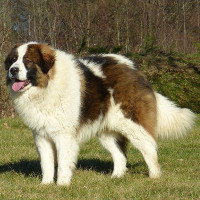
| The Tornjak is a large and powerful dog, well proportioned and agile. The shape of the body is almost square. The bone is not light, but nevertheless not heavy nor coarse. He is strong, harmonious and well balanced when standing and moving. His coat is long and thick. |
Important proportions |
| The body is almost square. The length of the body should not exceed its height by more than 8%. The ratio between the length of the skull and the muzzle is 1:1. |
Behaviour / temperament |
| Of steady disposition, friendly, courageous, obedient, intelligent, full of dignity and self confidence. Fierce in guarding property entrusted to him, cannot be bribed and is suspicious of strangers. Devoted to his master and very calm in his presence. Very affectionate towards persons living in his immediate vicinity. Learns quickly and keeps this in his memory for a long time, gladly performs tasks assigned to him. He is easy to train. |
Head |
||
Cranial region |
||
Head |
Elongated. The ratio between the skull and the muzzle is 1:1. Shorter muzzle can be accepted. | |
Skull |
The upper lines of the skull and muzzle are divergent. Supra-orbital arches are slightly visible. The hind part of the skull is elongated but moderately wide. The area from supra-orbital arches to the occiput is flat. The occipital protuberance is very slight. | |
Stop |
Slightly pronounced. | |
Facial region |
||
Nose |
Large with sufficiently wide nostrils. Should have dark pigmentation. Pigmentation in harmony with the colour of the coat. Depigmentation is not allowed. | |
Muzzle |
Rectangular. The bridge of the nose is perfectly straight. | |
Lips |
Tight fitting with dark pigmentation. | |
Jaws and teeth |
Jaws are very long and strong. Perfect scissor bite with full dentition. | |
Eyes |
Almond shaped, close fitting lids, dark colour. Dark pigmentation on edges of eyelids. | |
Ears |
Of medium size, triangular, folded and pendant, set rather high. Carried close to the cheeks. With shorter hair. | |
Neck |
| Of medium length, powerful, carried slightly low. Skin tight fitting. Long, abundant coat forming a mane. |
Body |
||
Withers |
Moderately developed. | |
Back |
Short, taut, moderately broad and straight. | |
Loin |
Connection between chest and croup is short and moderately broad; in females it is a bit longer. | |
Croup |
Of medium length, broad and slightly sloping. | |
Chest |
Very spacious, deep, broad and oval shaped. The lowest point of brisket reaches at least to the elbows. Never barrel shaped. Chest is strong, with moderately pronounced point of sternum. | |
Underline and belly |
Belly well muscled. The underline is not tucked up but gradually slopes up from the end of the sternum to the rear. | |
Tail |
| Long, set at medium height, very mobile. When relaxed it is hanging and in movement it is always raised over the level of the back, which is characteristic of the breed. Abundantly coated with distinct plume. |
Limbs |
| Strong and well angulated. | ||
Forequarters |
||
Generality |
Well developed, strong bones, tight muscles. Parallel and upright when standing. | |
Shoulders |
Of medium length, well laid back. The scapular- humerus angle is about 120°. | |
Upper arm |
Muscular and strong. Almost the same length as shoulders. | |
Elbows |
Moderately close to the body. | |
Forearm |
Strong bones, developed muscles, upright. | |
Pastern |
Slightly sloping. | |
Forefeet |
Toes arched and tightly knit. Nails pigmented, dark pigmentation desirable. Resilient pads, hard and tight, dark pigmentation desirable. Front feet more developed than hind feet. | |
Hindquarters |
||
Generality |
Strong and parallel. Upright when standing with adequate angulation. | |
Upper thigh |
Broad, strong, well muscled. | |
Lower thigh |
Well muscled, strong, broad, of the same length as the upper thigh. | |
Stifle |
Knee well bent. | |
Metatarsus |
Strong. Possible existence of dewclaws. | |
Hock |
Firm, set a bit high. | |
Hind feet |
Toes arched and tightly knit. Nails pigmented, dark pigmentation desirable. Resilient pads, hard and tight, dark pigmentation desirable. | |
Gait and movement |
| The Tornjak is a trotter. Movement is well balanced, supple, long reaching, harmonious, with strong drive from hindquarters. In movement the backline is firm. |
Skin |
| The skin is thick, well fitting all over the body. |
Coat |
||
Hair |
In general, the Tornjak is a long coated dog with short hair over the face and legs. The topcoat is long, thick, coarse and straight. It is specially long on the upper part of the croup; over the shoulders and the back it can also be slightly wavy. On the muzzle and the forehead, up to the imaginary line connecting the ears, over the ears and on the front parts of legs and feet it is short. It is especially abundant around the neck (mane), dense and long over the upper thighs (breeches). It forms feathers along the forearms. With well coated dogs it is also especially abundant on the rear of hind pasterns. The tail is richly coated with very long hair. Winter undercoat is long, very thick and of nice woolly texture. Hair is thick and dense and should not part along the back. | |
Colour |
As a rule the Tornjak is parti-coloured with distinct markings of various solid colours. Usually the dominant ground colour is white. There may be dogs with a black mantle and with white markings most often found around the neck, over the head and along the legs. There may also be almost white dogs with only small markings. | |
Size and weight |
||
Height at withers |
Dogs: 65 - 70 cm. Bitches: 60 – 65 cm. With a tolerance of +/- 2 cm. | |
Faults |
| • Any departure from the foregoing points should be considered a fault and the seriousness with which the fault should be regarded should be in exact proportion to its degree and its effect upon the health and welfare of the dog and its ability to perform its traditional work. • Faults listed should be in degree of seriousness. |
General faults |
 Bones too fine or too heavy. Head too fine or too coarse. Faults with ears (set on, length, coating). Pincer bite. Absence of 2 P2, 2 P3. Absence of more than 2 P1. Back too long. Roached or saddle back. Distinctly overbuilt dog. Faulty angulation. Elbows turned in or out. Tail laid on the back. Poorly coated tail. Hair of insufficient length. Dark mask. Weak feet. Bones too fine or too heavy. Head too fine or too coarse. Faults with ears (set on, length, coating). Pincer bite. Absence of 2 P2, 2 P3. Absence of more than 2 P1. Back too long. Roached or saddle back. Distinctly overbuilt dog. Faulty angulation. Elbows turned in or out. Tail laid on the back. Poorly coated tail. Hair of insufficient length. Dark mask. Weak feet. |
Disqualifying faults |
| Aggressive or overly shy dogs. Lack of type (untypical dogs). Deviation of sexual type. Anomalies in colour and shape of eyes (wall eyes, vicious expression, different colour of eyes). Entropion, ectropion. Overshot or undershot mouth. Absence of any other teeth than those mentioned above as faults. Hair too short. Lack of undercoat. Kinked tail. Absence of tail. Solid coloured dogs. Albinism. Untypical distribution of colours over the body. Diversion from allowed height limits (tolerance included). Cosmetic treatment of dog or evidence of cosmetic or surgical treatments. |
NB : |
| • Any dog clearly showing physical or behavioural abnormalities shall be disqualified. • The above mentioned faults when occurring to a highly marked degree or frequently are disqualifying. • Male animals should have two apparently normal testicles fully descended into the scrotum. • Only functionally and clinically healthy dogs, with breed typical conformation should be used for breeding. |
Bibliography |
| https://www.fci.be/ |



 English (United Kingdom)

Comments