 |
Hygen Hound |
|
FCI standard Nº 266 |
||
Origin |
Norway | |
Translation |
Norsk Kennel Klub | |
Group |
Group 6 Scenthounds and related breeds | |
Section |
Section 1.2 Medium-sized Hounds | |
Working |
With working trial | |
Acceptance on a definitive basis by the FCI |
Wednesday 06 October 1965 | |
Publication of the official valid standard |
Monday 09 August 1999 | |
Last update |
Monday 09 August 1999 | |
En français, cette race se dit |
 |
Chien courant de Hygen |
Diese Norm ist in deutscher Sprache sichtbar |
 |
Hygen Bracke |
En español, esta raza se dice |
 |
Sabueso de Hygen |
In het Nederlands, wordt dit ras gezegd |
 |
Hygenhund |
Usage |
| Scenthound. |
General appearance |
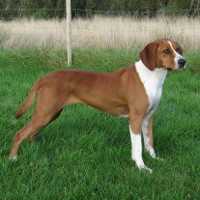
| Medium-sized, solid and compact, rectangular with strong topline. |
Head |
||
Cranial region |
||
Head |
Medium-sized and moderately broad, but not heavy. Medium long, somewhat wedge-shaped, but not pointed. | |
Skull |
Slightly domed seen both from the front and the side. The occipital bone is scarcely perceptible. | |
Stop |
Distinct. | |
Facial region |
||
Nose |
Black. | |
Muzzle |
Clean, broad and deep, rather short than long. Straight bridge of nose. Seen from the side the front of the muzzle should be rounded, not square. | |
Lips |
Clean, not pendulous, falling evenly away to the corner of the mouth. | |
Jaws and teeth |
Scissor bite. | |
Cheeks |
Clean and flat. | |
Eyes |
Dark brown. Medium size, not protruding. Calm and earnest expression. Not showing haw. | |
Ears |
Medium high set, neither broad nor long, tapering, rounded at the tip. Thin and soft, hanging not close to the cheeks, but somewhat away from them. Reaching hardly half way to the nose when pulled forward. | |
Neck |
| Medium length, strong, not too throaty. |
Body |
||
Back |
Straight and strong. | |
Loin |
Broad and muscular. | |
Croup |
Long, broad and slightly rounded. | |
Chest |
Medium broad, long, deep and spacious throughout. The back ribs should be particularly well developed, making the ribcage appear long. The depth of the chest is about half the height at withers. | |
Underline and belly |
Belly very slightly tucked up. | |
Tail |
| Set on level with the topline. Thick at the root, tapering towards the end. Carried straight or in a slight upward curve; reaching to the hock. |
Limbs |
Forequarters |
||
Generality |
Clean, solid and sinewy, but not heavy. | |
Shoulders |
Sloping shoulder blades, well angulated shoulder joint. | |
Elbows |
Well angulated. | |
Pastern |
Broad, rather short than long, sligthly sloping. | |
Forefeet |
High, arched and well-knit, pointing straight forward. Firm, and strong pads; well covered with hair between toes and pads. | |
Hindquarters |
||
Upper thigh |
Muscular and broad. | |
Lower thigh |
Long. | |
Stifle |
Well angulated. | |
Metatarsus |
Short, broad and slightly sloping. | |
Hock |
Well angulated. Broad and clean. | |
Hind feet |
High, arched and well-knit feet pointing straight forward. Firm and strong pads well covered with hair between toes and pads. Dewclaws permitted, but double dewclaws undesirable. | |
Gait and movement |
| Free movement, covering ground. Parallel in front and rear. Not cow-hocked behind nor toeing out in the front when moving. |
Coat |
||
Hair |
Straight and preferably somewhat rough to the touch, dense, shiny and not too short. The back of the thighs and the tail may be somewhat more heavily coated, but not too much. | |
Colour |
Red-brown or yellow-red, often with black shading on head, back and tail set, with or without white markings. Black and tan, usually combined with white markings. White with red-brown or yellow-red patches and ticks, or with black and tan markings. The different colours should be clearly defined from each other. |
|
Size and weight |
||
Height at withers |
Males 50-58 cm, ideal 54 cm. Females 47-55 cm, ideal 51 cm. | |
Faults |
| • Any departure from the foregoing points should be considered a fault and the seriousness with which the fault should be regarded should be in exact proportion to its degree and its effect upon the health and welfare of the dog and its ability to perform its traditional work. • Faults listed should be in degree of seriousness. |
Disqualifying faults |
 Aggressive or overly shy dogs. Aggressive or overly shy dogs. |
NB : |
| • Any dog clearly showing physical or behavioural abnormalities shall be disqualified. • The above mentioned faults when occurring to a highly marked degree or frequently are disqualifying. • Male animals should have two apparently normal testicles fully descended into the scrotum. • Only functionally and clinically healthy dogs, with breed typical conformation should be used for breeding. |
Bibliography |
| https://www.fci.be/ |



 English (United Kingdom)

Comments