 |
Ibizan Podenco |
|
FCI standard Nº 89 |
||
Origin |
Spain (Balearic Islands) | |
Translation |
C. Seidler | |
Group |
Group 5 Spitz and primitive types | |
Section |
Section 7 Primitive Type Hunting dogs | |
Working |
Without working trial | |
Acceptance on a definitive basis by the FCI |
Wednesday 10 November 1954 | |
Publication of the official valid standard |
Wednesday 26 May 1982 | |
Last update |
Friday 04 February 2000 | |
En français, cette race se dit |
 |
Podenco d'Ibiza |
Diese Norm ist in deutscher Sprache sichtbar |
 |
Ibiza Podenco |
En español, esta raza se dice |
 |
Podenco Ibicenco |
In het Nederlands, wordt dit ras gezegd |
 |
Podenco Ibicenco |
Usage |
| The Podenco Ibicenco is mainly used for hunting rabbits without guns, by day and at night. Thanks to his particularly good scenting ability, which, coupled with hearing, he uses more than sight, he scents and hunts out rabbits with ease, even in dense cover. Nimble and bright, he catches his prey quickly, specially when hunting together with other dogs. When one dog indicates game, he is surrounded by all the others, which keep a certain distance and stand in wait. They bark only when they see or hear the game and when they have surrounded it. Both when indicating and catching game, all dogs wag their tail fast, but are easily put off their waiting attitude. The Podenco Ibicenco is also used for hunting hare and large game. He is a good retriever. With certain exceptions only bitches are used for the formation of a pack or, at most, with one male only, as the latter do not work together during a hunt and are quarrelsome. When a pack has caught several thousand rabbits, it can happen with this breed, that some dogs from the same pack no longer want to hunt until they have had a considerable rest. The Spanish expression « enconillarse » ( go to rest ) refers to this peculiarity. |
Brief historical summary |
| This breed originates in the Balearic Islands of Majorca, Ibiza, Minorca and Formentera, where it is known by the original name of « Ca Eivissec ». It is also widely found in Catalonia, round Valencia, in the Roussillon and in the Provence, where it is known by the names Mallorquí, Xarnelo, Mayorquais, Charnegue, Charnegui and Balearic Dog. Probably these dogs were brought to the islands by the Phoenecians, Carthaginians and eventually also the Romans. This dog is a typical primitive and robust representative of one of the oldest still existing breeds. Illustrations of these dogs are found in the graves of the Pharaohs and on objects in museums, so that the existence of the breed can already be proved in the year 3400 BC |
Important proportions |
| The distance from the tip of the muzzle to the eyes is equal to that from the eyes to the occiput. |
Head |
||
Cranial region |
||
Head |
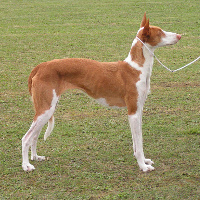
Seen as a whole, the long, fine head has the appearance of a cone cut off near its base ; completely dry, rather small in relation to body. | |
Skull |
Long and flat (dolichocephalic). Occipital bone protruding. Forehead fine and flat. | |
Stop |
Barely pronounced. | |
Facial region |
||
Nose |
Nose leather flesh colour. Nostrils open. Nasal bridge slightly arched. | |
Muzzle |
Nasal bridge and nose protrude over lower jaw ; fine, long and according to colour of coat, flesh colour. | |
Lips |
Thin, close fitting, flesh colour. | |
Jaws and teeth |
Perfect fitting bite, scissor bite, white and regular. | |
Eyes |
Slanting, small, light amber colour, reminiscent of caramel colour. The amber colour can be more or less intensive according to coat colour. Without seeming very noble, the expression shows intelligence but also fear and mistrust. | |
Ears |
Always stiff, very mobile. Pointing forward or sideways in a horizontal plane or held backwards. Upright when dog is animated. The center of the ear set on is level with the eyes . The shape is that of an elongated rhomboid, which has been cut off by a third of its long diagonal. They are fine without hair on the inside of the ear opening ; of medium, not exaggerated size. | |
Neck |
| Very dry, both in its upper and lower part. Its length is a quarter the length of the body, slightly arched and muscular. Skin is taut, smooth, without dewlap. Normally, the coat is longer and denser in the region of the set on to the body, especially in the smooth variety. |
Body |
||
Body |
Regarded as a whole, the body is symmetric, slightly convex and of medium, even proportions, compact and slightly longer than heigh, without the differences being laid down exactly. | |
Withers |
Well defined, high, dry and long. | |
Back |
Long, straight and pliable. Muscles strong, yet flat. | |
Loin |
Arched, of medium breadth, strong and firm. | |
Croup |
Strongly sloping with bone structure visible ; it shows very strong, hard muscles. | |
Chest |
Deep, narrow and long, but not reaching to the elbows. Forechest pointed and strongly protruding. Ribs flat. | |
Underline and belly |
Tucked up, but not too much. | |
Tail |
| Set on low ; there should be some longer and coarser, slightly offstanding hairs (like ears of grain) towards the tip ; long. When the tail is pulled through between the legs, it should reach the spine. Slightly thicker at set on, gradually tapering towards the tip. Hanging naturally in repose ; in movement carried in sickle shape more or less tightly curved. Preferably not carried upright or too much curled over back. |
Limbs |
Forequarters |
||
Generality |
Vertical, symmetric. Seen from front, the position of the front legs is very close together ; altogether sturdy, with long limbs which give the impression of a slim, fast, yet strong animal. | |
Shoulders |
Shoulder blades slanting, strong and freely mobile. | |
Upper arm |
Very long, straight, strong and very close in position. | |
Elbows |
Broad, set well apart from the body, parallel to the median plane of the body, but never loose. | |
Forearm |
Broadening towards front pastern. | |
Pastern |
Strong, firm, broad and well upright. | |
Hindquarters |
||
Generality |
Vertical with long, strong, flat muscles. | |
Hock |
Well angulated, broad, set low, vertical, turning neither out nor in. | |
Feet |
| Almost harefoot. Toes long and close together. Profuse hair in space between toes ; nails very strong and normally white, occasionally according to coat colour. Pads very hard. |
Gait and movement |
| The preferred movement is a suspended trot. Gallop is very fast and gives the impression of great agility. |
Skin |
| Taut, close fitting to body ; reddish pigment, but may be a different colour where coat colour differs. |
Coat |
||
Hair |
Smooth rough or long hair. The smooth should not be silky, but strong and shiny. The rough should be hard and very dense, somewhat shorter on head and ears and somewhat longer on rear of thighs and underside of tail. A beard is highly valued. The longhair is softer and should have at least a length of 5 cm. The head is very densely coated. |
|
Colour |
Preferred are white and red, or entirely white or red. Fawn dogs are permitted, provided it is an exceptionally good specimen ; in smooth coats, however, this colour is not permitted. | |
Size and weight |
||
Height at withers |
Dogs 66 to 72 cm, bitches 60 to 67 cm. Without undue strictness, dogs which are close to the required measurements can be accepted, provided they are well proportioned and aesthetic. |
|
Faults |
| • Any departure from the foregoing points should be considered a fault and the seriousness with which the fault should be regarded should be in exact proportion to its degree and its effect upon the health and welfare of the dog and its ability to perform its traditional work. • Faults listed should be in degree of seriousness. |
Serious faults |
 Head short and broad. Stop markedly pronounced. Missing of a premolar. Drop ears. Barrel ribs. Elbows turned outwards. Cow hocks. Feet turned out. Crossing of feet and hocks in movement. Head short and broad. Stop markedly pronounced. Missing of a premolar. Drop ears. Barrel ribs. Elbows turned outwards. Cow hocks. Feet turned out. Crossing of feet and hocks in movement. |
Disqualifying faults |
| Aggresive or overly shy. Skull in the shape of a stair (plane of skull too high in relation to nasal bridge). Brown pigment or black spots on nose leather. Any form of prognathism. Eyelids and lips reddish brown. Evidence of crossing with a « Galgo » or other form of sighthound : - Folded ears. - Dark eyes. - Croup broad. - Barely defined forechest. - Front legs wide apart. - Thighs rounded and broad with visible veins. |
NB : |
| • Any dog clearly showing physical or behavioural abnormalities shall be disqualified. • The above mentioned faults when occurring to a highly marked degree or frequently are disqualifying. • Male animals should have two apparently normal testicles fully descended into the scrotum. • Only functionally and clinically healthy dogs, with breed typical conformation should be used for breeding. |
Bibliography |
| https://www.fci.be/ |
Detailed history |
| The Podenco Ibicenco is a medium-sized dog from the Spanish Balearic Islands. The Balearic Islands are Ibiza, Mallorca, Menorca and Formentera. It is Ibiza that gives the Spanish name to this breed, Podenco Ibicenco. In Catalan the name is Ca Eivessenc. The height at the withers must be 60-72 cm. A certain amount of variation on this can be accepted if the dog is of exceptional quality. Different shades of red and white and combinations of the two colors are allowed. The coat occurs in two varieties: smooth and rough-haired. Some want to count the rare long coat as a third type of fur, but today this is seen as a variant of the shaggy. The Podenco Ibicenco is a very athletic and elegant dog with long legs, a slim body with an elongated stately head. Their large, upright ears are the most striking feature. They are very fast and agile with a lot of jumping power. When Podenco's Ibicenco hunt, they use all their senses. These dogs were bred for wild hunting, in other words hunting without any help from the human hunter. It is they and not the hunter who seeks the prey, chasing, killing and finally collecting the prey. The hunter is simply a silent spectator who gives the dogs their reward for hunting. Most of the time, the reward is a drink of water. The dogs are very thirsty in the heat. The use of dogs to kill prey is forbidden in many countries, only the hunter is allowed to kill the intended prey, by shooting. When they are released, the dogs first search the hunting ground as a pack, with the help of their sense of smell they catch the prey. The most common prey animals are rabbits and hares, but they also hunt for other larger animals. As soon as they notice something, it takes sight and hears it. This is when they show their astonishing jumping power. They are completely fearless when they pursue a prey. Nothing stops them. They tear through the undergrowth and over walls and rocks. They seem to be flying over everything that comes their way with royal elegance. With the help of their high jumps they get a better overview of the landscape and of the place where the prey is located. The dogs will use their excellent hearing for navigation if vision is inadequate. If the prey has been observed, one of the dogs will bark like a madman, and the rest of the pack will quickly merge for the hunt. The rabbit is immediately killed by breaking the neck or spinal cord. In this breed it is preferred that the prey is delivered live and unharmed to the hunter. A small number of the dogs supply the prey alive. If the hunter has established a good relationship with his dog, the Ibicenco will gladly hand it over to him. The big question is: are these hunting dogs suitable as pets? The answer is undoubtedly YES! They are excellent family dogs because they are gentle, friendly, patient and loyal. They are cuddly without clinging. Some find them a bit cat-like when they watch a newcomer vigilantly and carefully. In other words, it is not a dog that will throw itself on your guests and welcome them. There is a saying among the Podenco Ibicenco owners: You do not own Podenco Ibicenco. She owns you! We easily forget that these dogs are hunting dogs. It is especially important to remember about Podenco's. They are bred for hunting small game. If we are not careful, a few neighborhood cats and rabbits can mysteriously disappear. Podenco's quickly learn that the small animals in the family belong to the pack and are forbidden to them. For many Podenco's, that rule applies only in their own homes and not outside. Although visitors can view them as noble mythical creatures, one should not be misled by this facade. The Podenco Ibicenco is a very intelligent, active and dedicated dog. They are very stubborn and independent. In other words, inventive. They are looking for ways to enjoy themselves and this will not always be appreciated by the human part of the pack. They are very curious and like to be part of everything that happens around them. They like to stick their nose everywhere, even where it does not belong. When you throw the garbage into the garbage bin they are quick to help you get it out again. They will test your limits. But sooner or later even a Podenco gets tired. Remember that they are kangaroos in disguise, and master climbers. Fences around the garden must be high, very high. Do not think that you can overtake your dog if it has escaped. You just have to sit back and wait until he or she decides to return home again. This is a breed that requires a lot of physical and mental exercise for good health. They require an active family, not listless bank-sitters. Activities that they will enjoy are tracking, agility, lure coursing, cycling, retrieving, and of course long walks in nature to stimulate all their senses. They are a healthy breed without hereditary diseases, they live at least 12-14 years. They must be brought up using friendly methods. Never shout or hit. A Podenco who feels threatened will immediately run away at the first opportunity. In that case it will be very difficult for the dog to forgive you. One must be inventive to let the Podenco Ibicenco do what one wants from him / her. If they understand what we want and they think they can benefit from it, they will gladly do it with you because a pack clings everything together. This is not a breed that is easy to train. They can be incredibly skilled in every competition as long as they are motivated. So train for fun with them and not for a gold medal. As an owner, you have to be physically active and be able to take your dog everywhere you go. Ibicenco's do not only thrive, and preferably they should not be kept as the only dog. They are very attached to their pack, both human and dogs, and want to be with them. A lonely Podenco is an unhappy Podenco. This is the breed for an owner with a lot of humor, self-confidence and a lot of patience. The life that one shares with a Podenco will certainly never be boring. |



 English (United Kingdom)

Comments