 |
Icelandic Sheepdog |
|
FCI standard Nº 289 |
||
Origin |
Iceland | |
Translation |
Helga Andrésdóttir/ Original version (EN) | |
Group |
Group 5 Spitz and primitive Types | |
Section |
Section 3 Nordic Watchdogs and Herders | |
Working |
Without working trial | |
Acceptance on a definitive basis by the FCI |
Monday 17 July 1972 | |
Publication of the official valid standard |
Friday 15 June 2018 | |
Last update |
Tuesday 03 July 2018 | |
En français, cette race se dit |
 |
Chien de berger islandais |
Diese Norm ist in deutscher Sprache sichtbar |
 |
Islandhund |
En español, esta raza se dice |
 |
Perro de pastor islandés |
In het Nederlands, wordt dit ras gezegd |
 |
Ijslandse Hond |
In his country of origin, his name is |
Íslenskur Fjárhundur |
Usage |
| Herding dog. |
Brief historical summary |
| The Icelandic Sheepdog is Iceland’s native breed of dog. It is the descendant of the dogs brought to Iceland by the original Viking settlers (AD 870-930). The dogs became indispensable in the rounding up of livestock and in the daily work on the farms. Their method of working adapted to the local terrain, farming methods and the people’s hard struggle for survival over the centuries. |
General appearance |
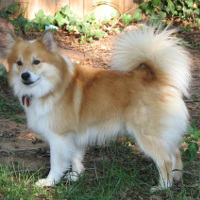
| The Icelandic Sheepdog is a Nordic Herding Spitz, slightly under medium size, sturdy, with erect ears and a curled tail. Seen from the side the dog is rectangular. The expression is gentle, intelligent and happy. A confident and lively bearing is typical for the breed. There are two types of coat, short and long, both thick and very weather-resistant. There is a marked difference in appearance between the sexes. |
Important proportions |
| Seen from the side the dog is rectangular, the length of the body from point of shoulder to point of buttock is greater than the height at withers. Depth of the chest is equal to the length of the foreleg. Muzzle slightly shorter than skull. |
Behaviour / temperament |
| The Icelandic Sheepdog is a hardy and agile herding spitz, which barks, making it extremely useful for herding or driving sheep and other livestock. The Icelandic Sheepdog is by nature very alert and will announce the arrival of visitors without being aggressive. The breed is cheerful, friendly, inquisitive, playful and confident with a gentle temperament. |
Head |
||
Cranial region |
||
Head |
Strongly built with close fitting skin. Triangular when seen from above or the side. | |
Skull |
Somewhat domed. | |
Stop |
Clearly defined though neither steep nor high. | |
Facial region |
||
Nose |
Black, dark brown on chocolate brown and some cream dogs. | |
Muzzle |
Well developed and strong, nasal bridge straight. Muzzle slightly shorter than skull. Tapering evenly towards the nose to form a blunt triangle when seen from both above and from the side. | |
Lips |
Close fitting. Black, dark brown on chocolate brown and some cream dogs. | |
Jaws and teeth |
Scissor bite, complete dentition preferred. | |
Cheeks |
Clean, well filled. | |
Eyes |
Almond shaped, of medium size. Dark brown, can be slightly lighter in chocolate brown and some cream dogs. The eye-rims are black or dark brown on chocolate brown and some cream dogs. Showing a mild expression. | |
Ears |
Erect and of medium size. Set well apart without being low set. Close to equilateral triangle with firm edges and slightly rounded tips. Very mobile, reacting sensitively to sounds and showing the dog’s mood. | |
Neck |
| Moderately long, clean and muscular. Slightly arched, carrying the head well. |
Body |
||
Body |
Strong and in harmony with general appearance. | |
Back |
Level, muscular and strong. | |
Loin |
Broad, muscular and fairly short. | |
Croup |
Moderately short and wide, slightly sloping and well muscled. | |
Chest |
Long, deep and well sprung. | |
Underline and belly |
Only a slight tuck up. | |
Tail |
| High set, curled over and touching the back. |
Limbs |
Forequarters |
||
Generality |
When seen from the front the forelegs are straight, parallel and strong. Normal angulation. | |
Shoulders |
Oblique and muscular. | |
Forefeet |
Slightly oval, toes well arched and tight, with well developed pads. Dew claws may be double. | |
Hindquarters |
||
Generality |
When seen from behind the hind legs are straight, parallel and strong. Normal angulation. | |
Upper thigh |
Broad and well muscled. | |
Hind feet |
Slightly oval, toes well arched and tight, with well developed pads. Dew claws well developed double dew claws are desirable. | |
Gait and movement |
| Displays agility and endurance with good driving action, covering the ground effortlessly. |
Coat |
||
Characteristics |
Double coat, thick and extremely weather resistant. | |
Hair |
There are two variants: Short-haired: The outer coat is fairly coarse, with a thick, soft undercoat. The hair is shorter on the face, top of head, ears and front of legs. It is longer on the neck, chest and back of thighs. The tail is bushy and the hair length is in proportion to the coat. Long-haired: The outer coat is longer and fairly coarse, with a thick, soft undercoat. The hair is shorter on the face, top of head, ears and front of legs. It is longer behind the ears, on the neck, withers, chest and back of thighs and with fringes on the back of the forelegs. The tail is very bushy and the hair length is in proportion to the coat. |
|
Colour |
• Fawn and red in various shades, ranging from cream to reddish brown. • Grey shaded. • Chocolate brown in various shades. • Black. White markings always accompany the main colour, lighter shading often occurs on the underside of the dog, from throat to tip of tail. On grey shaded dogs and quite often on fawn and red dogs a dark mask, dark tips to the outer hairs and dark hairs in the coat occur (dark overlay/sable). Black and chocolate brown dogs most often have traditional tan markings in any of the various fawn colours on the cheeks, over the eyes (eyebrows), below the tail, on the underside of the tail and on the legs. Pied dogs have patches of colour on the body on a white background, and can also have the accompanying white markings. The patches of colour, which can vary in size, should predominate. The white markings, which are often irregular, are a blaze or a part of the face, collar, chest, socks of varying length and tip of tail. Colour on or near the ears is preferred. |
|
Size and weight |
||
Height at withers |
Male: 46 cm. Female: 42 cm. | |
Faults |
| • Any departure from the foregoing points should be considered a fault and the seriousness with which the fault should be regarded should be in exact proportion to its degree and its effect upon the health and welfare of the dog and its ability to perform its traditional work. • Faults listed should be in degree of seriousness. |
General faults |
 A solid black or brown mantle or saddle on a fawn or red dog (hound markings). Very light eyes. Round eyes. Complete lack of dewclaws on hind legs. A solid black or brown mantle or saddle on a fawn or red dog (hound markings). Very light eyes. Round eyes. Complete lack of dewclaws on hind legs. |
Serious faults |
| Blue eyes. Yellow eyes. |
Disqualifying faults |
| Aggressive or overly shy dogs. |
NB : |
| • Any dog clearly showing physical or behavioural abnormalities shall be disqualified. • The above mentioned faults when occurring to a highly marked degree or frequently are disqualifying. • Male animals should have two apparently normal testicles fully descended into the scrotum. • Only functionally and clinically healthy dogs, with breed typical conformation should be used for breeding. |
Bibliography |
| https://www.fci.be/ |



 English (United Kingdom)

Comments