
 |
Sibercaan |
|
He is not recognized by the F.C.I. |
Origin |
Israel <> Siberia -> U.S.A. | |
Translation |
Francis Vandersteen |
A brief presentation of the Sibercaan |
| The Sibercaan is a designer dog, although opinions differ as to which breeds should contribute to this hybrid. While all breed registries agree that the Canaan Hound, a dog domesticated as early as 2200 to 2000 BC, returned to the Negev desert around 2000 years ago when the Romans moved the Israelites to the region, there is a difference of opinion when it comes to the second breed. While the American Canine Hybrid Club and the International Designer Canine Registry consider the Siberian Husky to be the second parent breed, the Designer Breed Registry considers the second breed to be the Native American Indian Dog. This is a highly intelligent, active breed which, with the right techniques, is extremely easy to train, but which, with harsh or overly repetitive training, can become obstinate and manipulative. This hybrid is generally a loyal and devoted watchdog that gets on well with family members of all ages, but can be wary of strangers. Siberians don't like confinement and require a lot of exercise and attention on a daily basis, making them unsuitable for small living spaces. |
History of the Sibercaan |
| The Sibercaan is not a purebred dog, but a type of intentional cross between two other breeds known as a designer dog. The American Canine Hybrid Club and the International Designer Canine registry list this dog as a cross between the Canaan Dog and the Siberian Husky, two ancient Spitz-type breeds. |
A little of the Canaan Dog |
||
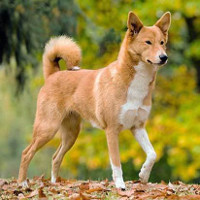
| The Canaan Dog is a rare and unusual breed of dog that was first domesticated thousands of years ago. The Canaan Dog breed is the national breed of Israel, and these dogs were known for their role as guardians and herders to the nomadic Israelites and Bedouins as early as 2200 to 2000 B.C. Hieroglyphics, skeletal remains and engravings from this period all closely resemble this breed, testifying to its close relationship with the inhabitants of the region. Then the Romans conquered the region and dispersed the Israelites. Many dogs remained, escaping into the Negev desert where, with the exception of a few who continued to be employed by nomadic Bedouins, they lived - and some still do - as wild or feral, semi-wild dogs. In the early 1930s, Professor Rudolphina Menzel, in search of a military dog capable of coping with the desert conditions of the region, captured some of the wild and semi-wild Canaan dogs living on the outskirts of the settlement. When she found that they were very easy to train, she launched a successful breeding program, producing a breed of extremely durable, healthy and competent dogs, which were widely used by the army throughout the Second World War and on which the Israeli defense forces still rely today. | ||
 |
||
| Standard of the Canaan Dog |
A little of the Siberian Husky |
| Siberian Huskies first came to public attention in the early 1900s. At that time, they were frequently used as sled dogs, and several dogs of this breed were instrumental in the well-documented Serum Run of 1925; a grueling race against a diphtheria epidemic that took twenty sled drivers and over a hundred dogs through 1100 kilometers of wilderness in unbearable conditions and probably saved around 10,000 people. Like the Canaan Dog, however, Siberian Husky dogs were domesticated and developed thousands of years ago, living closely with the Chuchki people in the cold regions of northern Russia, helping with hunting, guarding tribal property and pulling provision sledges. |
 |
| Standard of the Siberian Husky |
Appearance of the Sibercaan |
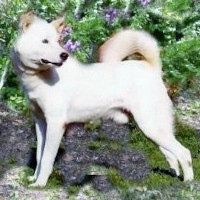
| The Sibercaan is a medium-sized working dog that is generally square in shape, although some can be a little longer than they are tall. They have a balanced head, somewhat flat and broad between the ears, and generally inherit the almond-shaped eyes that are characteristic of all three breeds, although their eyes can be any color, including browns ranging from almost black to amber, hazel eyes, blue eyes and even particolored eyes, depending on their overall ancestral makeup. Their muzzle is of medium length and somewhat pointed, their small to medium-sized triangular ears are pricked near the top of their skull, and they have the thick, dense coat common to almost all Spitz-type breeds. While the coat of the Canaan Dog is relatively short, that of the Siberian Husky is a little longer, so the Sibercaan's coat can be short to medium in length, and it can sport a solid-colored coat or a predominantly white coat with Siberian Husky-like markings or large patches of color, as sometimes seen in the Canaan Dog. Dogs that are mixed with the Native American Indian Dog instead of the Siberian Husky can sometimes have a longer coat and can add the possibility of a spotted, tortoiseshell-colored coat, as well as the occasional possibility of being considerably larger than the usual Sibercaan. |
Temperament of the Sibercaan |
| This is an active, intelligent hybrid that is likely to inherit an extremely high activity level from the Siberian Husky or Native American Indian Dog and an extremely alert, trainable nature from the Canaan Dog, although consistency and gentle reinforcement are necessary as heavy-handed methods can result in a stubborn, wilful response, and repetitive methods will result in a bored dog that may decide to try and train you instead. Although interactions between children and dogs should always be closely supervised, the three possible parent breeds tend to be very loyal to their families and are quite good with older children and quite tolerant of younger children too. They should not be left alone for long, as these sociable dogs quickly succumb to separation anxiety or depression and can become obsessively noisy or destructive. While the Siberian Husky and Native American Indian Dog are also quite friendly with strangers, other dogs and even other animals, the addition of the Canaan breed increases prey drive and aggression towards other dogs and can also increase suspicious behavior towards strangers. These dogs are totally unsuited to apartment living due to their high energy, vocal nature and aversion to confinement, and are more likely than other dogs to resist crate training. |
Needs and activities of the Sibercaan |
| The Sibercaan is an extremely athletic, active dog that needs plenty of exercise to stay in top shape. At least an hour to an hour and a half of vigorous activity is needed every day to keep this dog stable and healthy, although most enjoy even more exercise. The Sibercaan is also an extremely intelligent crossbreed, and combining mental exercise with physical activity is highly recommended. Activities for the Sibercaan that can combine mental exercise with physical activity can include agility training, advanced obedience, dog sledding, tracking exercises and sometimes even herding activities, although these dogs don't often enjoy water sports. |
Maintenance of the Sibercaan |
| Grooming this dog generally requires a moderate amount of work, although longer coats require more time and effort than shorter ones. Bathing is only necessary once or twice a year, but it's particularly important to ensure that the undercoat is completely dry in these dogs, as persistent dampness can lead to mold formation near the skin. The Canaan Dog and Native American Indian Dog shed very little hair for most of the year, and only need brushing two or three times a week to prevent knots and matting, and to distribute the dog's natural body oils correctly. The Siberian Husky, on the other hand, sheds a lot throughout the year and requires daily brushing all year round to control constant hair loss. |



 English (United Kingdom)

Comments