
 |
Siberian Cocker |
|
He is not recognized by the F.C.I. |
Origin |
Siberia <> U.S.A. -> U.S.A. | |
Translation |
Francis Vandersteen |
A brief presentation of the Siberian Cocker |
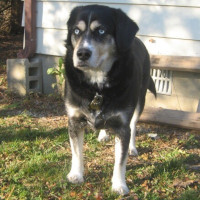
| The Siberian Cocker is a hybrid of design that is a combination of the American Cocker Spaniel and the Siberian Husky. This medium-sized dog has all the charming characteristics of its parents. Small, stocky and muscular, males measure 33 to 51 centimeters and females 35.5 to 40.5 centimeters. Siberian Cockers weigh between 12 and 18 kilos, with females tending to weigh slightly less than males. Its soft coat is not excessively long, but it is dense. The Siberian Cocker is an ideal companion dog with moderate energy levels. It's perfect for families, as the breed tends to adore children. They can live in apartments, provided they are given appropriate exercise. |
History of the Siberian Cocker |
| The Siberian Cocker is a relatively new breed. It is a cross between the Siberian Husky and the American Cocker Spaniel. As it is a combination of the two dog breeds, there is a good chance that the mix will share the various health problems of both parent dogs. It will also exhibit a combination of personality traits from both breeds. The Siberian Cocker is an optimal blend of its two parents. It has a lively character and a real affinity with children. |
A little of the Siberian Husky |
||
| The Siberian Husky was bred by the Siberian Indian tribe of Chukchi. They were used to pull the nomadic tribe's sledges, covering rough terrain and facilitating travel. In the 19th century, North American trappers also used this breed to pull sledges. In 1925, a Siberian Husky team was used to transport diphtheria medicine to Nome, Alaska. This courageous breed was added to the American Kennel Club working group in 1930. | ||
 |
||
| Standard of the Siberian Husky |
A little of the American Cocker Spaniel |
| The American Cocker Spaniel was originally bred as a small hunting dog in the UK and was a popular choice for woodcock hunting, hence the name "Cocker". Originally, "Cocker" classification depended on size, not ancestry. For a small Spaniel to be classified as a Cocker, it had to weigh less than 11.5 kilos. In 1878, the American Kennel Club recognized the breed. |
 |
| Standard of the American Cocker Spaniel |
Appearance of the Siberian Cocker |
| The Siberian Cocker is a medium-sized dog with a full, dense coat more reminiscent of the American Cocker Spaniel than the Siberian Husky. Some dogs need trimming, like the American Cocker Spaniel. This dog's coat is soft and smooth to the touch. It should be combed several times a week to remove any matting. This dog's coat varies in color and can be a combination of shades or a single color. Coat colors include white, black, tan, brown and cream. Its eyes are generally brown, black, blue or two-tone. This is a stocky dog with a muscular frame. Its legs are a little short and its paws and pads are wide. The Siberian Cocker's muzzle is a little short and its ears are long and floppy, like those of the parent American Cocker Spaniel. |
Temperament of the Siberian Cocker |
| The Siberian Cocker's temperament is ideal for a family. They love children. Its medium size makes it ideal for an active lifestyle. He loves walks and can even go for a jog. This intelligent dog will rarely pass up a game of ball or Frisbee. He also likes to snuggle up and lie down next to his master. His intelligence makes him an ideal dog for obedience training. He learns quickly and is always ready to please. Like his relative, the Siberian Husky, he is not inclined to bark, but will alert if a stranger is nearby. They are extremely endearing, outgoing and very loyal. Unlike many breeds, the Siberian Cocker is not prone to shyness and will happily welcome new people into its life. |
Needs and activities of the Siberian Cocker |
| The Siberian Cocker is active and needs exercise. They love to go for walks or play ball. Unlike many breeds, the Siberian Cocker gets on well with other animals and really enjoys playtime in a dog park. Its medium size makes it compatible with apartment living, provided it gets enough exercise to burn off its energy. A home with a large garden is ideal for your hybrid to run around and play in; just make sure you keep a constant eye on him when he's outside. He's an excellent companion for children, as he can play for hours without tiring. The Siberian Cocker enjoys a close bond with its owner or family, and loves to spend time with its favorite people. |
Maintenance of the Siberian Cocker |
| The Siberian Cocker has a dense, soft coat that requires weekly brushing. Some dogs also require monthly grooming, like the American Cocker Spaniel, but others don't have an actively growing coat. His nails need trimming once a month if his active lifestyle doesn't wear them down naturally. Some owners choose to brush their Siberian Cocker's teeth to keep them clean, plaque-free and prevent periodontal disease later in life. His floppy ears should be wiped with a damp cloth once a week to prevent the build-up of unwanted debris. |



 English (United Kingdom)

Comments