
 |
Siberian Boston |
|
He is not recognized by the F.C.I. |
Origin |
Siberia <> U.S.A. -> U.S.A. | |
Translation |
Francis Vandersteen |
A brief presentation of the Siberian Boston |
| The Siberian Boston is a hybrid breed. Its parent breeds are the Siberian Husky and the Boston Terrier. The Siberian Boston is a handsome, medium-sized dog. They are easy to care for, requiring little grooming. They are also easy to train; they are highly intelligent and eager to please their family. He may have a stubborn streak, but is still recommended for novice dog owners. He needs plenty of activity, both mental and physical. He can suffer from separation anxiety, so he's not a good companion for those who aren't regularly at home. However, his winning personality and desire to bond with his family make him an ideal dog for most owners. |
History of the Siberian Boston |
| The Siberian Boston is a hybrid breed, and little is known about its origins. However, we can study the history of parent breeds to better understand the Siberian Boston mixed breed. |
A little of the Siberian Husky |
||
| The origins of the Siberian Husky go back to an ancient breed of dog that traveled with the Chukchi, a group of Siberian nomads. The Chukchi used the Husky as a means of transport to pull sledges through deep snow, but the Husky's ancestor was also a family dog. He slept with family members, especially children, providing them with warmth. The Siberian Husky arrived in America in 1908 after being imported from Alaska. It was used as a sled dog during the Gold Rush, and continues to be used as a sled dog in the All-Alaska Sweepstakes. In 1930, the Russian government closed the border with Siberia, so all Siberian Huskies in the USA today are descended from these dogs. The Siberian Club of America was founded in 1938, and the first Siberian Husky was registered with the American Kennel Club in 1939. | ||
 |
||
| Standard of the Siberian Husky |
A little of the Boston Terrier |
| The Boston Terrier perfectly illustrates its nickname, the American Gentleman. So-called because its coat resembles that of a tuxedo, the Boston Terrier is truly an American dog. Although there is no documentation of its origin, it is believed that all Boston Terriers are descended from a dog named Judge owned by Robert Hooper of Boston. Judge was mated only once with a white bitch named Kate. Their union produced only one puppy, which, although not considered an attractive dog, had many characteristics that the breeder wished to reproduce. This puppy was eventually mated with another white female weighing around 9 kilos, and their puppies were bred with French Bulldogs to produce the modern Boston Terrier. In 1889, thirty owners of Boston Bulldogs, as some of them were nicknamed, got together and formed the Boston Terrier Club. The American Kennel Club began registering the breed in 1893. |
 |
| Standard of the Boston Terrier |
Appearance of the Siberian Boston |
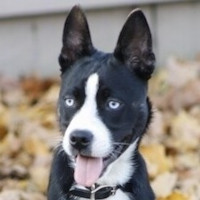
| The Siberian Boston has the best of both parent breeds' characteristics. It generally weighs between 9 and 18 kilos at maturity, depending largely on the dominant breed. They are slender, with high, erect ears. He may have blue eyes, or one brown and one blue eye; some say he has a “glass” eye. He will probably have the longer muzzle of the Siberian Husky's parent breed, but this is not guaranteed. He is likely to be black over most of his body, with white markings on his chest and belly. He may have a white patch on his face. His tail is likely to be long and slightly curved. His actual coat depends on the dominant parental breed. It may therefore have the thick undercoat of the Siberian Husky parent breed plus the short outer coat of the Boston Terrier parent breed. |
Temperament of the Siberian Boston |
| The Siberian Boston is a lively, energetic and intelligent dog. They are also very affectionate. They may bond particularly well with one member of the family. However, he loves every member of the family and is happiest when surrounded by them. He makes a good watchdog. He has no problem alerting his family to anything out of place on his territory. He's eager to please his human family, which makes him fairly easy to train. Be aware, however, that he can have a stubborn streak. Patience and perseverance are essential when working with a Boston Siberian. He can suffer from separation anxiety, which makes the Siberian Boston not a good dog for families who aren't home regularly. He's happiest when curled up on the sofa with you, or perhaps sitting on your lap, if you allow it. He's a gentle, fun addition to any family. |
Needs and activities of the Siberian Boston |
| The Siberian Boston needs a moderate amount of activity. Don't forget that he's highly intelligent. He's a working dog, and it's at work that he's happiest. The Boston Terrier is a lively little dog that also enjoys mental stimulation. To keep him busy, be sure to provide plenty of toys to stimulate his mind. In addition, you'll want to provide him with chew toys. Both parent breeds are known to destroy furniture and shoes when bored. For physical activity, brisk walks around the neighborhood are a great idea. He'll appreciate the dog park, but don't take him there until you've trained him to come back to you on your command. If you plan to give him free time in a fenced-in area, make sure the fence is at least 1.80 m high and anchored deep into the ground. The Siberian Husky's parent has been known to climb out of or dig under fences to find new territory to explore. |
Maintenance of the Siberian Boston |
| The Siberian Boston may or may not require a great deal of maintenance. This depends on the type of coat it inherits from its parents. If he inherits the short coat of his Boston Terrier parents, you can expect him to be low-maintenance. All he'll need is a monthly brushing to rid his body of excess hair. In spring and autumn, to combat shedding, you'll need to brush him once a week to keep your clothes and furniture free of hair. If he inherits the Husky parent's double coat, you'll need to be prepared for a “brush stroke” twice a year. This will happen in spring and autumn. During this period, it's best to brush him daily to rid him of excess hair. Bathe him only when necessary. Brush his teeth two or three times a week to prevent tartar build-up and bad breath. However, to avoid cavities, brush every day. Trim his nails once a month. You may need to do this twice a month, especially if he doesn't wear out his nails on his own. |



 English (United Kingdom)

Comments