 |
Silkytie |
|
He is not recognized by the F.C.I. |
Origin |
Australia <> Great Britain -> U.S.A. | |
Translation |
Francis Vandersteen |
A brief presentation of the Silkytie |
| The Silkytie is a cross between the purebred Shetland Sheepdog from the UK and the Australian Silky Terrier. Its name may not immediately betray its parentage, as some people don't remember the Shetland's nickname of Sheltie. The Silkytie's appearance can vary considerably from dog to dog, depending on which parent the hybrid most closely resembles. This wide variation makes it difficult to assign standards or accurately predict the health and character of the Silkytie based on breed. Silkytie owners can expect an affectionate temperament in a small dog, but energy levels can vary considerably. |
History of the Silkytie |
| The Silkytie is a cross between the Shetland Sheepdog and the purebred Australian Silky Terrier. Little is currently known about the Silkytie, apart from its parentage, and the hybrid is not as popular as other designer dogs. Owners who wish to better understand the Silkytie, or who are considering adopting one and want to know about possible traits, should examine the respective histories of the two breeds. |
A little of the Australian Silky Terrier |
||
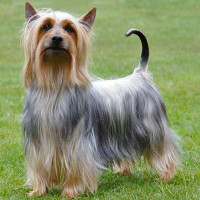
| The Australian Silky Terrier is an Australian breed developed in the late 1800s. The Yorkshire Terrier was crossed with Australian Terriers, and only puppies that adopted the Yorkie's silky appearance were subsequently bred until the silky traits were predictable. The Australian Silky Terrier was originally conceived as a vermin hunter, but quickly became a companion dog due to its luxurious coat and lap-dog temperament. The Australian Silky Terrier established itself in a short space of time, and the first Australian Silky Terrier to be registered with the American Kennel Club was in 1959. Today, the Australian Silky Terrier's popularity is nowhere near as high as that of its cousin the Yorkie, but the breed certainly has charm and popularity. | ||
 |
||
| Standard of the Australian Silky Terrier |
A little of the Shetland Sheepdog |
| The Shetland Sheepdog, also known as the Sheltie, is a small, rough Collie from the United Kingdom. The Sheltie is a robust Collie whose ancestors developed in the Shetland Islands, north of Scotland, near the Arctic Circle. These Arctic Circle dogs were known as Toonies, which means farm in Norwegian, helping to describe the breed's role as farm and herding dogs. In the 1800s, the Sheltie moved to Scotland and was crossed with Border Collies and other small dogs to reduce its size and give it an even fluffier coat. The Shetland was crossed with so many breeds that the original appearance of the dog faded, and enthusiasts, determined to restore the breed, launched the Shetland breeding program to restore and develop the standard. Collies were reintroduced into the lines, along with existing Shetlands, to help restore the breed. The Sheltie saw its name officially changed from Collie to Shetland Sheepdog during the 20th century because Collie enthusiasts were unhappy with the association between the two breeds, and the American Kennel Club recognized the breed in 1911. Today, the Sheltie ranks high on the list of most popular dogs and is considered a wonderful companion dog. |
 |
| Standard of the Shetland Sheepdog |
Appearance of the Silkytie |
| The Silkytie is a hybrid between the Shetland Sheepdog and the Australian Silky Terrier, and draws different traits from both parents. The Silkytie is a small dog that is generally low to the ground with proportionate body features. The Silkytie generally has a medium-sized muzzle with a black nose and deep, round, brown eyes. The Silkytie's coat can be fine and silky, like that of the silky-haired Australian Silky Terrier parent, or soft and downy, like that of the Sheltie parent, and is of medium length. The coat may also have certain hypoallergenic qualities. The Silkytie's ears can stand up or fold back, and are triangular in shape with long hairs adorning them. The Silkytie's tail also varies according to the parent the dog most resembles, and can be either short with a slight curl on the back, or medium-length and bushy. |
Temperament of the Silkytie |
| The Silkytie has a gentle, affectionate temperament. One of the best Terrier traits you can observe in the Silkytie is its independence. This characteristic is also reinforced by the Sheltie's high tolerance for solitude. These hybrids are low-maintenance when it comes to their social needs, and are always ready to please their masters. The Silkytie also makes an excellent companion for children, but is small and may not be suitable for young children who could accidentally hurt it. The Silkytie is curious about strangers and is never shy or aggressive. He also gets on very well with other dogs and pets, including cats. When it comes to training, the Silkytie is an intelligent and enthusiastic hybrid, but it absolutely needs mental and physical stimulation to lead a healthy life. |
Needs and activities of the Silkytie |
| The Silkytie is a medium-energy hybrid that is very agile. It has a lively stride and is fast, given its small size. Their speed and agility increase if they resemble the Sheltie, and they will need extra mental stimulation to keep their minds healthy. A small house with a garden is ideal for this hybrid, but they are able to adapt to apartment life if they get plenty of exercise. Their ideal environment also varies according to which breed the Silkytie most closely resembles. Sheltie-type Silkyties are much more versatile and need outdoor activities. They have a high tolerance for cold and like to be outdoors. This changes if the Silkytie resembles the Australian Silky Terrier. Silkytie hybrids prefer the comfort of indoors, and adapt well to small spaces. |
Maintenance of the Silkytie |
| The Silkytie may or may not be a heavy shedder. Silkytie shedding levels depend on which parent the hybrid most closely resembles. A dog with a straight, silky coat will not shed as much as the fluffy varieties. Whichever breed the Silkytie's coat most resembles, weekly brushing will help reduce the amount of loose and dead hair on the coat. The Silkytie has sensitive skin and can also develop allergies. For this reason, owners should refrain from bathing the Silkytie unless necessary, and always use hypoallergenic shampoos. The Silkytie is not prone to poor dentition, but weekly brushing will greatly reduce the amount of tartar and plaque that can build up and lead to dental disease. |



 English (United Kingdom)

Comments