 |
Skilky Terrier |
|
He is not recognized by the F.C.I. |
Origin |
Scotland <> Australia -> U.S.A. | |
Translation |
Francis Vandersteen |
A brief presentation of the Skilky Terrier |
| The Skilky Terrier is a hybrid between the purebred Scottish Terrier and the Australian Silky Terrier. The Scottish Terrier parent adds some ruggedness to the Skilky Terrier, but the Australian Silky Terrier softens it with a luxurious coat and a lap-dog temperament. The Skilky Terrier is currently recognized by the Designer Breed Registry and the International Designer Canine Registry as a Designer Companion Dog. The weight of the Skilky may vary depending on which parent breed the hybrid most closely resembles, but this hybrid will not exceed 25.5 centimeters in height as an adult. |
History of the Skilky Terrier |
| The Skilky Terrier is a hybrid between the Scottish Terrier and the Australian Silky Terrier. Little is known about the Skilky Terrier other than its parent breeds, and there are no detailed records of breeding programs. Owners and people considering adopting a Skilky Terrier should examine the backgrounds and dispositions of the respective parent breeds to better understand their dog. |
A little of the Scottish Terrier |
||
| The Scottish Terrier is a short, wire-haired Terrier that developed in Scotland over several centuries. The Scottish Terrier's predecessor was the Old Scotch Terrier and is thought to have been present in the region over 2,000 years ago. The Scottish Terrier belongs to the rough-coated group of Terriers known as the Skye Terrier group, and differs from its smooth-coated English cousins. The Scottish Terrier retains its strong hunting instinct and loves to dig, or "go to ground". Today, the Scottish Terrier is grouped with three other Terrier breeds in the Skye group, the Cairn Terrier, the Skye Terrier and the West Highland Terrier. The Scottish Terrier was imported to America in the 19th century, and the first of its kind was registered with the American Kennel Club in 1885. | ||
 |
||
| Standard of the Scottish Terrier |
A little of the Australian Silky Terrier |
| The Australian Silky Terrier is a cross between the Yorkshire Terrier and Australian Terriers. The breed was developed in Australia at the end of the 19th century, initially as silky-haired land dogs, but soon became a favored companion. Breeders selected only silky-haired hybrids until they achieved a predictable result, which enabled the breed to establish itself rapidly. In 1926, breed standards were established in Australia, and in 1959, the American Kennel Club recognized the first Silky Terrier. |
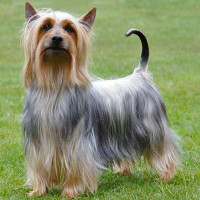 |
| Standard of the Australian Silky Terrier |
Appearance of the Skilky Terrier |
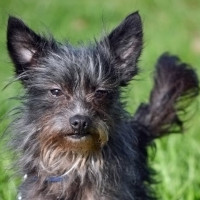
| The Skilky Terrier is a low-legged, robust-looking dog whose coat can range from silky to rough, depending on which breed it most resembles. However, most Skilky Terriers have a silky coat, like their silky-haired Australian Silky Terrier parents, and inherit their short legs from their Scottish Terrier parents. Skilky coat colors range from the lightest creams to blue and black, but are most often a combination of colors. The Skilky Terrier has a medium-sized head with a long muzzle and heavy hair on the chin. Its eyes are dark brown and round. The Skilky's ears are triangular in shape, rising to the top of the head. The Skilky can have a scissor or flat bite, and its lips are tight and black. |
Temperament of the Skilky Terrier |
| The Skilky Terrier is a spirited, self-confident dog that can be a little stubborn. However, they are affectionate with their family and love children. This hybrid is a sturdy dog, despite its seemingly delicate size, and can provide hours of entertainment and playtime with children. However, the Skilky Terrier does not tolerate rough play or teasing well, and may not be suitable for young children and those unfamiliar with how to interact with dogs. The Skilky Terrier can also adapt to life with other dogs, but needs to be socialized from an early age. Living with cats or other small pets can excite the Skilky Terrier's prey drive, but with time and socialization, this breed can learn to live in harmony with other pets. When it comes to training, the Skilky Terrier can be a little stubborn and independent, but this hybrid is intelligent and receptive to regular, patient training. They are also moderately active, but need daily exercise to avoid developing bad habits through boredom. |
Needs and activities of the Skilky Terrier |
| The Skilky Terrier is a moderately active dog that likes to go to ground. Both Terrier parents have a long history of working the land as vermin hunters, especially the Scottish Terrier. As an earth dog, owners can expect their Skilky Terrier to love digging and rummaging through bushes in search of any sign of life or movement. The Skilky doesn't need much exercise, but it's just as important to keep his mind stimulated while exercising his body to prevent the Skilky Terrier from digging up the flowerbed or potted plants indoors. If given sufficient physical and mental stimulation, the Skilky Terrier can adapt well to apartment and city life. They also adapt well to all climates, but prefer a temperate environment. |
Maintenance of the Skilky Terrier |
| Skilky Terriers can be hypoallergenic and are not known for shedding much. However, its long, silky coat requires frequent grooming to avoid tangles. Brushing the Skilky Terrier also easily removes dirt or debris that clings to the coat, so bathing is not as necessary for this breed. The Skilky should only be bathed when necessary, and owners should use a hypoallergenic shampoo to reduce the risk of skin irritation. The Skilky Terrier's bite may not be ideal, and over- or undershot teeth can lead to dental problems. Owners can help prevent major dental problems by brushing their Skilky Terrier's teeth at least three times a week. Skilky Terriers will adapt to tooth-brushing practices over time, especially if the practice is started while they are still young. |



 English (United Kingdom)

Comments