 |
Wire Toy Fox Terrier |
|
He is not recognized by the F.C.I. |
Origin |
Great Britain <> U.S.A. -> U.S.A. | |
Translation |
Francis Vandersteen |
A brief presentation of the Wire Toy Fox Terrier |
| Wire Toy Fox Terrier, also known as Wire Toy Foxter, are small hybrids of Wire Fox Terrier and Toy Fox Terrier. These dogs are courageous, self-confident, stubborn and energetic. Their coats are generally rough and vary in length from short to medium. Their coat color can be brown, white, fawn, cream, black, and is usually a combination of colors. They have a hunting instinct, so it's important to train them early on to prevent them from seeing small animals as prey. Their weight varies between 4 and 6 kilos, and they reach less than 38 centimeters in height. They love to run, dig and chase balls. |
History of the Wire Toy Fox Terrier |
| The Wire Toy Fox Terrier is a designer dog created by crossing a Wire Fox Terrier with a Toy Fox Terrier. As with many hybrid dogs, little is known about their origins. On the other hand, much is known about the parent breeds. |
A little of the Wire Fox Terrier |
||
| The Wire Fox Terrier is also related to the Fox Terrier Smooth, and both have their origins in England. Fox Terriers were developed in the 18th century, when hunting became very popular in England. It wasn't long before hunters recognized the need for a hunting dog capable of driving foxes from their dens, hence the creation of the Fox Terrier. Wire Fox Terriers and Fox Terriers Smooth were long considered part of the same breed. Wire Fox Terriers are thought to be a cross between wire-haired Black and Tan Terriers from Derbyshire, Durham and Wales. Wire Fox Terriers were literally crossed with rough-coated Fox Terriers to make the Wire Fox Terrier whiter, with a cleaner head and conventional silhouette. King Edward VII of England was the proud owner of a Wire Fox Terrier named Caesar. When the king died, Caesar took part in his funeral procession. The breed was introduced to America in the 1880s. The Fox Terrier was recognized by the American Kennel Club in 1885, and wire-haired and smooth-haired dogs were registered in the same breed. It wasn't until 1985 that the American Kennel Club recognized the Wire Fox Terrier and the Fox Terrier Smooth as different breeds. | ||
 |
||
| Standard of the Wire Fox Terrier |
A little of the Toy Fox Terrier |
| The Toy Fox Terrier is descended from the Fox Terrier Smooth, which was created in England to help hunt foxes. The Fox Terrier Smooth had a fairly wide size range; dogs could weigh from 3 to 9 kilos. Miniature dogs were preferred, as they were the bravest and excelled at hunting, raking and guarding. The Wire Fox Terrier was first recognized by the United Kennel Club in 1912, and all sizes of dog were registered under the same breed. It wasn't until 1936 that the Toy Fox Terrier was finally recognized by the UKC as a distinct breed. The American Kennel Club recognized the Toy Fox Terrier in 2003. |
 |
| Presentation of the Toy Fox Terrier |
Appearance of the Wire Toy Fox Terrier |
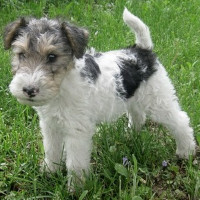
| The Wire Toy Fox Terrier is a small, shaggy dog with a short to medium-length, usually harsh, dense coat. They weigh between 4 and 6 kilos and stand less than 38 centimeters tall. Despite their small size, they have a strong, solid complexion. Their legs are long and lean, and their feet are strong. They have a small, slightly rounded head, with a slightly narrower, rather long and flat muzzle. They look like they have a moustache because of the fur that covers their muzzle. Their ears are triangular and fold forward. They have large, round brown eyes and a rounded black nose. Their coat can be brown, cream, fawn, white or black, but is most often multicolored. Overall, they have an innocent but playful appearance, and look athletic. |
Temperament of the Wire Toy Fox Terrier |
| The Wire Toy Fox Terrier is an active little dog with a strong hunting instinct. You'll often see him chasing small animals. He also likes to dig, run and play games like ball retrieving. He's a very stubborn dog who won't budge. It therefore takes a great deal of consistency and firmness to train him, but always with positive reinforcement; treats and praise generally produce good results. He can make an excellent pet if properly socialized as a puppy, and will happily play with children at any time. This hybrid is also very brave, alert, loyal and protective, making it a good watchdog. |
Needs and activities of the Wire Toy Fox Terrier |
| Although the Wire Toy Fox Terrier is small, it needs daily activity to expend its energy and keep it happy. They love to run, dig and jump, so taking them to a park or yard where they can run off-leash would be much appreciated. However, keep it away from gardens as it is a dexterous digger. A daily 30-minute walk is also recommended to allow him to stretch his legs and get some exercise. He'll do best in a home with a fenced garden, but you should never leave him unattended when he's outside, as he tends to wander and follow small animals. He can also adapt to life in an apartment, but he needs daily outdoor activity. Also, be sure to give him plenty of toys to keep him entertained when you leave him alone, as he may become anxious and destroy objects if bored. |
Maintenance of the Wire Toy Fox Terrier |
| Wire Toy Fox Terriers have dense coats and shed moderately, so frequent brushing is recommended. Comb his coat every other day with a long-haired brush to remove loose hair and prevent knots and tangles. He doesn't smell bad, but he should be bathed from time to time using a hypoallergenic dog shampoo to avoid irritating his skin. As his skin is delicate and prone to scabies, examine him often and take him to the vet if he shows any redness or irritation. Clean his ears every week with absorbent cotton and an ear cleaning solution. Brush his teeth two or three times a week, too, to help get rid of tartar build-up and bad breath. You may need to trim the hair around his ears, eyes and paws to prevent blockages and infections, and clip his nails every month. He may also need a few visits a year to a professional groomer, to keep his coat neat and elegant. |



 English (United Kingdom)

Comments