Wirehaired Pointing Griffondor

He is not recognized by the F.C.I.

Origin
France <> Canada -> U.S.A.
Translation
Francis Vandersteen

A brief presentation of the Wirehaired Pointing Griffondor

The Wirehaired Pointing Griffondor is a hybrid breed whose ancestry comes from two sporting dogs, the Wirehaired Pointing Griffon Korthals and the Labrador Retriever, whose combination has produced a very useful dog with a friendly, outgoing personality and a penchant for hunting. With an average height of almost 61 centimeters and a weight of 32 kilos, these large dogs have an exceptional temperament, making them excellent family dogs, even for people with young children. They are easy to train and eager to please their owners, with a high spirit that they are not afraid to show. Because of their size and energy level, they generally adapt better to larger homes, especially those with more space to move indoors and out, but they are adaptable enough to be housed in smaller environments, given proper attention and exercise.

History of the Wirehaired Pointing Griffondor

There is little published on the Wirehaired Pointing Griffondor itself, but the parent breeds are both well established in their countries of origin.


A little of the Wirehaired Pointing Griffon Korthals

        
The Wirehaired Pointing Griffon Korthals was bred to be an aquatic hunting dog. Its ancestors date back to 500 BC, but most of its modern congeners are due to Eduard Korthals, son of a Dutch banker and cattle breeder, who perfected the breed in an attempt to create a robust dog capable of hunting, tracking and pointing over a wide variety of terrain. He marketed them throughout Europe, but they never really gained in popularity, even today. Although not widely known, Korthals Wirehaired Pointing Griffons are still considered superior sporting dogs and excellent companions.
Standard of the Wirehaired Pointing Griffon Korthals


A little of the Labrador Retriever

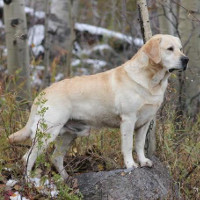
The Labrador Retriever easily ranks among the world's most popular breeds, thanks in large part to its general versatility and good-natured temperament. Its history can be traced back to the St. John's dog, a breed refined in Newfoundland, Canada, where British, Portuguese and Irish fishermen often traded their goods as early as the 16th century. As their early functions indicate, these dogs were bred to love water and have waterproof coats, and they still retain these useful characteristics today. In the early 19th century, the dogs were exported to England with fishermen's catches, and it was there that they received their name, Labrador, from the third Earl of Malmesbury, after the Labrador Sea, where they thrived. Over time, they have also been used as companion and family dogs, but remain one of the most popular breeds with the police and military, as well as a service dog, thanks to their high intelligence and obedience.
Standard of the Labrador Retriever

Appearance of the Wirehaired Pointing Griffondor

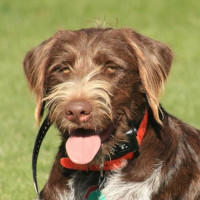
The Wirehaired Pointing Griffondor is a medium-sized dog, averaging 61 centimeters in height and 32 kilos in weight, with a medium-length outer coat and dense, waterproof undercoat. His general appearance is that of a sporting dog, as he is muscular and athletic, making him an excellent swimmer, as evidenced by his broad webbed paws. They have a slightly square head with a medium-length muzzle and folded ears, and often sport pronounced whiskers and eyebrows. Their tails are generally medium-length and tapered to help them swim, although some prefer to cut them off at half their length. Their coats range in color from black to white and brown to cream, and they usually wear at least two, one for their longer topcoat and the other for their shorter undercoat, giving them a distinct, untidy appearance.

Temperament of the Wirehaired Pointing Griffondor

Like its Labrador Retriever ancestry, the Wirehaired Pointing Griffondor is remarkably easy-going, and actively shows its affectionate side as often as possible. They are loyal, intelligent and obedient, making them easy to train, even with complex commands. Because of their friendly nature, high spirits and playful attitude, they make excellent family pets, as they get on well with adults, children, other dogs and other pets, even if they are only lightly socialized. They've even developed what breeders call a soft mouth - the ability to carry and use their mouths with surprising gentleness that doesn't interfere with the play they fetch, their toys or even their playmates. This is not necessarily true at birth, however, and they can become active biters as puppies who voluntarily exercise limited control if not properly trained. Because of their high energy levels, they can become restless, noisy or mischievous if not properly exercised.

Needs and activities of the Wirehaired Pointing Griffondor

The Wirehaired Pointing Griffondor, like both its parents, is a high-energy dog that needs regular space to run around, whether in a large fenced yard, in a dog park, or while cycling or jogging with its owners. They need 60 to 90 minutes of exercise a day, and an average week should include around 15 kilometers of running/walking. Training, playing and even taking part in regular activities such as fetching the mail or taking out the rubbish will help to keep them mentally and physically busy, as well as happy and healthy, and games such as ball games, where they have to run over vast expanses, are ideal for this purpose. Although intelligent and able to develop a slight sense of independence, Wirehaired Pointing Griffondors need frequent interaction. If left to their own devices, even in a large space, their boredom can become mischievous and sometimes destructive, which is why they often do best in large spaces, big homes and large families that can shower them with attention.

Maintenance of the Wirehaired Pointing Griffondor

Most maintenance for this breed is reserved for brushing. Although the two related breeds shed only seasonally, their double coats require weekly brushing to stay in tip-top shape. Despite their sometimes scruffy appearance, Wirehaired Pointing Griffondors are actually quite a clean breed and therefore only need a bath every couple of months, or when they decide to roll around in something nauseating, which is not uncommon for those allowed to walk off-leash. Their ears are the only other major source of maintenance problems, as excessive moisture build-up in their folded ears can encourage the growth of bacteria, making regular checks necessary. Their nails usually stay short naturally, with noticeable clicking noises being a good indicator of the need for trimming. Given the amount of food Wirehaired Pointing Griffondors consume, owners should also be prepared to have their pet's teeth brushed regularly, at least once a week, with a toothpaste suitable for dogs. Given their love of attention and bonding time, maintenance for this breed tends to be fairly easy and even enjoyable for both parties.

Comments

Latest page updates

  • Telomian

    Telomian He is not recognized by the F.C.I. Origin Malaysia Translation Francis Vandersteen A brief presentation of the Telomian The Telomian is a very rare breed of dog, and the only one native to Malaysia to have been bred outside the country. They were originally bred by the indigenous people of Malaysia to combat parasites such as snakes, rats,...
  • King Wheaten -- Cavalier King Charles Spaniel X Irish Soft Coated Wheaten Terrier

    King Wheaten He is not recognized by the F.C.I. Origin Great Britain <> Ireland -> U.S.A. Translation Francis Vandersteen A brief presentation of the King Wheaten The King Wheaten is a small dog with a heart this big and a playful disposition. Borrowing the energy and soft-coated waves of the Irish Soft Coated Wheaten Terrier and the size and...
  • Spanierd -- English Springer Spaniel X German Shepherd

    Spanierd He is not recognized by the F.C.I. Origin Great Britain <> Germany -> U.S.A. Translation Francis Vandersteen A brief presentation of the Spanierd The Spanierd is a hybrid dog. Its parent breeds are the English Springer Spaniel and the German Shepherd. They have an affable personality. He's known for entertaining family and friends with his...
  • Alaskan Goldenmute -- Alaskan Malamute X Golden Retriever

    Alaskan Goldenmute He is not recognized by the F.C.I. Origin U.S.A. <> Great Britain -> U.S.A. Translation Francis Vandersteen This breed is also known as Alaskan GoldenGoldenmuteAlaskan Gold Retriever     A brief presentation of the Alaskan Goldenmute The Alaskan Goldenmute is a descendant of two great dog breeds: the Alaskan Malamute and the Golden...
  • French pointing dog Pyrenean type

    French pointing dog Pyrenean type FCI standard Nº 134 Origin France Translation Mrs. Peggy Davis Group Group 7 Pointing Dogs Section Section 1.1 Continental Pointing Dogs « Braque » Type Working With working trial Acceptance on a definitive basis by the FCI Tuesday 18 January 1955 Publication of the official valid standard Tuesday 01 August 2023 Last...
  • French pointing dog Gascogne type

    French pointing dog Gascogne type FCI standard Nº 133 Origin France Translation Mrs. Peggy Davis Group Group 7 Pointing Dogs Section Section 1.1 Continental Pointing Dogs « Braque » Type Working With working trial Acceptance on a definitive basis by the FCI Monday 17 January 1955 Publication of the official valid standard Tuesday 01 August 2023 Last...
  • Vucciriscu

    Vucciriscu He is not recognized by the F.C.I. Origin Sicily Translation Francis Vandersteen En français, cette race se dit Vucciriscu Diese Norm ist in deutscher Sprache sichtbar Vucciriscu En español, esta raza se dice Vucciriscu In het Nederlands, wordt dit ras gezegd Vucciriscu This breed is also known as Sicilian Vucciriscu Sicilian Butcher...

© 2026 Groupe Milouchouchou ASBL. Tous droits réservés. En savoir plus

Protected by Copyright01
We use cookies

We use cookies on our website. Some of them are essential for the operation of the site, while others help us to improve this site and the user experience (tracking cookies). You can decide for yourself whether you want to allow cookies or not. Please note that if you reject them, you may not be able to use all the functionalities of the site.

Ok