
 |
Aussiedoodle |
|
He is not recognized by the F.C.I. |
Origin |
U.S.A. <> France -> U.S.A. | |
Translation |
Francis Vandersteen | |
This breed is also known as |
Aussiepoo |
A brief presentation of the Aussiedoodle |
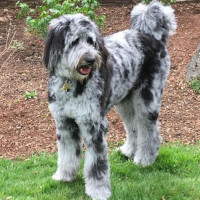
| The Aussiedoodle is the super-intelligent hybrid created by crossing the Poodle with the Australian Shepherd. Both parent breeds are renowned for their intelligence, and this is the remarkable characteristic that manifests itself in their puppies. An Aussiedoodle can almost read its owner's mind, which can be both a blessing and a curse. They are also extremely active dogs, and this combination of intelligence and energy can be a recipe for bad behavior without adequate stimulation or companionship. The ideal home for this breed is with an active family, with at least one person at home all day eager for long morning and evening walks. From the Aussiedoodle's point of view, the presence of children at home is a major asset, as it's a very playful and affectionate hybrid that lives on cuddles and games. Because the Standard or Miniature Poodle can be used for breeding, the size of the Aussiedoodle is highly variable. The same is true of its coat color, and the complex rearrangement of the many color variations in the Australian Shepherd and Poodle means that no two of their puppies are likely to look alike. Rather than trying to standardize appearance, Aussiedoodle breeders seek to emphasize its wonderful temperamental and intellectual qualities. Although he is a hybrid, several health problems may be encountered, some of which should be detected before breeding. Anyone wishing to buy a cross-breed puppy should research the parents' health as thoroughly as if they were buying one of the original breeds. The Aussiedoodle has an average life expectancy of 10-12 years. |
History of the Aussiedoodle |
| A little confusingly, the Australian Shepherd has very little connection with Australia, but is a very popular companion dog in the USA, where it was developed as a working dog. They are exceptionally intelligent and highly energetic. It requires a committed owner with the time and energy to train and exercise. Similarly, the Poodle has a reputation as one of the most intelligent breeds, and can also be a very active and exciting dog. So it's not surprising that crossing these two breeds produces puppies with predictable traits. Apart from its intelligence, the main reason why the Poodle is used in so many designer dog lines is its scaly coat. Early breeders of the Aussiedoodle clearly had this in mind for their puppies. However, all crosses are highly dependent on luck, and a good proportion of Aussiedoodles can be expected to look more like the Australian Shepherd's parent and take a reasonable amount from it, something that prospective owners should always bear in mind. Generally speaking, matings involve Poodle fathers and Australian Shepherd dams to avoid birthing difficulties, although a standard Poodle bitch can reasonably expect to deliver these cross-bred puppies without much difficulty. Multigenerational breeding is rare, which means that two family trees are normally crossed, rather than hybrid-to-hybrid selection. Although the Aussiedoodle has only appeared in the last ten years or so, it seems to be making a strong impression and is set to become one of the most popular specific cross breeds in the years to come. |
A little of the Australian Shepherd |
||
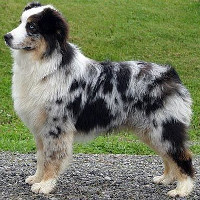
| The Australian Shepherd is a medium-sized working dog that, despite its name, originated in the western United States in the mid-19th century. Australians, as they are often called, are highly intelligent, energetic dogs that excel at canine sports. They are widely used by emergency services in roles such as search and rescue, drug and explosive detection and therapy dogs. The breed is extremely common in its home country, where it is currently ranked the 16th most popular breed by the American Kennel Club. This popularity is a reflection of the Australian's qualities as a pet, as they are responsive, charismatic dogs that can be very rewarding to own. Their gentle nature and loyalty make them great family dogs, but they have a strong herding instinct that needs to be channeled around young children and other pets. | ||
 |
||
| Standard of the Australian Shepherd | ||
A little of the Poodle |
||
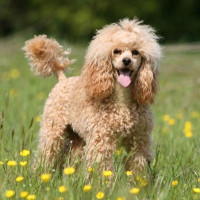
| The Poodle is an often underestimated breed of dog. It is intelligent, athletic, obedient and cheerful. The Poodle has an unusual coat, which tends to make the breed appear less than serious. The Poodle's curly coat is constantly growing and, without maintenance, can become a long, corded coat. Over the centuries, Poodle owners have experimented with different grooming styles, resulting in the sophisticated decorative clips for which the Poodle is renowned. When the tight Poodle curls are combed, the result is beautiful or ridiculous, depending on your point of view. Either way, there's a beautiful dog in the skin of its hair, and that's why Poodle cross breeds, such as Groodles and Multi-Poos, and many others, have become so popular in recent times. | ||
 |
||
| Standard of the Poodle |
Appearance of the Aussiedoodle |
| The mold is broken with the birth of every Aussiedoodle, as they can come in a bewildering array of sizes and colors. Not only that, but coat quality can also be very different, even between puppies from an individual litter. Most have wavy coats that fall somewhere between the straight and well-curled coats of both parents, but individuals can fall anywhere on the spectrum of curves. Aussiedoodles bred from Dwarf Poodles can measure 30 cm in height and weigh around 10 kg, and are rather slender and supple, while Standard Poodles tend to produce hybrid puppies weighing 24-28 kg and reaching 56 cm. Larger Aussiedoodles can have a fairly broad, robust torso and back, while their smaller cousins are lighter, but not delicate. Few dogs can carry so many different color combinations, the pattern of coloring being almost as variable. Commonly recognized forms available : black and white, red and white, cinnamon merle, blue merle, red merle, chocolate, chocolate and white, tricolor, red sand, black and beige, cream, silver. One of the joys of seeing this and other hybrids emerge is the natural variation in their appearance. Freed from rigid breed standards, breeders can concentrate on what makes their dogs unique, rather than keeping them all the same. |
Temperament of the Aussiedoodle |
| Aussiedoodles are cheerful, enthusiastic dogs with bundles of energy. They are extremely focused on their family and need to be inside and feel included at all times. They don't tolerate boredom or isolation and will quickly become destructive or hyperactive if ignored or left alone for long periods, which is understandable given that they have the intelligence of a young child. Speaking of children, this hybrid is a perfect choice for families with children. It has virtually no aggressive tendencies and is generally very tolerant and friendly with small pets of all species. |
Needs and activities of the Aussiedoodle |
| The Aussiedoodle is an active dog that requires both exercise and mental stimulation. Dogs of this hybrid can do well in an apartment or at home as long as he's taken out for exercise, a good walk, a good swim or active play, every day. If this isn't possible, the Aussiedoodle should have a fenced-in yard where it can safely run and expend its energy. Thanks to their athletic abilities, Aussiedoodles can take part in dog sports including agility, flyball and obedience exercises. Hybrid dogs are high-performance therapy dogs, which keeps them physically and mentally active. The Aussiedoodle is considered easy to train. Training should begin as early as eight weeks of age and should include behavioral training to help your dog avoid the development of bad habits. During training, positive reinforcement techniques are recommended. Socialization is also important to ensure that your Aussiedoodle is at ease with other people and animals. |
Maintenance of the Aussiedoodle |
| Your Aussiedoodle's maintenance will depend in part on the type of coat it inherits; in fact, the amount of shedding the hybrid will experience will be the result of its particular coat. The coat may need brushing every other day if it's curly, or less frequently if it's wavy. If it has a curly coat, trimming may be necessary every eight to twelve weeks. The basic care required by all dogs is equally important. These include trimming their nails and keeping their ears clean and dry. In addition, you'll want to brush his teeth regularly to ensure his overall dental health. |



 English (United Kingdom)

Comments