
 |
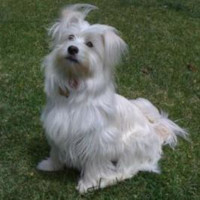
Highland Maltie |
|
He is not recognized by the F.C.I. |
Origin |
Great Britain <> Central Mediterranean -> U.S.A. | |
Translation |
Francis Vandersteen |
A brief presentation of the Highland Maltie |
| A little white dog that will melt your heart, the Highland Maltie has a confident, enthusiastic character, presented in a pint-sized package and being a cross between the West Highland White Terrier and the Maltese. Lively and quite active when young, the Highland Maltie may not be for everyone, and certainly requires a lot of time and dedication to become a well-rounded adult pet. With bright, dark brown eyes and a glossy white coat, the Highland Maltie is an attractive little breed with a sturdy body. If left untrimmed, their beautiful coats can grow to great lengths although they require a lot of maintenance, which means most will end up clipping it. |
History of the Highland Maltie |
| Like many new specific cross-breed dogs, information about the origin of this new breed is limited. Derived from the West Highland White Terrier and the Maltese, the Highland Maltie was probably created around the turn of the 21st century. |
A little of the West Highland White Terrier |
||
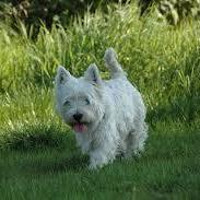
| The West Highland White Terrier, or simply Westie, originated in Scotland, the birthplace of many similar breeds, including the Cairn Terrier and Skye Terrier. As with all terriers, these breeds have never lacked liveliness and personality, and were often used as tiny, fearless hunters, unafraid of prey such as badgers and weasels. The Westie is thought to have originated in the 1800s from a now extinct breed known as the Poltalloch Terrier, very similar in appearance and a direct descendant of the Cairn Terrier. It wasn't until the early 1900s that the name Poltalloch Terrier was replaced by today's nickname, West Highland White Terrier. Some historians believe that the white coat color was introduced to the breed, so that it was easier to distinguish them from their darker-furred prey, such as foxes and badgers, meaning that their owners would be less likely to shoot them by mistake when hunting. Today, the Westie is recognized by the Kennel Club as part of its Terrier Group and is an extremely popular breed worldwide. | ||
 |
||
| Standard of the West Highland White Terrier | ||
A little of the Maltese |
||
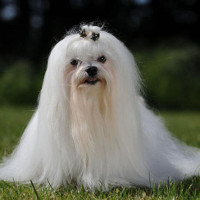
| The Maltese is a content little dog, perhaps best known for its silky white coat and smiling face. Although some believe that this dog originated on the island of Malta, it is actually thought that they were first established on an island formerly known as Meleda and now known as Mljet, off the coast of Croatia. An ancient breed that existed at the same time as the ancient Greeks, they have always been prized for their loving nature and were kept as loyal companions, rather than being used to fight or work. Rarely measuring more than 25 cm at the withers, Maltese belong to the Kennel Club's toy group. | ||
 |
||
| Standard of the Maltese |
Appearance of the Highland Maltie |
| The Highland Maltie's appearance will depend on the genes it inherits from its parents, so dogs can resemble either breed or be a good mix of the two. All are small and compact, measuring 25 cm to 30 cm and weighing 4.5 kg to 7 kg. They have a rectangular body shape with medium legs, which should be straight. Their heads are not too large, and their black eyes and nose complement their white facial fur. Their ears vary in position, some inheriting the straight Westie ears and others the floppy ears of their Maltese parent. Their tail is of medium length and can be well furnished with fur. The Highland Maltie's coat is characterized by its color, which must be white without exception. It is thick and long, usually with a slight wave or crimp. For the sake of convenience and to reduce grooming time, many owners will choose to trim the coat, especially in summer, when dogs can be prone to overheating. |
Temperament of the Highland Maltie |
| Full of bravado and with a cheeky streak, the Highland Maltie has a big personality and isn't afraid to speak up for itself. Loving and gentle, they generally enjoy being around people, but they can be more independent than you might think. Braver than dogs of the same size, some may find them a little overwhelming at times, and they certainly require constant training. Drunk and full of their own self-importance, they are rarely shy and approach potentially intimidating situations with bravado. Full socialization should help Highland Malties adapt to life in the company of other pets and children, but they may not be as tolerant as we'd like. Some will inherit the hunting instinct of their Westie parents and cannot be trusted with smaller pets, such as guinea pigs or rabbits. |
Needs and activities of the Highland Maltie |
| The Highland Maltie is not an overly active dog, but it is a busy one. They'll follow you around, sniffing around to see what you're up to. They'll enjoy a yard if you have one, but that's not vital to these dogs. What's essential is a daily walk or playtime at the animal park to burn off energy and meet other dogs to run and fight with. A daily walk around the neighborhood will do, and as your dog gets older, he'll join in the games with the family and play to win. These dogs make ideal apartment dogs as long as you train them not to bark excessively. They are companion dogs who enjoy being part of the family and will make loyal, devoted friends. |
Maintenance of the Highland Maltie |
| Although Highland Malties have a low-fall coat that can be hypoallergenic, they need regular brushing to prevent their beautiful white coat from becoming too pale. Daily brushing with a strong bristle brush is recommended. This is a good time to examine any wounds or sores on your dog's body or feet, to check for infected ears and irritated eyes. Bathe him if necessary, using a mild dog shampoo that will help retain the coat's natural oils, making grooming much easier. If your Highland Maltie has a yard to run around in, he may need to bathe more than an indoor dog, as they like to dig and explore. Training your dog as a puppy to get used to brushing his teeth is good practice. Most dogs appreciate the gentleness of their grooming time. |



 English (United Kingdom)

Comments