
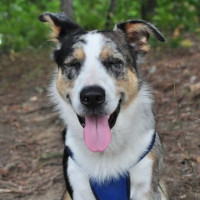
 |
Heeler Pei |
|
He is not recognized by the F.C.I. |
Origin |
Australia <> China -> U.S.A. | |
Translation |
Francis Vandersteen |
A brief presentation of the Heeler Pei |
| The Heeler Pei is a specific cross between the Australian Cattle Dog and the Chinese Shar Pei. This mix of breeds has produced a medium-sized dog, with moderate activity requirements and a dog that often bonds more with one person but will extend protection and affection to other family members. With strong muscles, the Heeler Pei is an attractive dog that requires a strong pack leader as owner. They are devoted dogs, although if you want a cuddly dog, you may be disappointed by their independent and slightly aloof nature. They are good with children as long as they don't pull their tails, ears or interfere with the dog at feeding time. The Heeler Pei can bond with other pets as long as it has grown up with them, but they have a strong prey drive, especially from the parent Australian Cattle Dog, so anything other than the family pets is considered fair game. Both parent dogs are wary of strangers, and the same goes for the Heeler Pei, and they can be very territorial. Training and socializing him when he's young will help overcome some of this tendency. Intelligent, stubborn, eager to please and endowed with a real character, this dog is not for inexperienced owners but will shine under strong leadership. |
History of the Heeler Pei |
| The Heeler Pei is a hybrid dog and although it doesn't have its own history, we can look to the parent dogs for the most likely characteristics. |
A little of the Australian Cattle Dog |
||
| The Australian Cattle Dog was born in the 19th century out of a need for a robust, independent dog capable of handling the extreme conditions and vast distances of the Australian outback. They were, and still are, invaluable on cattle ranches and help by calmly but firmly guarding wild cattle with nips and bites, particularly in the leg region, where the label "heeler" originated. The dogs of the first settlers who arrived in Australia couldn't cope with this new land, so they were bred with the native Dingo to create a tougher, more aggressive dog. Although there were many variants of the breed, it evolved into the cattle dog we know today. The breed's blue-colored dogs became very popular with ranchers and Bouviers, and earned the name Blue Heelers. The American Kennel Club accepted the Australian Cattle Dog in 1980. | ||
 |
||
| Standard of the Australian Cattle Dog | ||
A little of the Shar Pei |
||
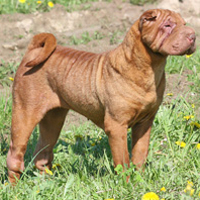
| The Shar Pei comes from southern China and is an ancient breed dating back to the Han dynasty 200 BC. The first Shar Pei was a working dog, helping on the farm, herding cattle, hunting game and guarding flocks. Held in high esteem, they were believed to protect against evil spirits with their wrinkled skin and unique purplish tongue. These dogs were also used in dog fights, where their loose skin prevented other dogs from latching onto them. A turn of fortune in the early 20th century after the Communist takeover saw many of them eliminated, on the grounds that they represented the decadent past. By the 1950s, they were all but extinct, but in 1973, a Hong Kong breeder appealed to Western dog lovers to save the breed and Americans fully embraced the wrinkled dog and it was fully recognized in 1992 by the American Kennel Club. | ||
 |
||
| Standard of the Shar Pei |
Appearance of the Heeler Pei |
| This unique and rather rare breed can vary in appearance, due to the genes of two very strong and dominant dogs. A medium-sized, muscular and robust dog, it has a well-proportioned body that supports strong legs with rounded paws and solid pads. The chest is deep, the neck thick and the head rounded at the top. Ears can vary from small, triangular and folded like the Shar Pei to pointed and erect like the Australian Cattle Dog. Featuring a long, slender muzzle with teeth that end in a scissor bite, and a nose that can vary from black to pinkish-beige, this hybrid has round, deeply-set eyes. They may have facial wrinkles due to the influence of the Shar Pei or the unique mottled coat color of the Australian Cattle Dog. The tail may be straight and held low, or it may curl over its back. The Heeler Pei is undoubtedly a dog with presence, confident, active, loving and protective. |
Temperament of the Heeler Pei |
| The Heeler Pei is a confident, calm dog that doesn't need to prove itself; you can tell by looking at it that this dog is not to be disturbed. They make ideal pets and tend to bond closely with one person while remaining friendly and protective towards others. The person they bond with will discover that they have a dog that almost looks like Velcro, will stick by their side and want to be part of their life. Socialization when they're young is important for these dogs, as they can be aggressive if not trained. They need to learn appropriate behavior from an early age. These dogs are aloof with strangers, taking time to warm up to them, but when they do, they accept them as part of an extended family. While the Australian Cattle Dog influence can produce a dog that will gather anything from your children to your pets and yourself if not prevented from doing so. Any nipping should be discouraged immediately before it takes hold. The Heeler Pei has a strong hunting instinct, so you'll need a fenced yard to prevent it from leaping over the fence and chasing other dogs or cats down the street. Unique, adorable and beautiful, the Heeler Pei is a rare breed that proves to be a quality dog. They need a strong pack leader as an owner to bring out their best qualities. |
Needs and activities of the Heeler Pei |
| The cross between the hyperactive Australian Cattle Dog and the calmer Shar Pei produces a dog that requires only moderate exercise. The Heeler Pei is a quiet dog in the house, but will enjoy a walk or two a day. Although they can adapt to apartment living, the ideal situation is a well-fenced yard so they can follow you, dig here and there and growl at any passing dog. These dogs adapt to extreme weather conditions, although intense cold can test their limits. The Heeler Pei is not a good mixer among other dogs, and while it won't attack or threaten, it certainly won't back down after a fall. Puppy training and socialization are essential for these dogs before their habits take shape in adulthood. This will teach them the appropriate social skills. |
Maintenance of the Heeler Pei |
| The Heeler Pei has a short, weather-resistant coat and tends to shed in one go at least twice a year. Firm brushing every other day will keep the coat in good condition, but when it falls out, daily brushing is required. If your Heeler Pei has inherited some of the Shar Pei's wrinkles, care should be taken to keep the wrinkles clean and dry to prevent infection. These dogs only need to bathe when necessary, using a gentle dog shampoo to maintain the skin's natural protective oils. Other basic care involves trimming the nails and gently wiping the ears with a damp cloth and a special solution to rid the ear of dirt and debris. Then gently dry the ears. Next comes the fun part, brushing the Heeler Pei's teeth. If you've trained him since childhood, this shouldn't be a problem, but you may have to train him patiently if you've left him until now. |



 English (United Kingdom)

Comments