
 |
Saint Dane |
|
He is not recognized by the F.C.I. |
Origin |
Switzerland <> Germany -> U.S.A. | |
Translation |
Francis Vandersteen |
A brief presentation of the Saint Dane |
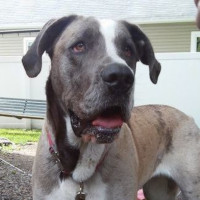
| Whether you're talking size, weight or personality, there's nothing small about the Saint Dane. A blend of the affectionate Great Dane and the docile Saint Bernard, this breed truly has a heart of gold. Well behaved around people and animals alike, the Saint Dane can integrate well into homes where pets are already present. A good blend of each parent when it comes to appearance, the Saint Dane is incredibly tall and well built, with a proportionate body and giant skull. Their fur is soft and short, with colors such as white, brown and black. |
History of the Saint Dane |
| Although the Dane and the Saint Bernard are very different breeds, they certainly share many similarities. Of course, both are oversized, the Great Dane being the largest dog breed there is. In addition to their matching sizes, both breeds are known for their gentle temperaments and calm, patient natures. Mixing two established breeds to create a specific crossbreed dog has been common practice around the world for the past thirty years. As with many new crosses, no one is quite sure when or where the very first Saint Dane, also known as the Grand Bernard, was created. Although this new breed is very recent and still quite rare, we know enough about each parent dog to be able to predict their personalities and general requirements. |
A little of the St. Bernard |
||
| The versatile Saint-Bernard is also European, though originally from Switzerland, where it was bred by local Swiss Mountain Dogs monks and has always been used to rescue people trapped in snowfalls, as well as farm and guard dogs. Beloved in their homeland, Saint Bernards have been Switzerland's national dog since the 19th century. | ||
 |
||
| Standard of the St. Bernard | ||
A little of the Great Dane |
||
| The Great Dane was once known as the wild boar, as it was traditionally used for boar hunting. These original breed members would have been shorter, more athletic and less docile than the Great Danes we know and love today. Paintings of dogs resembling Great Danes date back to 13th-century Greece. Over the centuries, these dogs migrated across Europe and were particularly popular in Germany, where they were used for hunting. | ||
 |
||
| Standard of the Great Dane |
Appearance of the Saint Dane |
| Larger than life, the Saint Dane takes on its parents when it comes to its colossal size. Their heads are particularly large, with a large jaw and drooping upper lips. Their black noses are quite large, while their brown eyes are relatively small and set wide apart. They face with a dominant, noble expression. They have thick necks, leading to a well-muscled, rectangular-shaped body. Their limbs are dense and strong. Their tail is of medium length and is kept low. The Saint Dane's coat is short and moderately dense. Many members of the breed are a mixture of brown and white or black and white, although other coat colors, such as gray, blue and bronze, are also possible. Weighing from 70 to 86 kilos and measuring from 58 to 76 centimeters, the Saint Dane is an extra-large or giant dog. |
Temperament of the Saint Dane |
| Although it's difficult to predict the temperament expected of a crossbreed, given that the Great Dane and Saint Bernard share many personality traits, we can expect a relatively uniform character from their offspring. The Saint Dane is placid and laid-back, and not overly afraid of reacting to a situation or becoming hyperactive and overexcited. They are relaxed when in the company of human beings and are extremely tolerant of children. While the Saint Dane is a gentle soul and would never knowingly harm a child, he still needs to be supervised when in their presence purely because of their size. Affectionate with their families, they are also renowned for their protection and will interrogate any newcomer to their home. Their resounding voice is enough to warn off any potential intruder. Most Saint Danes integrate well with other pets, even those much smaller than themselves. As with any multi-pet household, animals should be introduced to each other at an early age, and initial encounters should be closely supervised. |
Needs and activities of the Saint Dane |
| Saint Danes are very active dogs who love long walks or hikes. They'll enjoy a trip to the dog park or the beach, but especially spending time with their families. These dogs will also appreciate obedience and agility training. They are prone to obesity, so daily exercise is essential. An unsocialized Saint Dane can be very stubborn and difficult to control due to its size. These dogs are not suited to apartment living and need a garden to run around in. They can be very sensitive to extreme weather conditions. So don't overexploit them in summer, and make sure they're indoors in winter. |
Maintenance of the Saint Dane |
| The Saint Dane sheds a lot, so you'll need to brush it regularly to remove hair and preserve its coat. These dogs drool quite often. You may need to use a cloth or towel to blot them. They won't need to be washed as often unless they're very dirty. Some shampoos can dry out the skin, so only use a vet-approved product. It's a good idea to brush your dog's teeth to prevent tooth decay, and to trim his nails if necessary. Get into the habit of checking his ears for debris or signs of infection. |



 English (United Kingdom)

Comments