 |
Schweenie |
|
He is not recognized by the F.C.I. |
Origin |
Tibet <> Germany -> U.S.A. | |
Translation |
Francis Vandersteen |
A brief presentation of the Schweenie |
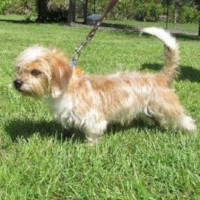
| The charismatic Schweenie is a delightful blend of loyal, confident Shih Tzu and bold, independent Dachshund. This hybrid dog will show a lot of love to their family and form extremely strong bonds with them. A bonus for those with active lifestyles, Schweenies don't need much exercise and can also adapt to life in an apartment. On first meeting a Schweenie, you might have thought it was a Heinz 57 mix, as their short, stiff coat and stocky body are not clearly recognizable at first glance, whether Shih Tzu or Dachshund. On closer inspection, however, we can see the sausage-shaped silhouette of the Dachshund and a few facial features of the beloved Shih Tzu. |
History of the Schweenie |
| The Schweenie is a newly created hybrid that hasn't been around very long. Like many specific crossbreed dogs, we don't know exactly when or where they were bred. However, we can still gather a good appreciation of their history by taking a closer look at the background of each parent breed. |
A little of the Shih Tzu |
||
| The Shih Tzu is thought to have originated in China around 3,000 years ago, making it one of the oldest companion dogs still in use. Although difficult to prove, most historians agree that both the Lhasa Apso and the Pekingese contributed to its genetics. These dogs were revered by the local population, who carved sculptures and painted them in their honor. Unlike many breeds, the Shih Tzu was not bred for specific working or hunting purposes and has always been kept as a pet, a factor that has meant they have always made loyal pets. | ||
 |
||
| Standard of the Shih Tzu | ||
A little of the Dachshund |
||
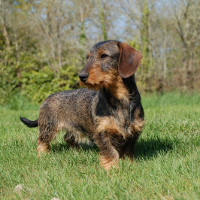
| The Dachshund is a fragrant dog and, despite its unusual body shape, can be quite sporty when it wants to be. Developed in Germany around 300 years ago, they were traditionally used for hunting low to the ground in pursuit of prey, such as badgers and rabbits. Indeed, Dachshund means badger dog. While these dogs can and are still used for hunting, most are kept as pets and like to be sociable with their owners. The Dachshund breed is made up of several variants, and individuals can be short-haired, wire-haired or long-haired. Likewise, dogs can be standard or miniature in size. Any of these combinations can be used to create the Schweenie. | ||
 |
||
| Standard of the Dachshund |
Appearance of the Schweenie |
| The long-haired, majestic Shih Tzu and the long-legged, fleshy Dachshund are two small breeds that don't look alike. As a result, the Schweenie breed has many physical variations. Most will have a long back with a belly close to the ground due to their short, often sloping limbs. Their skulls are relatively small and can be domed or flattened at the forehead. Their soft ears hang close to their faces and are widely separated. Their eyes are round and dark brown, which often gives them the impression of pleading for something. Their muzzle is of medium length, ending in a clean, black nose. Their tail is not too long and will taper to a point. It is often carried straight when the dog is active. Once mature, the Schweenie will weigh between 4 and 9 kilos and measure between 28 and 38 centimeters. Their body is compact and rather dense. Some Schweenies will have longer coats than others, but most will have a medium-long, wiry coat that can come in a variety of shades, including brown, white, black, fawn and gray. Bicolored and tricolored dogs are common and preferred by many owners. Some will have longer fur around the face and may even have a moustache and beard. |
Temperament of the Schweenie |
| A dog designed to be a family pet, the Schweenie is the ideal companion for children and adults alike. Friendly and always eager to please their owners, Schweenies are not difficult dogs to handle if properly trained. With proper socialization, these guys can integrate with people of all sizes, as well as other dogs. However, assuming that they will be socialized automatically is unrealistic because, like any breed, it takes time. It's not uncommon for a Schweenie to develop separation anxiety. This is particularly the case with those who become strongly attached to a particular owner and spend a lot of time without human company. Wherever possible, we should strive to prevent this anxiety from developing by seeking to breed a well-developed dog that is not overly dependent on one particular owner. Confined training can also be a useful tool. Wherever possible, these dogs need to be surrounded by humans, and are therefore unsuitable for homes that are often empty. More intelligent than the average canine, this characteristic works in the Schweenie's favor when it comes to training, but can make them overly sensitive. Under-stimulated, these dogs carry quickly and can become destructive in the home. Similarly, excessive barking can become a problem for some. |
Needs and activities of the Schweenie |
| The Schweenie is not a very active dog. He'll enjoy a brisk walk with you around the neighborhood, but on rainy days he's just as happy to run free inside the house. Provide him with toys that will stimulate his mental abilities. He'll spend days at the dog park, but remember that he'll need to be fully trained before releasing him from his leash for free play. He also needs to be socialized with other animals before being surrounded by strange dogs. He'll appreciate being able to play in a fenced-in area under your supervision. At no time should he be allowed to get too hot or overworked. Keep water on hand for exercise on hot, humid days. |
Maintenance of the Schweenie |
| The Schweenie will need a little maintenance. Brush it two or three times a week to remove excess hair. In spring and autumn, you may need to brush him daily to avoid excessive hair on your clothes and furniture. His floppy ears may need special attention from you. Wipe his ears with a damp cotton ball once a week. Check for odor or redness, which indicates an ear infection. Brush his teeth two or three times a week to prevent tartar build-up. However, to avoid bad breath and tooth decay, brush every day. Trim his nails twice a month, unless he wears them out on his own. As a general rule, if you hear his nails clicking on the tiles or parquet, it's time to trim his nails. Start a grooming routine when he's young. Some dogs are sensitive to touch, and getting him used to this routine will be beneficial as he grows. |



 English (United Kingdom)

Comments