 |
Afghan Chon |
|
He is not recognized by the F.C.I. |
Origin |
Afghanistan <> France / Belgium -> U.S.A. | |
Translation |
Francis Vandersteen |
A brief presentation of the Afghan Chon |
| Fiery yet gentle, the Afghan Chon is a hybrid breed developed from the Afghan Greyhound and the Bichon Frise. It is not known when the Afghan Chon came into being, but it is said to have been originally bred in the United States. The Afghan Chon retains the characteristics of both parent breeds, which may vary depending on the litter. The Afghan Chon's coat is long, with soft, dense, curly hair. Size varies, as the Afghan Greyhound is a large breed, while the Bichon Frise is a small breed. Many owners say their Afghan Chon has inherited much of its temperament from the Bichon Frise. The Afghan Chon is an adorable, cheerful, bubbly breed. The breed was developed as a family pet. Because of its coat, the Afghan Chon requires moderate maintenance. |
History of the Afghan Chon |
| As with other hybrid breeds, the history of the Afghan Chon is unknown, simply because it is new to the scene. The Afghan Chon is descended from its parent breeds, the Afghan Greyhound and the Bichon Frise. Its original and current purpose is to serve as a loyal, lively pet. |
A little of the Afghan Hound |
||
| The Afghan Greyhound originated in Afghanistan and is considered an ancient breed dating back thousands of years. In 1925, the breed was transported to England, where it was later imported to the United States. In the 1970s, the Afghan Greyhound became the center of attention when Barbie graced America with her Afghan Greyhound. In the 1980s, the Afghan Greyhound became an AKC staple at shows and excelled in obedience trials. | ||
 |
||
| Standard of the Afghan Hound | ||
A little of the Bichon frise |
||
| It is generally believed that the Bichon Frise is descended from a woolly water dog known as the barbet, and that its name is derived from the word barbichon. The Bichon à poil frisé originated in the Mediterranean, as did the rest of the Barbichon family: the Bichon maltais, the Bichon havanais, the Bichon bolonais and the Coton de Tuléar. There is conflicting information on the origins of the Bichon Frise. One account states that in the 14th century, French sailors brought the Bichon Frise back from the Canary Islands. Although the exact location is unknown, the Bichon Frise was initially used for trade. The other story is that the Spaniards brought the Bichon Frise to the Canary Islands, then Italian sailors brought them back. The Bichon Frise was popular with royalty and considered a symbol of nobility. After the First World War, interest in the Bichon Frise increased and the French helped to preserve the breed. In 1956, the Bichon Frise was first introduced to the United States. In 1973, the breed was officially recognized by the AKC. | ||
 |
||
| Standard of the Bichon frise |
Appearance of the Afghan Chon |
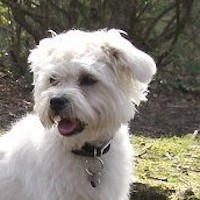
| The Afghan Chon most closely resembles one of its parent breeds, the Bichon Frise. Its skull is slightly rounded. Its muzzle is less pointed than that of the Afghan Hound. The tail is carried over the back and is long and curly. The Afghan Greyhound has a black nose. Its eyes are round and dark brown. The Afghan Chon is available in white or off-white. Its coat is curly, dense and does not shed much, although some Afghan Chons may have a less curly coat because they have inherited dominant traits from the other parent breed. The facial expression of this adorable breed is one of independence and outgoing radiance. |
Temperament of the Afghan Chon |
| The Afghan Chon has inherited much of the Bichon Frise's cheerful, fun-loving personality. The Afghan Chon is known for being incredibly affectionate, fun-loving and entertaining. He loves to feel part of the family and thrives on play. The Afghan Chon is welcoming to strangers, children and other pets. However, it's always a good idea to expose your Afghan Chon to other animals as a puppy so that he fully accepts meeting unfamiliar species. Positive reinforcement will benefit your Afghan Chon in terms of training, although he's easy to teach and eager to please. The Afghan Chon likes to be busy. It's a good idea to involve your Afghan Chon in intense play, divided into two or three periods a day. If your Afghan Chon gets bored, it may adopt destructive behaviors. Excessive barking and chewing can be avoided if your hybrid is given appropriate mental and physical stimulation. |
Needs and activities of the Afghan Chon |
| Providing your Afghan Chon with daily exercise is essential to maintaining an active, healthy lifestyle. As the Afghan Chon has been bred to be a pet, he doesn't feel the need to keep up with specific tasks, although he does have a high energy level that requires constant activity. It's important to be able to stimulate him mentally with dog-friendly games such as fishing and shooting. The Afghan Chon would do best in an apartment or house with a large garden. Boredom can set in if you're unable to offer your pet the outings he needs; consider doggy daycare to keep him occupied if you're going to be away for a while. |
Maintenance of the Afghan Chon |
| The Afghan Chon is considered to be mainly hypoallergenic due to the influence of the Bichon Frise. The Afghan Chon's coat most closely resembles that of the Bichon Frise. Its coat is soft but dense, curly and non-hydrophobic. Bathing your Afghan Chon should be limited to every 6 to 8 weeks, and only if necessary. Regular grooming is necessary for this breed; a firm bristle brush and a greyhound comb will be very useful to brush your dog daily to prevent tangles. Ears should be cleaned regularly to prevent bacteria from accumulating in the ear canal. Teeth should be brushed regularly to prevent tartar build-up, and nails should be trimmed and filed every 2 to 3 weeks. The Afghan Chon is not known for drooling and has no noticeable odors. |



 English (United Kingdom)

Comments