
 |
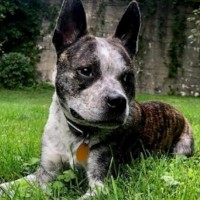
Boston Cattle Dog |
|
He is not recognized by the F.C.I. |
Origin |
U.S.A. <> Australia -> U.S.A. | |
Translation |
Francis Vandersteen |
A brief presentation of the Boston Cattle Dog |
| There isn't much data on the new Boston Cattle Dog hybrid, so we have to look to the parents for their joint characteristics. Both the Australian Cattle Dog and the Boston Terrier have a strong muscular structure, so the Boston Cattle Dog will have an athletic but muscular structure. These dogs are playful, energetic and very affectionate. They inherit their intelligence and excellent trainability from their parent breeds. Boston Cattle Dogs respond well to a strong, firm leader who is consistent and fair at all times, never harsh as they inherit a hint of sensitivity from the Boston Terrier. They have a strong desire to dominate that comes from their Australian parent, but is tempered by the influence of the Boston Terrier. Their penchant for herding comes from the Australian Cattle Dog side, so don't allow them to nip at peoples' heels in an attempt to get them where they think they should go. This dog needs exercise and plenty of mental stimulation like games and tasks to solve, to keep him happy and well behaved. Loyal to their families, they make loving, lively pets, good with children and devoted to their humans. |
History of the Boston Cattle Dog |
| The Boston Cattle Dog is a perfect balance between the Australian Cattle Dog and the Boston Terrier. Although a rare breed, the Boston Cattle Dog has become very popular over the last decade. Their intelligence, loyalty and affection combined with attractive looks and lively personalities are behind their success. Although their history is vague, if we look at the history of the parent dogs, it can give an idea of what the Boston Cattle Dog has gained from its lineage. |
A little of the Boston Terrier |
||
| The Boston Terrier was bred in size from Bulldog and Terrier-type pit fighting dogs. These elegant little dogs originated in Boston, Massachusetts, making them one of the few breeds developed in the USA. The original Boston Terrier was a cross between the English Bulldog and the now extinct English White Terrier. In 1889, the Boston Terrier became popular and the American Bull Terrier Club was formed, but the name was not well liked by Bull Terrier owners. It was eventually renamed the Boston Terrier after its birthplace. The Boston Terrier has mellowed considerably from its history as a fighting dog and is now a lovable popular dog. With all this history, it explains the growing popularity of Boston Cattle Dogs. | ||
 |
||
| Standard of the Boston Terrier | ||
A little of the Australian Cattle Dog |
||
| The ancestors of the Australian Cattle Dog were brought to Australia with the first settlers, but were unable to cope with the long distances and inhospitable climate of the new continent. Pioneer settlers developed the Australian Cattle Dog during the 1800s, crossing Dingo blue-sea Dies with Dalmatians and black and tan Kelpies. Rumor has it that the Bull Terrier breed was also added. The result was a dog that excelled on large cattle ranches. Dry, dusty and hot conditions didn't affect them, and they had incredible stamina. In 1893, Robert Kaleski wrote the standard for the breed, which was approved in 1903. The breed was recognized by the AKC in 1980. The Australian Cattle Dog is respected for its herding, guarding, retrieving, agility, competitive obedience and tricks. | ||
 |
||
| Standard of the Australian Cattle Dog |
Appearance of the Boston Cattle Dog |
| The Boston Cattle Dog is a well-muscled, agile and powerful dog with an athletic appearance. Body length varies according to genetic parentage, but is generally slightly longer than it is tall. The tail is narrow, held moderately low and has a slight curve. The front legs are strong and straight, with round paws. The skull is broad and slightly square, with large, dark oval eyes. Ears are large and moderately sized, raised and alert. However, these characteristics may vary depending on the percentage of Australian Cattle Dog to Boston Terrier. The muzzle is pointed, with teeth meeting in a scissor bite. The coat is smooth, short-haired and weather-resistant, often with a dense undercoat, and it tends to shed once or twice a year depending on the region. |
Temperament of the Boston Cattle Dog |
| Boston Cattle Dogs are loyal, courageous and intelligent dogs that like to be actively involved in family activities. They are alert, easy to train and make excellent watchdogs, warning of strangers approaching the property. Although they can have a high level of dominance, they respond well to a strong leader who demonstrates consistent management. the Boston Cattle Dog responds exceptionally well to training, with obedience and agility being its strong point. Obedience training can be achieved at a very high level. These dogs have absolute loyalty to their master and integrate happily into their family. They have a wonderful ability to clown with children, to accept and mingle with other animals and pets as long as they are well socialized and trained as puppies. A firm but not hard hand is better, they respond to praise and treat each other better. With gentle masters, they can become a trial, with their dominance and aggression at stake. Train them well, exercise them often, make them part of your family and be a strong leader, and these dogs will be your best behaved and most loving dog. |
Needs and activities of the Boston Cattle Dog |
| Boston Cattle Dogs require daily exercise. They love to run or walk, and enjoy the challenge of playing hide-and-seek or fetch. Without sufficient exercise and mental stimulation, they can become bored, which is when they get into trouble. They also respond well to training and obedience activities and excel in the ring at competitions. Although they love activity and like to be part of what you're doing, they also like to snuggle up and lie on the sofa. Socializing them by taking them to dog parks or beaches is a great way for them to learn to mix with other dogs and people. It also helps them burn off energy. |
Maintenance of the Boston Cattle Dog |
| Boston Cattle Dogs need a good brushing once or twice a week to manage any excretion. They don't need to be bathed as often, unless they're dirty or smelly. When you bathe them, use a special dog shampoo so that it doesn't irritate their skin. Make sure all skin folds are dried properly to avoid inflammation or infection. A damp cloth rub between baths will be all you need and your dog will love all the attention. While you're grooming your dog, check vital areas such as the ear, eyes and brush his teeth. Also check their nails while you're at it. If you get your Boston Cattle Dog used to the grooming routine when he's young, it will be easier as he matures. These dogs are good with regular daily exercise and constant training. |



 English (United Kingdom)

Comments