
 |
Boxita |
|
He is not recognized by the F.C.I. |
Origin |
Germany <> Japan -> U.S.A. | |
Translation |
Francis Vandersteen |
A brief presentation of the Boxita |
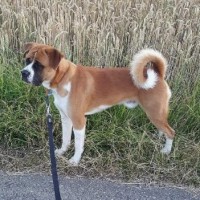
| Because a mixed-breed dog is a cross between two different breeds, it's necessary to take a look at both parent breeds to determine your dog's characteristics. The Akita Inu is a big, powerful working dog and the Boxer is a medium to large athletic dog, so your Boxita is likely to be an intelligent, energetic dog who loves to work and play. The Boxita has a strong, muscular body with a short, weather-resistant coat that is most often brown and white. This eager-to-move dog is loyal, courageous and adorable, and will make a perfect pet to defend you and your family. |
History of the Boxita |
| Because the Boxita is a new hybrid breed, it has little history, so the stories of parent breeds are used to create one. |
A little of the Boxer |
||
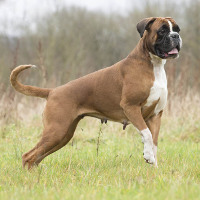
| There is evidence to suggest that the Boxer is one of many descendants of the old fighting dogs of the high valleys of Tibet. The Boxer is also thought to be a cousin of most Bulldog breeds. For example, the Dogue de Bordeaux has many of the characteristics seen in the Boxer, and some sources claim that the Boxer is also related to the Danziger Bullenbeisser and the Brabanter Bullenbeisser (two breeds that no longer exist). It is thought that in the 1830s, German hunters tried to develop a new breed by crossing Bullenbeissers with Mastiff-type dogs and Bulldogs, creating a robust dog with excellent agility and a streamlined body. By 1895, this new breed, known as the Boxer, had become established. Americans didn't show any interest in the Boxer until around 1940. | ||
 |
||
| Standard of the Boxer | ||
A little of the Akita Inu |
||
| The Akita Inu was officially recognized by the American Kennel Club (AKC) in 1972 and is the 46th most preferred breed in the USA. The breed originated in Japan in the 1600s and was bred primarily for hunting, although many were used for fighting. They hunted large animals such as bear, deer and wild boar. When dog fighting began to lose popularity in 1927, the Hozankai Society of Japan began to help preserve the Akita Inu and, by 1931, the breed was one of Japan's natural treasures. The breed became popular because of the loyalty of an Akita Inu named Haichiko, who met his owner at the train station every day after work and continued to do so for nearly 10 years after his owner's death. The first Akita Inu in the USA was a gift from the Japanese government to Helen Keller. | ||
 |
||
| Standard of the Akita Inu |
Appearance of the Boxita |
| The best way to determine what your Boxita will look like is to look at the appearance of its parent breeds, the Akita Inu and the Boxer. Both are large dogs, measuring over 61 centimetres and weighing between 41 and 55 kilos on average. With a square head, medium-sized muzzle and soft triangular ears, the Boxita resembles the Akita Inu more than the Boxer. They are usually two-tone brown and white; yellow and white; sand and white; black and white; or gold and white. Their fur is short and weather-resistant, so they're just as happy in the sun or snow. |
Temperament of the Boxita |
| Although both the Akita Inu and Boxer were originally bred as fighting dogs, these breeds no longer have aggression in their personalities due to good breeding. The Boxita is an excellent family dog that loves children and other pets, has a gentle disposition and a fun-loving personality. They're sometimes pranksters who'll bring you their food bowl when it's empty, and at other times they'll defend you and your family from strangers. They are moderately easy to train, but you need to be consistent with the training to succeed. The Boxita responds best to positive reinforcement, as do other dogs, as negative discipline can make your dog aggressive. |
Needs and activities of the Boxita |
| The Boxita is an energetic dog who loves to run and needs at least an hour of moderate activity every day. A trip to the dog park, a game of fetch or a long walk can fulfill the Boxita's activity needs. This lively dog also enjoys agility training and obstacle courses, which you may want to do with your pet. Swimming is another activity your Boxita is good at. Try throwing a ball into the water that your dog fetches from the local pond or lake, but make sure it's safe and legal for your pet to swim there first. If they don't get enough exercise, dogs tend to have behavioral problems due to boredom and pent-up energy. |
Maintenance of the Boxita |
| Because the Boxita has a short, fine coat, it doesn't need much maintenance to keep it looking neat and attractive. Brushing them once or twice a week with a stiff bristle brush will keep skin health and shedding to a minimum. You can wash them with a mild dog shampoo if necessary, but not too often, as it removes the protective oils their skin needs to stay healthy. Check your dog's ears once a week for wax, dirt and debris build-up, and clean them with absorbent cotton or a soft cloth if necessary. Trim their nails as needed to avoid tears and wounds, and brush their teeth about two or three times a week. |



 English (United Kingdom)

Comments