
 |
Boxspring |
|
He is not recognized by the F.C.I. |
Origin |
Germany <> Great Britain -> U.S.A. | |
Translation |
Francis Vandersteen | |
This breed is also known as |
Sproxer |
A brief presentation of the Boxspring |
| Obedient and loving, the Boxspring is a relatively docile breed with a love for its family. The Boxspring is made up of the Boxer and the English Springer Spaniel. While the Boxer originated in Germany, the English Springer Spaniel originated in England. The exact origin of the Boxspring is unknown, but it is suspected that the breed was developed to eliminate certain health problems (such as rabies syndrome). This easy-going breed craves affection and constantly seeks validation from its family. Its main goal is to be a faithful companion. The Boxspring is not much of a barker, but can serve as an effective watchdog if necessary. Its short coat is silky, short and fine, and requires minimal maintenance. Because of its moderate energy levels, it requires a fair amount of exercise. |
History of the Boxspring |
| Although it's not known when the Boxspring was born, the breed was developed from the Boxer and the English Springer Spaniel. |
A little of the Boxer |
||
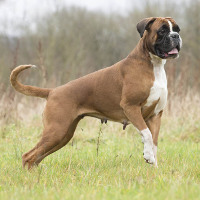
| The Boxer was created in Germany at the end of the 19th century. It is widely believed that the breed was established by its ancestor, the Bullenbeisser. The Bullenbeisser was a favorite among Germans due to its efficient skills at hunting bear, wild boar and deer. Unfortunately, the Bullenbeisser was deemed too slow for hunters and they switched to faster breeds. In 1897, the Boxer Club was founded. In 1904, the Boxer breed was published for the first time. In the 20th century, the Boxer was introduced to the United States. The Boxer became a staple of the First and Second World Wars after the breed proved to be an exceptional messenger and attack dog. The Boxer eventually came home with soldiers as companions. | ||
 |
||
| Standard of the Boxer | ||
A little of the English Springer Spaniel |
||
| Research suggests that the English Springer Spaniel originated in Spain with the Romans, where it was subsequently divided into the Land Spaniel and the Water Spaniel. The breed was eventually divided into sizes: the smaller Spaniels became the Cocker, the medium Spaniels became the Springer Spaniel and the larger Spaniels became the Setters. The Springer Spaniel got its name from its ability to "bring out" the game. In the 1800s, the Duke of Norfolk bred some of the Springer Spaniels at the time, and the breed name was officially adopted in 1900. In 1902, the English Kennel Club recognized the Springer Spaniel as its own breed. In the 1900s, the breed began to gain popularity in the United States. In 1910, the English Springer Spaniel was registered with the American Kennel Club. The English Springer Spaniel continues to be an excellent and popular hunting dog. | ||
 |
||
| Standard of the English Springer Spaniel |
Appearance of the Boxspring |
| The Boxspring strongly resembles the Boxer in appearance. This loving dog is a medium to large breed with a muscular build. Their expression exudes confidence and elegance. Its brown eyes are generally sad, similar to those of an English Springer Spaniel. The short, silky, fine coat is non-water repellent. Color combinations range from red and brown to black and gold. Boxspring ears are soft, but not as short as Boxer ears. They are also placed on the sides of the head. The longer muzzle can be attributed to the dominant features of the English Springer Spaniel. Its long tail hangs below. The Boxspring's weight varies from 9 to 27 kilos, and it stands between 53 and 63.5 centimeters tall. |
Temperament of the Boxspring |
| The Boxspring's energy levels are considered moderate compared to other breeds. Although it's a lively breed, it's also considered a docile dog that would be more than happy to take a brisk walk with you to the corner. The Boxspring works well with its owners and will comply with commands as long as it receives the appropriate training. This breed is not recommended for young children. Its parent breed, the English Springer Spaniel, is known to suffer from rabies syndrome, which can lead to unprovoked aggression towards anyone. For this reason, it's not known what traits the Boxspring may or may not inherit from its parents. This otherwise affectionate breed does well with other dogs and animals as long as early training is provided. It can accept and welcome strangers as long as it learns to distinguish friendly strangers. This breed is easy to train and likes to be able to follow commands. Positive reinforcement is highly recommended to prevent his stubborn ways from getting through. |
Needs and activities of the Boxspring |
| The Boxspring has moderate energy levels and should be provided with the appropriate amount of exercise per day. Recommended exercise should last between 30 and 40 minutes a day, with around two walks a day being the minimum. Other activities such as retrieving, agility training and running can also benefit your dog. Apartment living is acceptable as long as your dog can exercise outdoors. An ideal home for your Boxspring would be a medium-sized house in an urban or rural environment with a fenced yard and a warm climate. If provided with the right amount of exercise, your adorable dog will shower you with affection. |
Maintenance of the Boxspring |
| The Boxspring is not considered a hypoallergenic breed and will shed moderately. This breed requires daily brushing with a firm bristle brush to remove loose hair and tangles, and to avoid hair build-up around the house. Avoid bathing him too often, as this can lead to overproduction of oils on the skin; every two months should suffice. Teeth should be brushed weekly to prevent tartar build-up, as plaque build-up can lead to periodontal disease. Nails should be trimmed or filed every 2 to 3 weeks. It's advisable to start trimming nails at an early age, so that your Boxspring can get used to the grooming process. Ears should be cleaned once a week to prevent wax build-up. |



 English (United Kingdom)

Comments