
 |
Bull-Pei |
|
He is not recognized by the F.C.I. |
Origin |
Great Britain <> China -> U.S.A. | |
Translation |
Francis Vandersteen |
A brief presentation of the Bull-Pei |
| A cross between the English Bulldog and the Shar Pei, the Bull-Pei is a sturdy, medium-to-medium-sized dog that requires minimal grooming. Both breeds were once used as fighting dogs in the 1800s and 1900s, and although selective breeding has created an easy-going, versatile family dog from the English Bulldog, the Shar Pei may still retain some of its more aggressive traits. These dogs are very strong and athletic, but they don't need as much exercise as some of the other athletic breeds and will generally be satisfied with 40 to 60 minutes of exercise a day, although most will happily go longer. They do admirably well in apartments as they are not particularly vocal or overactive, although they do not get on particularly well with other animals. |
History of the Bull-Pei |
| The Bull-Pei is a hybrid dog, a cross between the English Bulldog and the Shar Pei, two breeds that were first developed as farm dogs, but later used in dog fighting and other blood sports. |
A little of the English Bulldog |
||
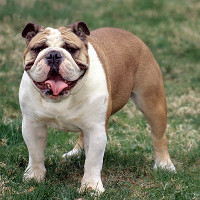
| The English Bulldog is a very old breed, and much of its original history is lost to history. Some experts believe that the Mastiff descended from the English Bulldog, while others think that the English Bulldog was itself a cross between a Mastiff and a Pug. Whatever the case, it's very clear that these dogs were used by farmers to control, guard and bait bulls in the 19th century. To this end, Bulldogs of the 1800s were bred to be much more aggressive and tenacious than today, with an extremely high pain tolerance. This made them not only excellent for controlling and baiting bulls, a practice designed to improve hard meat, but also excellent candidates for fighting other dogs. Because of their prowess in the dog-fighting ring, they were instrumental in the development of the American Pit Bull Terrier and the American Staffordshire Terrier. When these violent "sports" were outlawed in 1885, the breed was nurtured by Bulldog enthusiasts who chose to breed for a more pleasurable nature, and today's English Bulldog is generally a docile animal capable of adapting to many situations. | ||
 |
||
| Standard of the English Bulldog | ||
A little of the Shar Pei |
||
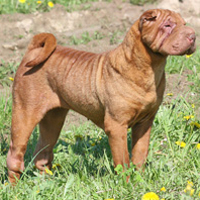
| The Shar Pei also has a long and mysterious past, but we do know that it also started out helping farmers with farm work, hunting wild boar and guarding property. It was this dog's aggressive nature, coupled with the loose wrinkled skin that made it difficult for other dogs to gain a grip, that made this dog very capable in the fighting ring. Many dogs were killed in the 40s and 50s in China due to famine, government policies and fear of biological warfare and many breeds were decimated, including the Shar Pei, but enough survived to be recognized by the Hong Kong Kennel Club in the 60s. Cross-breeding these dogs can soften the Shar Pei's aggression and lengthen the Bulldog's muzzle. | ||
 |
||
| Standard of the Shar Pei |
Appearance of the Bull-Pei |
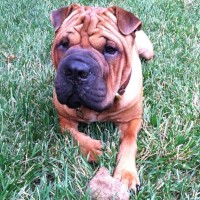
| The hybrid of the Bulldog and Shar Pei is a square-bodied dog of medium to large size, with powerful muscles, a thick neck and powerful jaws. Their heads are larger than average for their body size, with a muzzle that can vary between the broad, flat muzzle of the Bulldog and the substantial medium-length muzzle of the Shar Pei breed. They have small eyes that sit low on the face and triangular ears that sit high on the head and fold flat, either in front of the face or to the sides. Bulldog and Shar Pei wrinkles, but Shar Pei wrinkles are a little more dramatic, and the Bull-Pei will probably inherit this trait too. They have short, straight, single-ply coats, although depending on which side of the family they prefer, these hairs can be fine-textured and lie flat against the body, or they can come straight off the body with an extremely coarse texture. |
Temperament of the Bull-Pei |
| The Bull-Pei is generally a fairly placid animal that is happiest when spending time with its family. They tend to have a confident air about them and can become a little territorial. Most Bull-Peis will get on very well with children due to the Bulldog side of their heritage, however, Shar Peis are not always tolerant of children and some Bull-Peis will inherit this temperament instead. All interactions with young children should be supervised, as these animals are quite powerful. Socialization is essential with this crossbreed to avoid anxiety or aggression, as unsocialized Bull-Peis are much more likely to act aggressively and lash out at another animal or stranger than their properly socialized counterparts. This dog may be more likely to chase small pets than other dogs. This dog should also be fairly easy to train, although you may come across Bulldog and Shar Pei mixes that are a little more stubborn than most. |
Needs and activities of the Bull-Pei |
| Neither the Shar Pei nor the Bulldog has very high exercise requirements, and the Bull-Pei will also be happy with several short exercise sessions throughout the day. The Bull-Pei can also be more sensitive to weather problems, so precautions should be taken when exercising in very hot or very cold weather. They don't usually bark frequently, but it's certainly noticeable when they do, and they tend to snore quite loudly. These dogs tend to prefer a yard for sniffing, but they can also be quite content in an apartment, as long as they're close to their family. |
Maintenance of the Bull-Pei |
| When it comes to grooming, these dogs are pretty easy to manage. The short coat of this hybrid is quite manageable and although they require regular brushing with a curry comb or soft bristle brush to control shedding and distribute body oils, monthly baths are usually sufficient for these dogs. Care must be taken to ensure that skin folds are not trapped with moisture or dirt, as this could lead to skin irritation and a foul odor. Medicated shampoo may be necessary if skin disorders such as pyoderma folds or scabies develop, and the face and muzzle area should be examined and wiped down once a week to avoid red yeast and other fungal or bacterial infestations. |



 English (United Kingdom)

Comments