
 |
Cattle Collie Dog |
|
He is not recognized by the F.C.I. |
Origin |
Australia <> Great Britain -> U.S.A. | |
Translation |
Francis Vandersteen |
A brief presentation of the Cattle Collie Dog |
| Proud and lively, the Cattle Collie Dog was developed from the Australian Cattle Dog and the Border Collie. There is little or no documentation on the breed's origin or who was responsible for the initial crossbreeding. It is suspected that the Cattle Collie Dog was developed as part of the designer dog trend to create healthier dogs. Its talent for raising livestock is what makes this breed preferable to other breeds. Its reactive nature and eagerness to engage in a wide variety of activities also make it an excellent companion dog. This active breed resembles both parent breeds, and can take on the dominant traits of either. Its high energy levels enable it to thrive best in an environment large enough to allow it to move freely and receive physical and mental stimulation. |
History of the Cattle Collie Dog |
| While the exact origins of the Cattle Collie Dog are unknown, it's equally important to review the history of its parent breeds. The Cattle Collie Dog is not officially registered with the American Kennel Club due to its hybrid status. |
A little of the Australian Cattle Dog |
||
| The Australian Cattle Dog was developed to travel long distances over rough terrain. The breed was known for its ability to stifle its barking and stay quiet so as not to get carried away on the terrain. Research suggests that a blue-merle Highland Collie was crossed with a Dingo by a man named Hall. This cross resulted in a breed known as Hall's Heelers. Although there is no well-documented proof, it is also thought that one of the specimens, Bentley's dog, was responsible for the white markings found on the breeds today. One thing is certain: the Australian Cattle Dog was revered for its strong work ethic and ability to breed cattle successfully. The Australian Cattle Dog became an important aspect of the cattle industry in Queensland, leading to its other name of Queensland Blue Heeler. Its name was later changed to Australian Heeler, which was then changed to Australian Cattle Dog. In 1897, the first breed standard was published. In 1893, Robert Kaleski began breeding the modern Australian Cattle Dog and showed them in 1897. In 1980, the Australian Cattle Dog was officially recognized by the American Kennel Club. | ||
 |
||
| Standard of the Australian Cattle Dog | ||
A little of the Border Collie |
||
| The Border Collie is said to have been found in wood carvings by Thomas Beckwith before the 1800's. There were indications that both rough-coated and smooth-coated varieties of the modern Border Collie existed. By the 1800s, sheepdogs in Britain had their own breeding styles. In 1873, the first documented Sheepdog trial took place, and in 1860, the Birmingham Dog Society organized courses for Scottish sheepdogs. Queen Victoria is thought to have been in love with the breed. In 1906, the first breed standard was drawn up. In 1915, the name Sheepdog was changed to Border Collie. In 1995, the Border Collie was officially recognized by the AKC. | ||
 |
||
| Standard of the Border Collie |
Appearance of the Cattle Collie Dog |
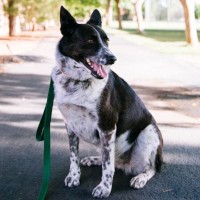
| The Cattle Collie Dog bears a strong resemblance to its two parent breeds, the Australian Cattle Dog and the Border Collie. The coat may vary from puppy to puppy, due to the lack of a breed standard. It can be a dense, rough, straight short coat or a dense, rough, long-haired length that is not water-repellent. Color combinations can vary from white, sandy, red, brown and blue. The expression most often seen is that of a curious dog eager to learn more. The Cattle Collie Dog's body is longer than it is tall. Its strong, muscular build exudes a hard but relaxed posture. The long, voluminous tail is carried high and slightly over the body. |
Temperament of the Cattle Collie Dog |
| Cattle Collie Dogs are curious, nervous and full of energy. He craves attention and prefers to be able to follow you as long as you keep him engaged, otherwise he may decide to find excitement elsewhere. This active breed requires constant training to remain your faithful companion. This energetic dog does best when kept active and stimulated both mentally and physically. The Cattle Collie Dog is ideal with children, but can be too energetic for small family members, so be sure to keep an eye on him. This is a loyal breed with a lot of courage. Strangers should take extra precautions when approaching, as this defensive hybrid may hesitate in the face of unfamiliar faces. Early training and advice should teach your dog to tell the difference between friendly strangers and unwelcome intruders. Your Cattle Collie Dog is known to be curious about other dogs and animals. When introducing new pets, give your dog boundaries and make sure he feels comfortable with his surroundings. |
Needs and activities of the Cattle Collie Dog |
| Your Cattle Collie Dog is known to be nervous and active in the field. His energy levels are moderately high, so 90 minutes of intense play and outdoor activity a day is recommended. Obedience trials, agility competitions and other games or groups that involve your hybrid in using his mind and body will give him the outlet he needs to flourish as a member of the family. An ideal environment for your Cattle Collie Dog would be a large rural or urban home with a secure space for him to explore and play. Supervision and companionship are essential, as boredom can lead to the destruction of property, and if left alone, he may start digging for a friend. |
Maintenance of the Cattle Collie Dog |
| The Cattle Collie Dog is not considered a hypoallergenic breed and will shed moderately. Daily brushing is recommended with a rubber curry brush or firm bristle brush to help reduce the amount of dead hair in the coat. Not known for being a drooling dog, this hybrid will require at least a weekly teeth cleaning. Foot care is always essential in an active dog, as the pads of the feet can be prone to dryness and chapped skin. Check the feet often to ensure that the pads are in good health and that there is no debris trapped between the toes. Nails should be trimmed often. Torn or infected nails can be very painful and problems can be difficult to resolve, simply because the dog is always on the move. |



 English (United Kingdom)

Comments