 |
Cavaton |
|
He is not recognized by the F.C.I. |
Origin |
Great Britain <> Madagascar -> U.S.A. | |
Translation |
Francis Vandersteen |
A brief presentation of the Cavaton |
| The Cavaton is a cross between a Cavalier King Charles Spaniel and a Coton de Tuléar. The result is a cute little companion dog with a big heart. They love people and aspire to please. Cavatons can be a little sensitive by nature, so they require gentle handling. They have high energy levels, so take them out for a walk every day. Not only will this deplete some of that energy, but it's a fantastic opportunity for them to socialize with other people and dogs. The Cavaton is generally sociable and trainable, and tends to love children and playing with them. If you have a home with a fenced-in yard, the Cavaton will love to go out with you to play in the garden, and you can bet you'll tire of the games first. These dogs love to be with their family, but you need to train them to have good dog manners and accept that you're the pack leader, not them. |
History of the Cavaton |
| The Cavaton owes its personality and appearance to its popular and beautiful parents, the Cavalier King Charles Spaniel and the Coton de Tuléar. |
A little of the Cavalier King Charles Spaniel |
||
| The Cavalier King Charles Spaniel is a descendant of the King Charles Spaniel. In the late 1600s, the King Charles Spaniel was crossed with the Pug. This crossbreed produced a smaller dog with an upturned face, flatter nose and large, protruding eyes. These became the standard for the King Charles Spaniel. However, in 1920, an American by the name of Rosewell Eldridge was keen to see dogs that resembled Van Dyck's paintings of King Charles II and his Spaniels. These dogs lacked the influence of the Carli dog, so he offered cash prizes at the Crufts Dog Show in London to anyone who exhibited a King Charles dog with the long nose. Miss M. Walker won but unfortunately Eldridge had passed away and he wasn't there to present the prize personally. But thanks to other American breeders who have embraced the idea that they are responsible for the Cavalier King Charles Spaniel we know today. From royal houses to American breeders, the Cavalier is a true heir to the Royal Spaniels. In the 1940s, they were classified as a separate breed and given the prefix Cavalier to differentiate them from their ancestors. With such a colorful and romantic past, the Cavaton could not have been anything other than the special little dog it is today. | ||
 |
||
| Standard of the Cavalier King Charles Spaniel | ||
A little of the Coton de Tuléar |
||
| The Coton de Tuléar originated on the island of Madagascar and is related to the Bichon Frise and Bichon Maltese. They arrived on the island of Madagascar several hundred years ago, although no precise date can be found. The little white dogs are said to have accompanied ladies on long sea voyages, while some say they were used as raftsmen on ships. Some of Tuléar's Coton dogs became pets of the royal court and wealthy Malagasy households, while others were street dogs. In the 1970s, a Frenchman visiting the island brought Cotons back to France and made a breed of them. They were also taken to North America around the same time. The Coton can still be found in its native home, but its gentle, loving personality has ensured its place as a worldwide favorite. He is registered with the American Kennel Club's Foundation Stock Service. | ||
 |
||
| Standard of the Coton de Tuléar |
Appearance of the Cavaton |
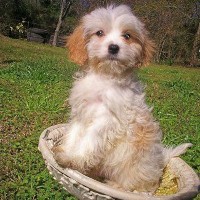
| The Cavaton is a truly cute dog, with an engaging face that's hard to resist, large, seductive round eyes and a button nose. It's often hard to see the shape of the body beneath their fluffy coat, but they are well proportioned in body but have short legs with soft, rounded feet. The head is rounded with long, feathery ears. The face often has long eyebrows and a medium-length muzzle that meets in a uniform bite or could be slightly lower. Their tail is often short and feathered or may be docked. The coat is part of what makes them so attractive, they look a lot like a stuffed animal rather than a dog. Combine this with their energetic nature and affectionate cuddles and you have a dog that fits perfectly into family life. |
Temperament of the Cavaton |
| The Cavaton is a happy little dog who loves just about everyone. They love being with their family and will follow you from room to room to be with you. Although they are smart little dogs who can be trained, it's their focus that can be a problem. They're so eager to please you that they forget what you've said as their concentration shifts from one thing to another. But instead of getting frustrated, persevere and go slowly, and teach just one thing a day rather than overwhelming your little companion. Once the Cavaton gets used to the training routine, he'll improve faster as he achieves what you're asking him to do. Give them lots of praise, petting and the occasional treat as a reward for trying. Cavatons love children and will interact closely with them. They make good companions for singles or the elderly, their antics lightening every day. Their attractive beauty, gentle nature and big, seductive brown eyes will appeal to anyone, human or pet. They're great in apartments because they're small and generally not a yappy dog. They'll need a daily walk or lots of play to release their pent-up energy. But generally, bouncing around the house all day will meet most of their activity needs. |
Needs and activities of the Cavaton |
| The Cavaton is a small dog, but it has a lot of energy that's usually used up just bouncing around the house and following you from room to room. They love to play and will play as long as your stamina lasts. The Cavaton will love to go for walks, where he can meet and greet other humans and dogs he expects to love him. This unique breed is highly adaptable and will do equally well in a small house or apartment. They can tolerate most climates but are indoor dogs, not kennel dogs. Their aim in life is to be your constant companion, and they'll do everything in their power to achieve this. |
Maintenance of the Cavaton |
| Cavatons aren't the easiest dogs to care for when it comes to coat care, but they're well worth it. Their coat is generally like that of the Coton, soft, curly and thick. But some dogs inherit the Cavalier's long, silky coat. In any case, the coat should be brushed often, which helps avoid matted fur and reduces the bathing required. When bathing, use a dog shampoo as human shampoo is too harsh. Be sure to dry your dog afterwards, checking the ears for any signs of infection to which long, floppy ears are prone. Dental care and brushing, as well as nail trimming, will complete the grooming. If you start when your Cavaton is a puppy, he'll grow to love these grooming sessions. This will help him later in life when he needs veterinary examinations and other manipulations as an adult. |



 English (United Kingdom)

Comments