
 |
Chin-Pin |
|
He is not recognized by the F.C.I. |
Origin |
China <> Germany -> U.S.A. | |
Translation |
Francis Vandersteen | |
This breed is also known as |
Chi-a-pin |
A brief presentation of the Chin-Pin |
| The Chin-Pin is a cross between a Japanese Spaniel and a Miniature Pinscher. They will adopt many characteristics of the parent breeds, so colors can include black, white, red, tan, rust and chocolate. Their coats are likely to be fine and short, but can be quite silky if they resemble the Japanese Spaniel. Chin-Pins won't need much grooming and they don't shed much. They're good with children and don't need much exercise to stay in shape, so they're well suited to apartment living. Both parent breeds are quite strong-willed, so you may need to be patient when it comes to training your dog. |
History of the Chin-Pin |
| The Chin-Pin is a combination of a Miniature Pinscher and a Japanese Spaniel. Like most hybrid dogs, the Chin-Pin's origins are unclear. However, its parent breeds are well known. The original purpose of Chin-Pin breeding remains unknown. But over time, their demand grew, and breeders continued to raise these happy, intelligent and alert dogs. |
A little of the Japanese Spaniel |
||
| Despite its name, the Japanese Spaniel's earliest origins lie in China. Believed to have originated in the Chinese imperial court, they were highly prized and often given as gifts. Some historians believe that the Pekingese, which also has its origins in China, was developed from the Japanese Spaniel, also known as the Japanese Spaniel. In Japan, dogs were restricted to those of royal blood. There is evidence that the first Japanese Spaniels were given as gifts by the Emperor of Japan to an American naval officer, Commodore Matthew Perry, in 1853, when he sailed into the port of Uraga near Edo, now Tokyo, and introduced Japan to international trade. He was apparently given seven dogs, two of which survived to return to the USA, where some of the owners included President Franklin Pierce, then Secretary of War Jefferson Davis, and Perry's daughter Caroline Perry Belmont. They were officially recognized by the American Kennel Club in 1888. | ||
 |
||
| Standard of the Japanese Spaniel | ||
A little of the Miniature Pinscher |
||
| The first Miniature Pinscher was bred in Germany as a ratter and dates back some 200 years. Although they resemble a mini Doberman, they are a different breed. The breed was originally called the Reh Pinscher because the Germans thought they resembled the little red deer that lived in the nearby forests. It was also bred in Scandinavia and is still popular there. It is thought that the Miniature Pinscher is most likely descended from the German Pinscher. Other ancestors may be Terriers such as the Dachshund and Italian Greyhound. German breeders formed the Pinscher Klub, later renamed the Pinscher Schnauzer Klub in 1895. The first dogs were taken to the United States around 1919 and were recognized by the American Kennel Club in 1929. | ||
 |
||
| Standard of the Miniature Pinscher |
Appearance of the Chin-Pin |
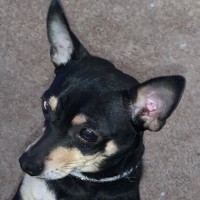
| The Chin-Pin is a cross between a Japanese Spaniel and a Miniature Pinscher. They will adopt many characteristics of the parent breeds, so colors may include black, white, red, tan, rust and chocolate. Their coats are likely to be fine and short, but can be quite silky if they resemble the Japanese Spaniel. Chin-Pins won't need much grooming and they don't shed much. If your Chin-Pin has the facial features of the parent Japanese Spaniel, the eyes will be wide apart, although it is generally found that this hybrid has the head shape and appearance of the Miniature Pinscher, with the beige and black mask. |
Temperament of the Chin-Pin |
| A Chin-Pin will adopt many traits from their parent breeds, and is therefore likely to be an excellent pet with preferably older children. They are likely to be affectionate and energetic like the Miniature Pinscher, often called Min Pin, and known as the "King of Toys" for its confident attitude. They are very inquisitive dogs, always looking to explore, and skilled enough to close the gap when a door is open. They are fearless and good watchdogs, and dislike strangers. They are best with older children as they are small dogs and can be easily hurt with younger ones. They can be a challenge to train and are prone to chasing other dogs. Your hybrid will also love being with people and will be a happy, playful dog. They are a bit like cats in that they love to climb and groom themselves. Chin-Pins can be trained with positive reinforcement, but keep them on a leash when outdoors as they chase other animals. They don't need much exercise and don't like to be left alone for too long. |
Needs and activities of the Chin-Pin |
| Your Chin-Pin won't need much exercise to stay happy and healthy, but this will depend on the parent breed it chooses, as Miniature Pinschers need more activity than Japanese Spaniels. This hybrid can become destructive if bored, so regular walks and play sessions will keep him calm. Both parent breeds are excellent for apartment-dwellers, but need to be taken out regularly. Neither parent breed is happy to be left alone for any length of time, so it's best to expect a Chin-Pin that always wants to be by your side. Your pet should be kept on a leash when taken outdoors, as it may chase other animals and hesitate to come when called. Your pet is likely to be sensitive to heat and cold; don't leave them out in extreme weather conditions. |
Maintenance of the Chin-Pin |
| None of the parent breeds are hypoallergenic, but your dog won't need much grooming to keep a good appearance, and he won't shed much either. Like the parent breeds, your dog is unlikely to need brushing more than once a week. A nice brush with a smoother coat will keep it smooth and shiny. Chin-Pins rarely need a bath, sometimes just a wipe down with a damp cloth if they've been playing outside and are muddy. Try to brush your dog's teeth every day to avoid any dental problems, as small dogs often have teething problems, and check the ears for dirt. Depending on whether your hybrid has a more cheerful ear or a folded set, moisture build-up can be a problem, so be vigilant. |



 English (United Kingdom)

Comments