
 |
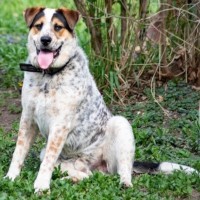
Dalmatian Heeler |
|
He is not recognized by the F.C.I. |
Origin |
Croatia <> Australia -> U.S.A. | |
Translation |
Francis Vandersteen |
A brief presentation of the Dalmatian Heeler |
| The Dalmatian Heeler is not a pure-bred dog, so it's hard to say what characteristics it will inherit. Both parents are very active working dogs who need a lot to keep them busy and to use up some of that energy, so it's only natural that the Dalmatian Heeler should inherit an energetic personality. Dalmatian Heelers are strong, medium to large dogs that are loyal, faithful and very playful. They are good family dogs, although they can be noisy at play and knock over smaller children. These dogs are intelligent and easy to train, but can sometimes have a sensitive temperament. They respond well to firm but friendly leadership and are not suited to an inexperienced owner. Good socialization from the start will help your dog become a complete friend who accepts other pets, dogs and humans without aggression. |
History of the Dalmatian Heeler |
| The Dalmatian Heeler is best understood by examining the history of its lineage, the Dalmatian and the Australian Cattle Dog. |
A little of the Dalmatian |
||
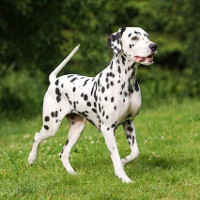
| The history of the Dalmatian is a debatable subject, with many experts disagreeing on its origin. Some say it's linked to the pointer. It is accepted that it is an ancient breed, as spotted dogs can be found in Egyptian bas-reliefs and Hellenic friezes. Some claim that the dog is a Croatian breed, which was debated until 1993, when it was finally recognized. In the 1800s, he became popular as a carriage dog, running alongside horses and clearing a path for them while protecting them and the carriage when not supervised by the master. He has had a variety of tasks as a fire dog, war sentry, draft dog, circus performer, vermin hunter, bird dog, sled dog and finally, a shepherd and guard dog. | ||
 |
||
| Standard of the Dalmatian | ||
A little of the Australian Cattle Dog |
||
| Settlers developed the Australian Cattle Dog in the 1800s, crossing Dingo-blue merle Collies with Dalmatians and Black and Tan Kelpies. The result was a strong dog that could withstand the harsh climate and long distances. These dogs were excellent workers, handling livestock calmly but forcefully and driving cattle over long distances. In 1980, the breed was finally recognized by the AKC. The word "heeler" refers to the dogs' breeding ability to snap and bite the heels of cattle. The Australian Cattle Dog is a talented retriever, shepherd, guard dog and ideal for obedience and agility competitions. Interestingly, the Australian Cattle Dog has Dalmatian genes in its lineage. | ||
 |
||
| Standard of the Australian Cattle Dog |
Appearance of the Dalmatian Heeler |
| It's always difficult to say with certainty what a hybrid dog will look like, due to which parent it takes after most, or which characteristics are most dominant. While the Blue Heeler parent (Australian Cattle Dog) is robust and compact with a well-muscled body, the Dalmatian is a big, strong dog with an athletic look. Your Dalmatian Heeler could be a combination of the two, or take either parent. The chest is deep, the tail straight and held moderately low. The head is slightly rounded, with large ears set high on the head but hanging down, or they may stand upright. The eyes are round and may have the characteristic blue-brown or a combination of the two colors like the Dalmatian. The front legs are strong and straight, and the feet are rounded and arched. Due to the mixed parentage of Dalmatian Heelers, they are available in a wide range of colors, patterns and coat types, making them an attractive dog. |
Temperament of the Dalmatian Heeler |
| The Dalmatian Heeler is a loyal and courageous dog, with great energy and stamina. Not a dog to stay at home and do nothing, it needs plenty of exercise to avoid boredom, which can lead to behavioral problems such as digging crater-sized holes in your garden. This alert, active dog is excellent in the obedience ring and will excel in agility and breeding trials. Firm but benevolent leadership is required with this dog, he can be sensitive to stern leadership like the Dalmatian, so be consistent in your training and reward him with praise and affection. If your dog is not properly socialized as a puppy, he may become aggressive with other dogs as he grows. Lots of outings and exercise while mixing with other people and dogs is a must. The Dalmatian Heeler may nip at people's heels in an attempt to herd them (like their Blue Heeler relative nips at cattle), so the owner must teach the dog that this is not acceptable. These dogs do well in the country, or if they get enough exercise, they can adapt to city life. Their playfulness, loyalty, devotion and affection make them ideal family dogs. |
Needs and activities of the Dalmatian Heeler |
| These dogs have great stamina and will appreciate as much exercise as you can give them. They are ideal as jogging partners and are almost tireless. They love games that challenge their intellect, such as obstacle courses or obedience classes. They have a natural instinct for stalking or herding, and are great retrievers. The Dalmatian Heeler has a strong nature, so it needs a good pack leader, but will be devoted and loyal to its owner. |
Maintenance of the Dalmatian Heeler |
| Bathe your hybrid only when necessary to preserve its waterproof coat. Using a specially formulated dog shampoo will help prevent the development of dry or allergic skin. Your Dalmatian Heeler is quite soft, so frequent brushing with a firm bristle brush will be necessary to prevent the coat from matting. Some dogs may have more Australian Cattle Dog coat, which is short and easy to groom, but it still sheds twice a year, requiring extra maintenance at these times. Other grooming needs include ear care, nail trimming and tooth brushing. If your dog is trained to accept this period as a normal part of his life from an early age, it will be easier to maintain your dog's health and help him during visits to the veterinary clinic. |



 English (United Kingdom)

Comments