 |
Engachon |
|
He is not recognized by the F.C.I. |
Origin |
Great Britain <> France / Belgium -> U.S.A. | |
Translation |
Francis Vandersteen |
A brief presentation of the Engachon |
| The Engachon is an alert, well-behaved dog, a cross between the King Charles Spaniel and the Bichon à poil frisé. Two adorable dogs make up the parentage of this hybrid, and he's described as cheerful and affectionate, making him an excellent companion for anyone who likes to have a dog on their lap. Always eager to be with you, this little dog is active but not at all a pain in the ass. |
History of the Engachon |
| The hybrid known as the Engachon is a new breed of dog with no detailed history, but looking at the parents can give a good picture of the past. |
A little of the King Charles Spaniel |
||
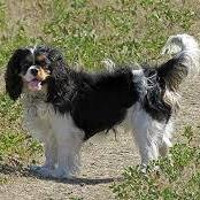
| The presence of the King Charles Spaniel was first noted in England, although the breed is thought to have originated in Asia, where most experts believe they were given as gifts to Japanese royalty. Prior to 1903, each of the four color combinations of English Toy Spaniels were listed as separate breeds, King Charles, Prince Charles, Blenheim and Ruby, for show purposes, although mixed for breeding. In 1904, the American Kennel Club decided that the four colors should be combined into a single breed, called the King Charles Spaniel. Their short muzzle and small stature are thought to be the result of cross-breeding with Carlins in the early 1900s. While the dogs were originally bred for hunting, they were not particularly successful at it due to their size. Although they have hunting instincts, they prefer to lounge around like a pocket dog. | ||
 |
||
| Standard of the King Charles Spaniel | ||
A little of the Bichon frise |
||
| There are many beliefs about the history of the Bichon Frise. Some claim that the breed has existed since before the time of Christ, while others believe that the breed originated from Maltese bloodlines. Many accounts indicate that the Bichon Frise originated from the Barbet or Water Spaniel and possibly the Poodle. This is where some believe the name "barbichon" originated and was later shortened to "bichon". Bichons are said to be divided into four categories: the Bolognese Bichon, the Havanese Bichon, the Maltese Bichon and the Teneriffe Bichon, all of which originated in the Mediterranean region. History shows that the breed was often bartered by sailors. The dogs were very popular in Spain, and it is thought that Spanish sailors introduced the breed to Tenerife, an island in the Canary Islands. In the 1300s, the dogs were rediscovered by Italian sailors and became popular among the Italian nobility. By the Renaissance, the breed was popular in France, gaining even greater popularity under Henry III. The Bichon Frise became less popular in the late 1800s, at a time when it participated in fairs and circuses. The President of the Fédération Canine Internationale recommended that the breed be named the Bichon à poil frisé in 1933. The first domestic Bichon Frise litter was born in the United States in 1956. | ||
 |
||
| Standard of the Bichon frise |
Appearance of the Engachon |
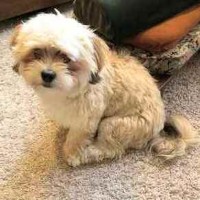
| The engaging Engachon will be a compact, robust little dog with muscular legs and small, hairy feet. His dense coat will be medium to long and is usually quite wavy, echoing the Bichon à poil frisé side of the mix. The Engachon's good posture shows its confidence and cheerfulness. His eyes are brown, round and bright. His nose is black and his muzzle is not too long. His ears are long and can be quite hairy, and his tail can be feathery. |
Temperament of the Engachon |
| The Engachon is a happy dog with a gentle heart. Owners of this hybrid say it can be stubborn in training, but is otherwise easy-going and pleasant to be around. He will play well with children as well as other dogs, although due to his small size, he needs to be supervised in the presence of younger children who may not understand his delicacy. Not a big barker, he may vocalize when excited but should calm down fairly quickly. He generally has no aversion to strangers, but should be given plenty of opportunity to mingle with people and other dogs so he doesn't become the nervous, lively type. |
Needs and activities of the Engachon |
| This proud and courageous hybrid will want to accompany you wherever you go. Although his size is small, he's always up for an adventure. He's happy to cuddle for the afternoon, but still needs to stretch his legs for a short time twice a day. He's not the kind of dog who likes to be left alone for long, so he'll need a nice variety of safe toys to keep him occupied when you go out. The lack of things to do when he's alone can lead him to concoct his own mischief. Adequate daily exercise will keep him satisfied, however, and he'll then be happy to take a nap when you need to go out. |
Maintenance of the Engachon |
| The Engachon should be brushed at least every two days, using a pin brush. If mats are present, a metal comb may be useful. Bathing is only necessary every few months, or on occasions when your dog is particularly dirty. However, to make grooming easier after the bath, make sure your Engachon doesn't tangle before you wet it. Neglecting to do so can mean that your hybrid will be very difficult to brush. It's important to keep his long ears clean and dry. Sometimes you'll need to pluck stray hairs further back in his ear canal, if that doesn't suit you, a groomer can help. You'll also want to keep your dog's face clean because of the long hairs around his mouth and eyes, his eyes can tear, and the fluid leaking from his eyes can cause problems if left untreated and can also stain the fur. |



 English (United Kingdom)

Comments