 |
Englian Mastiff |
|
He is not recognized by the F.C.I. |
Origin |
Great Britain <> Italy -> U.S.A. | |
Translation |
Francis Vandersteen |
A brief presentation of the Englian Mastiff |
| The Englian Mastiff is a big dog and can seem a little intimidating, but it's a gentle giant, affectionate and peaceful. They make good family dogs, but can drool a lot and are not suited to hot weather. Generally quiet, they bark only when necessary. They are good with children if the children know how to show leadership. The Englian Mastiff can be reserved with strangers, so it's best to socialize these dogs when they're young. They respect a strong leader and obedience training is important. Although they are peaceful animals, they are born guard dogs, so the instinct that is strong in the parent dog will have been passed on to the Englian Mastiff. They will react if there is a threat unless the owner is there to confirm that all is well. These dogs are somewhat difficult to train, but perseverance will pay off. They respond well to firm but gentle training. |
History of the Englian Mastiff |
| The history of the Englian Mastiff hybrid lacks definitive data, so it's easier to look to the parent breeds to find the characteristics your pet may inherit. |
A little of the Mastiff |
||
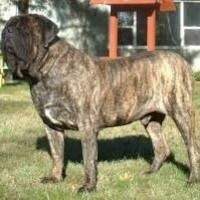
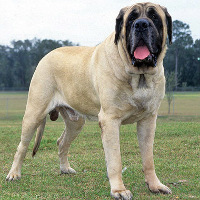
| All European Mastiffs are descended from the ancient Tibetan Mastiff. The breed fought alongside British soldiers in 55 BC. Caesar brought a pack of Mastiffs to Rome, where the dogs were forced into the arena as gladiators fighting humans, lions, bull baiting, bear baiting and dog-to-dog combat. After this bloody period, they became popular in England, where they were used as guard dogs and companion dogs. The English Mastiff is thought to have come to America on the Mayflower, and later others were imported. The English Mastiff's talents include police work, military work, search and rescue, watchdog and guard dog. | ||
 |
||
| Standard of the Mastiff | ||
A little of the Neapolitan Mastiff |
||
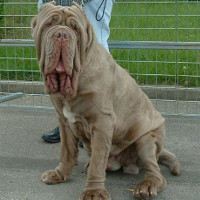
| Neapolitan Mastiff origins come as a direct descendant of the Roman Molossus dog. It faced extinction but managed to survive in Campania, despite the dangers of war. They were used in warfare and in the bloody spectacles of the Roman arena. They have a formidable reputation as watchdogs, and their enormous, powerful appearance should be enough to deter any burglar. Neapolitans have been used by the Italian police and army, as well as business and estate owners, to protect property and people. The breed is still quite rare in the United States. It was officially recognized by the American Kennel Club in 2004. | ||
 |
||
| Standard of the Neapolitan Mastiff |
Appearance of the Englian Mastiff |
| The Englian Mastiff is a serious, powerful dog that can inherit the facial folds around the head of the Neapolitan Mastiff. Others may inherit the black mask for which the English Mastiff is famous. This dog is a big, solid animal with a large, square head. The muzzle should measure about half the length of the skull, and the teeth should meet in a scissors or slightly lower bite. Eyes can vary according to the parent genes they inherit, from medium-sized, dark hazel in a dark mask like the English Mastiff, to sunken amber-brown eyes that almost disappear beneath drooping upper eyelids. Small triangular ears are proportionate to the head, and the tail is set high and tapers to a point or curls over the back. Strong legs with rounded paws support the strong, muscular body, which sports a short, straight, smooth coat that can be supplied in a variety of colors. |
Temperament of the Englian Mastiff |
| The Englian Mastiff is a big dog that can seem very intimidating. But beneath his serious demeanor lies a gentle giant who is devoted to his family, lovingly protective of children and a dog who can get along well with other family pets. It's important to socialize them early in life so they understand their role in the family, just like a strong, firm but gentle leader. These dogs like to please and will respond well with training, but they have a mind of their own and won't listen to humble owners; you have to be the pack leader to earn their respect. With patience, they can become highly trained and obedient. Although they're not a dog for just anyone, it's an exaggeration to say they're difficult. They just need a natural leader and will reward you with affection, love and devotion. Although they are big, heavy dogs, they seem to realize their strength and are gentle and careful with small animals and children. |
Needs and activities of the Englian Mastiff |
| The Englian Mastiff is relatively inactive indoors, but will be better mentally and physically if exercised regularly. Because of their low activity level, they can live in apartments if they exercise daily. These dogs are natural watchdogs, their size and solemn faces being enough to deter anyone, but they also have their playful side, especially with the children in the family. Socialization is important for the young Englian Mastiff puppy, and a regular trip to the dog park is an activity your gentle giant will enjoy. The Englian Mastiff respects a business owner, but will outgrow a gentle one. Training is another activity your dog will benefit from. |
Maintenance of the Englian Mastiff |
| The Englian Mastiff is relatively easy to groom, but it does take some time to brush this massive dog. Regular brushing with a firm bristle brush will help keep the coat tangle-free and remove loose hair and dirt. Bath or dry shampoo if necessary. Check all skin folds for debris and infection. When your dog gets wet, make sure the inside of these skin folds are dry to avoid health problems. Teeth-brushing training should be carried out when they're a puppy, making it much easier for them to mature. They can drool quite profusely, especially in hot climates, or after a drink. Keep paper towels handy if this happens. |



 English (United Kingdom)

Comments