
 |
English Bull Staffy |
|
He is not recognized by the F.C.I. |
Origin |
Great Britain <> U.S.A. -> U.S.A. | |
Translation |
Francis Vandersteen |
A brief presentation of the English Bull Staffy |
| Strong and courageous, the English Bull Staffy is a hybrid breed developed from the English Bulldog and the American Staffordshire Terrier, also known as the Am Staff. Although the history of the hybrid breed is unknown, it is thought that breeders wanted to create a healthier breed from the two parent breeds. The result was a protective but loving dog that would do anything to keep its family safe. The average English Bull Staffy weighs between 25 and 30.5 kilos and measures between 38 and 46 centimeters. Its main purpose is to provide companionship. Its short, fine coat makes it easy to groom. The English Bull Staffy contains high levels of energy and will require intense daily play to ensure it receives the necessary exercise. |
History of the English Bull Staffy |
| The history of the English Bull Staffy is not well documented at present. It is suspected that the breed was developed as a desire to create a healthier breed. |
A little of the English Bulldog |
||
| While the English Bulldog was originally descended from the ancient Mastiff, the breed was developed in England. In 1500, mention was made of a man walking a Bulldog. At the time, the breed was developed to be aggressive and effective at bull-baiting. Bull-baiting was supposed to tenderize bull meat, leading to increased popularity in the sport. In 1835, bull-baiting was outlawed in England, and the English Bulldog no longer had a raison d'être. Due to its aggressive nature, the dog was not considered a pet. Breeders wanted to modify the breed and develop a gentle, calm disposition. In 1859, English Bulldogs began to appear in conformation shows. In 1860, the first English Bulldog dog show was held in Birmingham, England. In 1880, the breed was imported to the United States. In 1890, the Bulldog Club of America was founded. In 1894, the first official breed standard was published. In 1890, the American Kennel Club recognized the English Bulldog. | ||
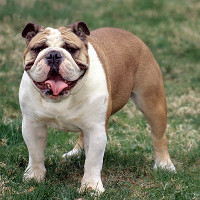 |
||
| Standard of the English Bulldog | ||
A little of the American Staffordshire Terrier |
||
| In the 19th century, the Am Staff was used in dog-fighting circles among the wealthy. The breed's other purpose was among farmers, who used the dogs to hunt rats, wild pigs and bears. Owners appreciated their versatility in the field and wanted to put their skills to good use. In the 1920s, there was a desire to show the Am Staff in conformation shows. In 1936, the American Kennel Club accepted the Am Staff as distinct from the smaller Staffordshire Bull Terrier. | ||
 |
||
| Standard of the American Staffordshire Terrier |
Appearance of the English Bull Staffy |
| The English Bull Staffy has a stocky, muscular build like the American Staffordshire Terrier. Its medium-length head and pronounced cheek muscles strongly resemble the Am Staff. The ears are set high on the sides of the head. Eyes are dark and round. Jaws are powerful, with tight lips. The heavy neck is slightly arched. Its coat is short, fine and water-repellent, and comes in combinations of brown, white and beige. Its tail is short in relation to its body and set low. Its legs are straight and its paws strong. His expression is that of a goofy but protective nature. |
Temperament of the English Bull Staffy |
| The English Bull Staffy is protective and wary of strangers. His loyal nature will enable him to protect his family and loved ones. They are also described as loving, clumsy and with a sense of humor. This adorable breed will do best with family and young children. English Bull Staffies love to be around people and love to show off their talents. They make excellent friends with other dogs, but will need early training to get along with small animals. Positive reinforcement will encourage your dog to welcome others. His protective nature will require patience to introduce strangers into his life. The English Bull Staffy will want to protect you from people he doesn't recognize. His high energy levels mean he'll need to be offered activities that keep him engaged. Leaving him unattended for long periods is not recommended, as he may become involved in the destruction of property. |
Needs and activities of the English Bull Staffy |
| The English Bull Staffy contains high energy levels that will require between 45 and 60 minutes of exercise per day. Your dog will benefit from activities such as Frisbee, walking, running, swimming and jogging. About two walks a day are recommended to maintain weight and health. An ideal environment for your English Bull Staffy would be an average urban home with a fenced yard in a warm climate. Apartment living is not recommended, as he would need the outdoor activities necessary to maintain his high energy levels on a daily basis. If your active dog lives in an apartment, be proactive in making sure he meets his daily exercise requirements. |
Maintenance of the English Bull Staffy |
| The English Bull Staffy is not considered a hypoallergenic breed and will shed moderately. Daily brushing for 15 minutes with a rubber curry brush will help remove dead hairs. This short-haired breed can develop allergies due to its skin. A hypoallergenic shampoo would be beneficial for its skin to eliminate any irritants in the shampoo. This breed is not known for drooling or strong odors. Its nails should be trimmed every 2 to 3 weeks. Ears should be wiped and cleaned weekly to prevent wax build-up. Teeth should be brushed regularly to prevent tartar build-up, and an annual visit to the vet to check the condition of the teeth is always a good idea. |



 English (United Kingdom)

Comments