 |
English Lhasa Bull |
|
He is not recognized by the F.C.I. |
Origin |
Great Britain <> Tibet -> U.S.A. | |
Translation |
Francis Vandersteen | |
This breed is also known as |
Lhassa Bull
|
A brief presentation of the English Lhasa Bull |
| The English Lhasa Bull is a specific cross between the Bulldog, a family dog that was originally bred to bait and control bulls, and a tiny but ancient temple guardian, the Lhassa Apso. The cross between these two dogs is likely to be calmer and less prone to barking than the Lhassa Apso, but unlike the typical English Bulldog, they can retain their juvenile vigor for longer and remain clownish and playful for some time after maturing. They are generally gentle by nature, although they can be uncomfortable with strangers, and can make a durable and entertaining companion in any size home. |
History of the English Lhasa Bull |
| The English Lhasa Bull is a hybrid dog, a cross between the Bulldog, a pet once used to bait and control bulls, and the Lhassa Apso, a small sentry dog from the temples of Tibet. This cross is slightly larger than the parent Lhassa Apso breed and more energetic than the English Bulldog, without significantly increasing exercise requirements. |
A little of the English Bulldog |
||
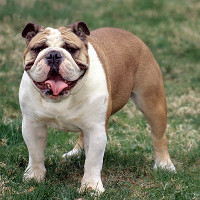
| The English Bulldog is an ancient breed with somewhat mysterious origins. While some experts believe the Bulldog is descended from a Mastiff and a small dog like a Pug, others maintain that the Mastiff line descended from the English Bulldog, rather than the other way around. Whichever descended from whom, history clearly shows that these dogs were used to control, guard and bait bulls in England. To this end, Bulldogs of the 1800s were bred to be far more aggressive and tenacious than they are today, with an extremely high pain tolerance. This made them excellent candidates for fighting other dogs and, because of this trait, they were instrumental in the development of the American Pit Bull Terrier and the American Staffordshire Terrier. When these violent sports were outlawed in 1885, the breed was protected by a few Bulldog enthusiasts who chose to breed for a more pleasurable nature, and today's English Bulldog is generally a placid, docile animal that is able to adapt to many situations. | ||
 |
||
| Standard of the English Bulldog | ||
A little of the Lhassa Apso |
||
| The Lhassa Apso is an ancient breed, developed in the mountains of Tibet by the Buddhist monks who lived there. They acted as guard dogs for temples and monasteries thousands of years ago, and their original lineage has long been lost to history; some experts believe they are descendants of the larger Tibetan terriers, while others think there may be a Nordic component to the breed. Recent DNA studies indicate that this dog is one of the breeds most closely related to their wolf-like ancestors, leading to the idea that the Lhassa Apso is descended from a variety of mountain wolf. These dogs were bred by Tibetan monks for their ability to withstand the cold, their excellent sense of hearing and good judgment in distinguishing stranger from friend. They were carefully guarded by the monks against any outside influence and were never exchanged for money, but were sometimes given as gifts to important guests such as imperial families and visiting dignitaries. It is thought that dogs given as gifts to people outside monasteries had an influence on smaller Chinese dog breeds, such as the Pekingese and Shih Tzu. | ||
 |
||
| Standard of the Lhassa Apso |
Appearance of the English Lhasa Bull |
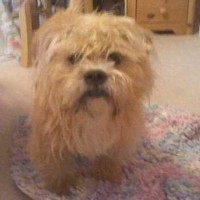
| The two parent breeds that contribute to the English Lhasa Bull can be very different from each other in terms of structure and appearance, so there can be a great deal of variation in appearance from one dog to the next, even with dogs from the same litter. This hybrid generally has a broad, slightly rounded head with a fairly broad short to medium muzzle; those who prefer the Bulldog side of their heritage will have shorter, broader muzzles and heads than those who prefer the Lhassa Apso. Their dark brown eyes are generally round and set low, and they have ears that will be set high on the head and fold sideways as a pendant or backwards in a configuration known as a pink ear. Both dogs are robust, but the English Bulldog is considerably bulkier than the Lhassa Apso, and the hybrid can take its general form from either of the parent breeds. The biggest difference between the two is the coat, with the Lhassa Apso sporting a coarse coat of long, flowing fur that covers a thick, dense undercoat, and the English Bulldog sporting a single layer of short, smooth fur that lies close to the skin. The cross may inherit a coat or elements of both. |
Temperament of the English Lhasa Bull |
| English Lhasa Bull crosses can take personality traits from either side of the family tree. Although the English Bulldog was originally developed as an aggressive, tenacious dog suited to taking on a bull, later breeding created a much more placid animal with an affectionate, dignified demeanor that generally gets along easily with humans and other animals. The Lhassa Apso, on the other hand, still embodies much of its guard dog instincts and can be wary of strangers and, in some cases, possessive of objects or food. This is particularly true if socialization does not take place during the animal's early development. If the hybrid favors the Bulldog temperament, it may be a suitable companion in households with older and younger children, but those resembling the Lhassa Apso may not be suitable for households with very young children. Training the English Lhasa Bull can be a challenge, as the modern Bulldog has retained its notoriously stubborn sequence and the Lhassa Apso can tend towards independence. |
Needs and activities of the English Lhasa Bull |
| These dogs don't need much exercise to stay happy and healthy, and are generally quite content with just 20 to 40 minutes of vigorous activity a day. In addition to short walks, these dogs enjoy games of fetch and hide-and-seek with treats. This crossbreed will often have a shortened muzzle, making it more sensitive to temperature extremes, especially heat, and should be walked when the temperature is more moderate, such as in the morning or evening in summer. These small dogs are quite calm due to the Bulldog heritage and are not particularly prone to barking, making them an excellent companion for apartment dwellers as well as those living in larger homes. |
Maintenance of the English Lhasa Bull |
| Grooming requirements for this hybrid can range from simple to complex, depending on the dog's inherited coat. In most cases, this crossbreed needs to be bathed fairly frequently, usually about once or twice a month, to keep it clean and fresh. Dogs that prefer the Bulldog with short, single-layer coats are the easiest to care for after that, requiring only a swipe with a smoother brush or rubber grooming brush or glove a few times a week to remove dead hairs and properly distribute body oils. Hybrids that inherit the Lhassa Apso's more complex coat will need thorough brushing daily to avoid tangles and mats, and owners may even choose to have their coat professionally trimmed or clipped. Regular dental care is also important for these dogs, as their small mouths can expose them to the development of dental disease. |



 English (United Kingdom)

Comments