
 |
English King |
|
He is not recognized by the F.C.I. |
Origin |
Great Britain -> U.S.A. | |
Translation |
Francis Vandersteen |
A brief presentation of the English King |
| The English King is a toy breed mix between the closely related King Charles Spaniel and the Cavalier King Charles Spaniel. English Kings are known as "happy", affectionate pets. In fact, this breed is so people-oriented that it is sensitive to separation anxiety. So human companionship is a must for English Kings. They have an average lifespan for toy breeds of 9 to 14 years. They generally weigh between 4.5 and 7.5 kilos and reach a height of 28 to 30.5 centimeters. Their ample coats come in many colors common to both parent breeds, and require weekly brushing. Although this hybrid is thought to have existed for some time, it is not totally stable in appearance and temperament. As such, English Kings are not currently recognized by the American Kennel Club. |
History of the English King |
| The English King's name is a combination of its two parent breeds: the King Charles Spaniel and the Cavalier King Charles Spaniel. These two parent breeds have intertwined histories. They originated from the same ancestors in Asia, probably ancient Japan or China. The first versions of Spaniel mixes appeared in Europe around the 17th century. During this time, there were four color combinations that were classified as distinct breeds: King Charles (black and tan), Prince Charles (white, tan and black), Blenheim (red and white) and Ruby (red). Because the two parent breeds are so similar, this hybrid is relatively common, widely recognized and popular in the United States and the United Kingdom. Nevertheless, English Kings are not recognized by the American Kennel Club, and breeders who raise Cavalier King Charles Spaniels and King Charles Spaniels should be thoroughly researched if you are considering buying a puppy from them. |
A little of the King Charles Spaniel |
||
| The King Charles Spaniel was named after its biggest fan at the time, King Charles II. Over the centuries, King Charles Spaniels were bred haphazardly and varied in appearance. That changed when American financier Roswell Eldridge traveled to England to buy two Spaniels in the 1920s. He restored stability to the breed by offering prizes to breeders for the King Charles Spaniels that most closely resembled the dogs depicted alongside King Charles II in works of art and literary accounts. Also at this time, the prefix "Cavalier" was added to the breed name. In 1952, the first Cavalier King Charles Spaniels were brought to the USA, and were officially recognized by the American Kennel Club in 1996. Spaniel mixes that were not siphoned off into the "Cavalier" offshoot were grouped into a single breed in 1904. They are now known as the King Charles Spaniel. This breed is smaller and has a flatter nose than the Cavalier King Charles Spaniel due to breeding with pugs in the early 1900s. | ||
 |
||
| Standard of the King Charles Spaniel | ||
A little of the Cavalier King Charles Spaniel |
||
| The Cavalier King Charles Spaniel is a charming, adorable little companion dog. The breed's big eyes and constantly wagging tail are sure to delight everyone, and they are patient and affectionate with other pets and children. Although its name evokes its origins in the court of Charles II, the Cavalier King Charles, or Cavie, is actually a recently developed breed, modeled on the Epagneul toys seen in many old paintings of European royalty. Cavies are highly adaptable and will learn to live happily in most environments. They are suited to indoor living only, but are basically a small, athletic breed and therefore need a moderate amount of exercise every day. They need to be in constant contact with their owners and should not be left alone for long periods, as they can become upset and depressed by regular isolation. | ||
 |
||
| Standard of the Cavalier King Charles Spaniel |
Appearance of the English King |
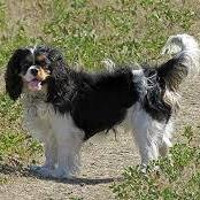
| The English King has a bouncy gait and a square, compact build. It averages 4.5 to 7.5 kilos in weight and 28 to 30.5 centimeters in height. His coat is of medium length, slightly wavy and has a silky texture. English Kings are available in multicolor combinations of black, tan, white, ruby, red, with tan and white markings. They have numerous feathers around the ears, chest and legs. This breed's medium-length tail is also feathered, generously coated and relatively high on its hindquarters. English Kings have relaxed shoulders and compact, well-padded legs, likely an evolution for outdoor sporting activities. This breed has a gentle expression with large, round black eyes, low-set floppy ears and a short muzzle with a lower bite. |
Temperament of the English King |
| These affectionate, gentle dogs are friendly with everyone and make wonderful pets that require constant human companionship. English Kings are playful and love to engage with children of all ages, as well as socialize with other dogs. They tend to be very sensitive to their surroundings and do best in stable environments with a structured daily schedule. As English Kings are eager to please their owners, they are easy to train. What's more, their small size makes them very practical for city or apartment living. Note, however, that this breed has a lot of energy and needs daily exercise regardless of the type of household they live in. If English Kings become agitated or upset, they'll let you know by barking or whining. This breed doesn't have strong hunting or wandering tendencies, so you can count on English Kings to stay by their owners' side at all times. |
Needs and activities of the English King |
| The English King is an agile, playful breed that needs daily exercise and plenty of attention to stay happy and healthy. English Kings love daily walks and outings to the dog park, as well as playing indoors with their owners. They'll enthusiastically engage in games like fetch and tug-of-war. English Kings will also be happy to relax indoors with their owners. As such, it's important to incorporate an equal balance of play and rest into your English King's schedule. Note that this breed is well suited to all types of climates, however, they should not be exposed to very hot or cold temperatures, as small dogs are sensitive to dangerous changes in body temperature under extreme conditions. |
Maintenance of the English King |
| English Kings shed moderately and need frequent grooming for their flowing, silky coat. Weekly brushing with a comb and pin brush is recommended to reduce matting and tangles, and to control shedding. Note that owners must be particularly diligent in combing heavily feathered areas of the coat. Some owners opt for professional grooming if the English King's coat is particularly long. English Kings should be bathed monthly, and owners should take great care in cleaning their dangling ears to avoid wax build-up and infection. English Kings should also have their teeth brushed daily and their nails trimmed once or twice a month. |



 English (United Kingdom)

Comments