
 |
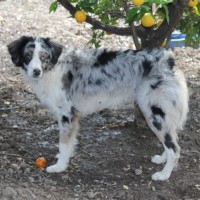
English Cotralian |
|
He is not recognized by the F.C.I. |
Origin |
Great Britain <> U.S.A. -> U.S.A. | |
Translation |
Francis Vandersteen |
A brief presentation of the English Cotralian |
| An English Cotralian is a combination of a purebred Australian Shepherd, standard, miniature or toy, and an English Cocker Spaniel. They are social and affectionate animals that need a lot of attention from their owners. They are suited to all types of climates and home environments, provided owners are diligent in providing daily exercise and frequent opportunities for play. The English Cotralian has an average lifespan of 12 to 15 years and an average weight of 13.5 to 20.5 kilos. Although this hybrid breed is relatively popular and well known for its adorable personality and practical size, its form and personality are not yet fully stabilized. Consequently, it is not recognized by the American Kennel Club. |
History of the English Cotralian |
| The name English Cotralian is a combination of the names of the two parent breeds, the Australian Shepherd, also known as the Aussie, and the English Cocker Spaniel. |
A little of the Australian Shepherd |
||
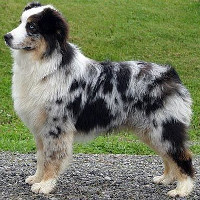
| The Australian Shepherd, despite its name, is not native to Australia. In fact, these dogs were probably bred from Colley varieties in the early 1900s to herd sheep in the western United States. The popularity of the Australian Shepherd took off in the 1950s and today it is used as a guide for the disabled, therapy dog, drug detector, search and rescue agent and, of course, as a beloved pet. Throughout its history, this breed has been reduced in size to create miniature and toy varieties. The breed was recognized by the American Kennel Club in 1993. | ||
 |
||
| Standard of the Australian Shepherd | ||
A little of the English Cocker Spaniel |
||
| The English Cocker Spaniel originated in the UK and was bred in the 1800s for woodcock hunting, hence part of its name "Cocker". Until 1936, the English Cocker Spaniel and the American Cocker Spaniel (which tends to be smaller than the former) were considered one and the same breed. However, American and English breeders began to disagree on breed standards. The result was two varieties, the American Cocker Spaniel and the English Cocker Spaniel. The English version of the Spaniel was registered with the American Kennel Club in 1945. Although there is no exact date of origin for the English Cotralian, it is thought that the English Cocker Spaniel and the Australian Shepherd were bred together for decades due to their long parallel history in the USA. This breed, although known for being extraordinarily friendly, is not very popular. Furthermore, the English Cotralian is not a pure breed and is therefore not recognized by the American Kennel Club. | ||
 |
||
| Standard of the English Cocker Spaniel |
Appearance of the English Cotralian |
| The English Cotralian has the compact body of the Cocker Spaniel and many of the characteristics of the Australian Shepherd Dog. If the English Cocker Spaniel is bred to a standard Australian Shepherd, both dogs will be medium-sized, with an average weight of 13.5 to 20.5 kilos and a height of 40.5 to 51 centimeters. However, the English Cotralian will be smaller if the English Cocker Spaniel is mated to a miniature or toy Australian Shepherd. Miniature breeds generally weigh no more than 13.5 kilos, while toy breeds weigh no more than 9 kilos. A dog's size varies in proportion to its weight. The breed's medium-length coat is generally dominated by two or three colors, and comes in black, tan, white, blue, lemon, gold, liver, orange and red, with ticked, roan or merle patterns and white or tan points or markings. The English Cotralian has a soft face with round, dark eyes, low-set floppy ears and a tapered muzzle. |
Temperament of the English Cotralian |
| The cheerful English Cotralian is an extremely affectionate and intelligent pet. He's always looking for something to do and someone to love; however, these adorable traits also make him prone to separation anxiety. So it's important to give him plenty of opportunities to interact with other people throughout the day. It's worth noting that English Cotralians aren't aggressive in groups, but they do tend to chew while playing, bark occasionally and congregate in dog parks. In keeping with their friendly, intelligent personalities, English Cotralians are eager to please their owners, easy to train and good at learning and performing tricks. They can be quite sensitive to changes in their environment, so they do best in a structured setting with a consistent schedule. All in all, owners living in the suburbs or countryside who are looking for an ever-present, enthusiastic companion would be well advised to choose the English Cotralian. |
Needs and activities of the English Cotralian |
| The English Cotralian is an active breed known for its stamina and agility. They are very playful and love daily walks or fun outings to the dog park. Because of their thick coats, owners should not over-exercise English Cotralians in hot weather. These dogs thrive in an urban environment if they get enough exercise, but will be more at home in a suburban or rural area where they have plenty of access to the outdoors. English Cotralians have strong hunting and roaming impulses, so they should always be supervised when off-leash and outdoors. Don't forget that English Cotralians love to spend time with their owners whenever they get the chance. |
Maintenance of the English Cotralian |
| The English Cotralian is not a hypoallergenic dog, and its medium-length coat requires regular grooming. Owners should brush their pet's coat daily to reduce shedding and knot formation, and maintain coat shine. The English Cotralian should be washed once a month, paying particular attention to cleaning its large, floppy ears to avoid infection from wax or debris build-up. English Cotralians may even need to have the longer parts of their coat around their ears trimmed. Many owners prefer to entrust their English Cotralian to a professional groomer for maintenance. As with all breeds, English Cotralians should have their teeth brushed daily and their nails trimmed once or twice a month. |



 English (United Kingdom)

Comments