 |
Frenchie Staff |
|
He is not recognized by the F.C.I. |
Origin |
France <> U.S.A. -> U.S.A. | |
Translation |
Francis Vandersteen |
A brief presentation of the Frenchie Staff |
| The Frenchie Staff is a solid, stocky small-to-medium-sized dog that combines the strength and power of the American Staffordshire Terrier with the playful, affectionate nature of the French Bulldog. A gentle, affectionate dog, the Frenchie Staff is good with both children and adults. This dog needs to be fully socialized when young to overcome any tendency to chase or fight other dogs and pets. Generally, they are placid, but if provoked, the Frenchie Staff will assert its inherited courage and can be a persistent fighter. This dog needs a strong pack leader whom the dog can respect and obey willingly. They make ideal companion dogs and want nothing more than to please their owner. |
History of the Frenchie Staff |
| The Frenchie Staff takes its name from its parent breeds: the French Bulldog and the American Staffordshire Terrier. |
A little of the French Bulldog |
||
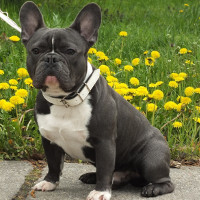
| The English Industrial Revolution replaced many workers with machines. By the 1850s and 1860s, lacemakers were out of work. English lacemakers began moving to France to find work. They brought their dogs, which were small, miniature Bulldogs. Eventually bred with the native French Bulldog, today's French Bulldog was born. In 1885, a breeding program for American French Bulldogs was launched. Once in America, the breed became popular with society women. The breed was shown at the Westminster Kennel Club dog show in 1896. The only winners in the French Bulldog group were those with "pink ears", not breed members with "erect bat ears". The ladies of the society disagreed with the judge's decision. They formed the French Bulldog Club of America, which went on to create the breed standard. The "erect bat ear" was the correct type. In the early 20th century, the breed was owned by the Rockefeller family and the J.P. Morgan family. The American Kennel Club recognized the breed in 1898. By 1906, the French Bulldog was the 5th most popular dog breed in America. | ||
 |
||
| Standard of the French Bulldog | ||
A little of the American Staffordshire Terrier |
||
| The history of the Staffordshire begins in the 19th century in the English town of Staffordshire, where numerous breeders crossed the Bulldog and various Terriers to produce a very muscular, active dog they called the Staffordshire Bull Terrier. This breed was imported to the United States, where breeders increased its weight, giving it a more powerful head. This led to a split in the breed, the name American Staffordshire being given to the American breed. When dog-fighting sports were banned in the 1900s, the result was the development of two strains of dogs: a show strain called the American Staffordshire and the unexhibited strain labeled the Pit Bull Terrier. The American Staffordshire Terrier was recognized by the American Kennel Club in 1936, and its talents include companionship, guarding, police work and agility skills. | ||
 |
||
| Standard of the American Staffordshire Terrier |
Appearance of the Frenchie Staff |
| The Frenchie Staff is inspired by its parents' stocky, solid, small-to-medium-sized breeds. The head is often fairly square and blocky, with a rounded skull. The muzzle is of medium length, with scissor-like teeth. The eyes are dark, round and very expressive. They are often set low and wide apart. The ears are often set high on the head and held upright or half-pointed. The tail is often shorter than the length of the body, ending in a tapering tip. These dogs are sturdy for their size, with short, sturdy, rounded legs, and an attractive appearance and nature. Size varies according to the genetics of the parents they inherit most from. |
Temperament of the Frenchie Staff |
| Frenchie Staffs are intelligent, happy, outgoing, stable and confident. They are curious and lively, and great pets. Their aim is to please, and they are very obedient, although they can also have a touch of stubbornness that requires patient and firm but caring handling to overcome. The Frenchie Staff needs a strong pack leader, an owner who is experienced with dogs and understands their needs. These dogs don't like to be ignored; they're part of the family and want to be involved in everything that's going on. Although they are not generally aggressive dogs, they are brave and will fight if provoked. They protect the owner and his property. These dogs need socialization when they're very young, they need to be fully immersed with people and other dogs to understand the standards of behavior expected of them. Dedicated and lovable, the Frenchie Staff is a new breed of dog making positive inroads into people's hearts. |
Needs and activities of the Frenchie Staff |
| Frenchie Staffs have a lot of energy, which they need for running and walking. A daily walk is vital to prevent boredom turning into habits that are hard to break. They'll be happy to accompany you for a walk around the neighborhood, to the beach or even to jog alongside your bike. Everything is an adventure for them. These dogs will live quite happily in an apartment if they get the daily dose of exercise. It's advisable to keep the dog on a leash when you go out, as he has a strong hunting instinct. For play, ball retrieving, tug-of-war and other challenging games will suit your Frenchie Staff perfectly. |
Maintenance of the Frenchie Staff |
| With a short coat that varies in texture from fine to thick, and a soft, shiny appearance, the Frenchie Staff is an easy dog to care for. A good brushing twice a week with a firm bristle brush is all it takes to remove loose hair. Your dog only needs a bath when necessary, otherwise a dry shampoo and brushing will keep him looking his best. While you're in grooming mode, pay attention to Frenchie Staff's ears, wiping them with a soft, damp cloth to remove debris and look for any signs of infection. Follow this with a pair of nail clippers, then brush your dog's teeth. |



 English (United Kingdom)

Comments