
 |
German Longhaired Sprointer |
|
He is not recognized by the F.C.I. |
Origin |
Germany <> Great Britain -> U.S.A. | |
Translation |
Francis Vandersteen |
A brief presentation of the German Longhaired Sprointer |
| The German Longhaired Sprointer is the result of crossing the German Longhaired Spaniel with an English Springer Spaniel, two enthusiastic hunting dogs with different specialties. These dogs are friendly, high-energy animals with quick, adaptable minds. These muscular yet elegant dogs are highly sensitive to the needs of their families, and have the stamina to hunt, spring and retrieve game for hours on end. This enthusiastic, optimistic animal is quite good with children of all ages, although they can be a little too exuberant for the little ones, especially before the dog has matured. This hybrid likes to be close to its family at all times, and can be prone to separation anxiety if left alone for too long. |
History of the German Longhaired Sprointer |
| The German Longhaired Sprointer is a specific cross between the German Longhaired Pointer and the English Springer Spaniel, two optimistic and friendly hunting dogs, one from Germany and the other from England. |
A little of the German Long Haired Pointing Dog |
||
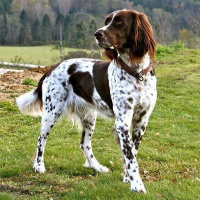
| The German Long Haired Pointing Dog began its development in Germany in the mid-1800s as a pointing dog. During the dog's initial development, breeding records were irregular, but it is thought that local hunting dogs were mixed with English Setters and Pointers as well as other dogs. Although many varieties of dog color existed when the breed was first developed, breed standards established in 1879 specified that this breed should sport a brown or brown and white coat. The breed was developed at around the same time as the German Shorthaired and Wirehaired varieties, which were only recognized as a foundation strain by the American Kennel Club in 2010, and have yet to be recognized as a separate breed. | ||
 |
||
| Standard of the German Long Haired Pointing Dog | ||
A little of the English Springer Spaniel |
||
| Spaniels like the English Springer Spaniel are classified as hunting dogs, but they have been helping hunters long before the invention of the rifle. Initially, these dogs were bred to chase game from deep brush for bowhunters and, in some cases, to retrieve birds from where they had fallen. Early Spaniels were divided into two groups according to where they worked, Water Spaniels and Land Spaniels. At some point in the 1600s, a distinction was made between types of land Spaniel and they began to be classified as Springer or Cocker Spaniel, based entirely on the size of the dog. Smaller Spaniels were used to flush out both game and game birds like woodcock, giving them the name Cocker Spaniel, and the biggest Spaniels, all those weighing over 13 kilos, were given the name English Springer Spaniel for their ability to bring game out for hunting. It wasn't until 1902 that the Kennel Club of England granted Springer and Cocker Spaniels separate breed status, and the American Kennel Club recognized them shortly afterwards in 1910. | ||
 |
||
| Standard of the English Springer Spaniel |
Appearance of the German Longhaired Sprointer |
| The German Longhaired Sprointer is an athletic animal, with a well-built but not heavy head, featuring a slightly rounded skull and a long, strong, rather square-shaped muzzle. They generally have oval-shaped brown eyes, although hazel can occasionally appear, and long, rounded ears that sit low on the skull and hang well beyond the jaw. These dogs should have particularly well-developed, muscular hips and thighs, and a feathered tail that they carry horizontally behind them. Their coat is double-layered, consisting of a short, dense undercoat that is protected by a more weather-resistant outer layer. The glossy outer layer can be smooth like the longhaired pointer or slightly shorter and wavy like the English Springer Spaniel, and will usually have feathering on the ears, legs and feet, as well as on the tail. |
Temperament of the German Longhaired Sprointer |
| This crossbreed is an enthusiastic, intelligent dog, always on the trail of the next best thing. They are very loyal to their families, although they may tend to be more loyal to a particular family member. Their devotion can sometimes cross the line from loyalty to attachment, and separation anxiety can develop if left alone for too long. German Longhaired Sprointer are generally tolerant of children of all ages, although they can be too noisy for very young children, however, their reactions to other dogs can vary somewhat from dog to dog, some being very unreservedly social and others more cautious with new dogs or situations. Consistent early socialization and training will help steer this gregarious dog in the right direction, although some aggression with dogs of the same sex can be particularly persistent. They have a fairly high prey drive and tend to chase smaller animals, although early socialization can also help with this trait. |
Needs and activities of the German Longhaired Sprointer |
| German Longhaired Sprointer are lively, active dogs that require fairly long exercise programs, usually at least 90 to 120 minutes a day, although most would be more than happy to do so for longer. In addition to walking and jogging, this hybrid can benefit from alternative exercises such as hunting and tracking drills, swimming and endless games of fetch. This crossbreed not only has an active body, but also an active mind, and mental stimulation is essential to prevent the development of noisy or destructive habits. This hybrid doesn't like confinement and is happiest with plenty of space to run and hunt in safety, so it's not generally suited to apartment living. |
Maintenance of the German Longhaired Sprointer |
| Bath maintenance is recommended about every six to eight weeks for the German Longhaired Sprointer and English Springer Spaniel, and the same would be true for their offspring, unless they become dirty or muddy. However, German Longhaired Sprointer tend to get dirty and muddy more often than most dog breeds, as they like to wade in puddles and are used to chasing things in the mud. Fortunately, they are not prone to dry skin problems if frequent bathing becomes necessary. They should be brushed several times a week to control shedding and avoid tangles and mats, especially the feathered areas around the ears, chest, legs and belly, as these areas are prone to tangles and need to be carefully inspected. |



 English (United Kingdom)

Comments