
 |
German Hund Pointer |
|
He is not recognized by the F.C.I. |
Origin |
Germany -> U.S.A. | |
Translation |
Francis Vandersteen |
A brief presentation of the German Hund Pointer |
| The German Hund Pointer is a small to medium-sized hybrid, the result of a deliberate cross between the German Wirehaired Pointer, an excellent all-round hunting dog used on land and water for pointing, flushing and retrieving game, and the Dachshund, a small but tenacious German Terrier developed for chasing and killing badgers in their dens. Its exercise requirements are fairly average, on the order of 60 to 90 minutes a day, but its grooming routine is quite simple. While this hybrid may not be the best choice for apartment dwellers or households with young children, it can be an ideal choice for those who want a fairly compact, independent and perceptive exercise companion. |
History of the German Hund Pointer |
| The German Hund Pointer is a designer dog, an intentional cross between two German breeds: the German Wirehaired Pointer, a pointing Retriever developed in the mid-1800s, and a badger-hunting Terrier developed in the 1600s, the Dachshund. |
A little of the German Wirehaired Pointer |
||
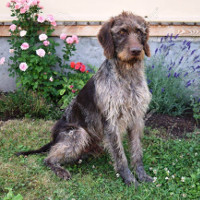
| The German Wirehaired Pointer was developed in the 1800s as an all-round hunter, capable of flushing, pointing and retrieving game with skill on land and water, and enduring long days in the field in changing conditions and over rough terrain. Among the dogs that have been combined to develop this breed are pointers, Foxhounds and Poodles. The breed was introduced to the United States in the 1920s and recognized by the American Kennel Club in 1959. | ||
 |
||
| Standard of the German Wirehaired Pointer |
A little of the Dachshund |
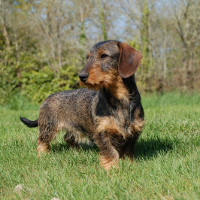
| The Dachshund was developed in Germany to hunt and kill burrowing animals, especially badgers. To do its job effectively, the Dachshund had to be small enough to slip into badger tunnels, brave enough to chase an angry badger and tough enough to take out the badger once it arrived. Although the majority of today's Dachshunds are kept as pets, they still have the same courage and tenacity as their ancestors. The first Dachshund clubs began to form in the late 1800s, and only eleven of these sturdy little dogs were registered with the American Kennel Club in 1885. The breed quickly gained popularity throughout the United States and, by 1914, was one of the ten most popular breeds. |
 |
| Standard of the Dachshund |
Appearance of the German Hund Pointer |
| The German Hund Pointer is a mixture of two dog breeds that are quite different from each other in structure, and their offspring can be very varied, even within the same litter. They are generally longer than they are tall, although for dogs that look more like the Wirehaired Pointer than the Dachshund, the difference may be less noticeable. This hybrid may have the long, straight legs of a pointing dog or the short, slightly curved legs of a Dachshund, or anything in between. Its skull is long, broad and slightly arched, with either the long, square muzzle of the Pointer or the long, tapering muzzle of the Dachshund. It has almond-shaped or oval brown eyes and medium-length rounded ears that fall to the sides. Its coat is double-layered, with a very short, soft undercoat and a topcoat that is generally medium-length and harsh, although some German Hounds may have a short, smooth or medium-length, silky topcoat. |
Temperament of the German Hund Pointer |
| The German Hund Pointer is still a fairly recent hybrid, and can take all or part of its temperament from any of its parent breeds. The German Wirehaired Pointer is an extremely athletic animal that needs to keep busy, otherwise it risks becoming noisy and destructive, but it is also rather serious and, although it can clown on occasion, this is an uncommon phenomenon. The Dachshund is described as lively and courageous; it tends to clown much more often than the Wirehaired Pointer and is content with less exercise. While this cross should play well with older children, it is often not as suitable a companion for younger children. Individuals with the German Wirehaired Pointer temperament can be too boisterous for toddlers, and those with the Dachshund temperament can be jealous or possessive. With plenty of extra exercise, they can adapt somewhat to apartment living, but in general they are too energetic and noisy to be good housemates. |
Needs and activities of the German Hund Pointer |
| While the German Wirehaired Pointer is an extremely active dog, the Dachshund doesn't need as much exercise to stay healthy and fit. The German Hund Pointer needs at least an hour to an hour and a half of vigorous exercise a day to stay in top shape, and he can do this in a number of ways. Not only are leash walks appreciated, but this crossbreed can also enjoy and excel in tracking and retrieving exercises, agility training and swimming. This particular hybrid is not well suited to apartment living and is much happier in a home with a fenced garden. It's important not to leave this dog alone in the yard for long periods, as it can quickly dig under an average fence in pursuit of prey. |
Maintenance of the German Hund Pointer |
| The grooming needs of this hybrid are fairly undemanding. A bath is rarely necessary, unless the dog gets dirty and, in most cases, brushing is enough a few times a week to keep the coat shiny and healthy. If the German Hund Pointer follows the wirehaired German Pointer side of its heritage, it may start life with a silky or woolly coat rather than a wirehaired one. This puppy coat has a greater tendency to tangle and needs to be brushed more often than the harsh coat of a wirehaired German Pointer or wirehaired German Dachshund. The German Hund Pointer can also receive its genes from a smooth-coated or long-coated Dachshund, giving it the option of being born with a short, smooth outer coat or a medium-length silky coat. |



 English (United Kingdom)

Comments