
 |
Great Cambrian Shepherd |
|
He is not recognized by the F.C.I. |
Origin |
France <> Great Britain -> U.S.A. | |
Translation |
Francis Vandersteen |
A brief presentation of the Great Cambrian Shepherd |
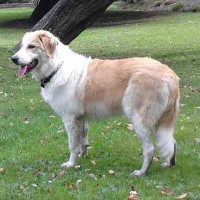
| Great Cambrian Shepherds are dogs with a strong presence, both literally and figuratively, and a complex personality. They are fairly active animals that enjoy spending time with their owners. Great Cambrian Shepherds generally live to 12 years of age, weighing between 27 and 52 kilos. At maturity, they can measure between 61 and 81 centimeters. Great Cambrian Shepherds have long, full coats that come in tricolored variations of white, black and brown, or red with merle pattern or markings. They can also be predominantly beige with badger, gray, reddish-brown or tan markings. This giant crossbreed is highly unusual and rarely seen due to the rarity of its parent breed, the Welsh Shepherd Dog. The Great Cambrian Shepherd, like the Welsh Shepherd Dog, is not recognized by the American Kennel Association. |
History of the Great Cambrian Shepherd |
| The Great Cambrian Shepherd takes its name from one of its parent breeds, the Pyrenean Mountain Dog, and from the homeland of its other parent breed, the Welsh Shepherd Dog, which comes from "Cambria", the medieval name for Wales. The mating of these two parent breeds is unusual, but the result is an alert, eager and loyal companion. The Great Cambrian Shepherd, like its Welsh parent, is not recognized by the AKC and still varies considerably in temperament and appearance due to unregulated breeding guidelines for the hybrid. |
A little of the Pyrenean Mountain Dog |
||
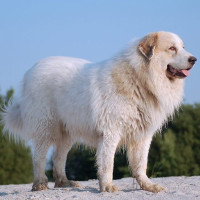
| Its relative, the Pyrenean Mountain Dog, is closely related to the Kuvasz and is thought to have originated in Central Asia or Siberia. The breed eventually migrated to Europe and settled in the mountainous region between France and Spain known as the Pyrenees Mountains. In fact, evidence of Pyrenean Mountain Dogs in Europe dates back to the Bronze Age between 1800 and 1000 BC. In Europe, this breed was used for sheep breeding until the 1600s, when it was declared the royal dog of France. They were then used as guard dogs for the French elite and began to attract international attention. Canada began importing Pyrenean Mountain Dogs to breed with other large dogs, and the USA soon followed the import trend in the 1800s. In 1933, after decades of shipping to North America, Pyrenean Mountain Dogs were recognized by the American Kennel Club. | ||
 |
||
| Standard of the Pyrenean Mountain Dog | ||
A little of the Welsh Shepherd Dog |
||
| The Great Cambrian Shepherd's other relative, the Welsh Shepherd Dog, originates from Wales, where it has worked on farms for centuries. As their name suggests, they were originally bred to herd sheep and other livestock. In modern times, however, it has been largely replaced by more popular Border Collies. It has also been bred with the Border Collie, making the Welsh Shepherd Dog breed extremely rare outside its native Wales. Although closely related to other types of Collies and Shepherd mixtures recognized by the AKC, the Welsh Shepherd Dog is not currently on its list of purebred dogs. | ||
 |
||
| Presentation of the Welsh Shepherd Dog |
Appearance of the Great Cambrian Shepherd |
| The Great Cambrian Shepherd is a large but agile animal. They generally weigh between 27 and 52 kilos. At maturity, the Great Cambrian Shepherd measures between 61 and 81 centimeters. It has a robust, muscular build, flat back and broad chest. Its coat is ample and comes in many combinations of black, white, red and brown, with a possible merle pattern and various markings. The coat is generally straight, thick and rough. Some Great Cambrian Shepherds are predominantly one color, usually beige or brown, due to the influence of Pyrenean Mountain Dogs. This breed also has a dense, soft undercoat, which is generally a lighter base color. Their ears are medium-sized, erect and triangular, with a slightly rounded tip. These dogs generally inherit the alert, round eyes and tapered muzzle of the Welsh Shepherd Dog. |
Temperament of the Great Cambrian Shepherd |
| The temperament of this hybrid depends on the behavioral traits inherited from the two parent breeds, with some more closely resembling Pyrenean Mountain Dogs and others more closely resembling Welsh Shepherd Dogs. In general, however, the Great Cambrian Shepherd is known to be a host of paradoxes. It is active yet calm, alert yet patient, and playful yet reserved. These seemingly contradictory traits make the Great Cambrian Shepherd a good companion dog for families who like variety. This breed may, however, be wary of strangers at first. However, once the Great Cambrian Shepherd warms up, it can be very friendly with those outside its immediate circle. This dog generally gets along with other animals and can live comfortably in a multi-pet household, due to its large size, however, it must be supervised around very small or young companions. Great Cambrian Shepherds are not an aggressive breed, but they will be vocal if they are unsure of themselves or anticipate a threat. Finally, this breed prefers to play outside in the cool rather than indoors. Indoors, they prefer to lounge around the house with family members or other pets. |
Needs and activities of the Great Cambrian Shepherd |
| Great Cambrian Shepherds have plenty of energy and need daily exercise to stay healthy. This breed prefers long walks and hikes in cool conditions with their owners. In fact, the Great Cambrian Shepherd thrives in colder climates due to its thick coat. Depending on the dog's individual personality, it may even enjoy the occasional romp in the dog park. If a Great Cambrian Shepherd inherits the playful side of the Welsh Shepherd Dog, it may also try to play inside the house, Pyrenean Mountain Dogs don't tend to do so. Beyond that, he loves to rest indoors and spend time with family members. Because of their size, Great Cambrian Shepherds need plenty of space, both indoors and out, and are best suited to large homes in suburban or rural areas. |
Maintenance of the Great Cambrian Shepherd |
| Great Cambrian Shepherds are constantly moulting, especially as the seasons change. Regular brushing, every two weeks or so, with a pin or smoother brush can control shedding to some extent. However, brushing is also necessary to remove the inevitable mats and tangles in this dog's long, full coat. Great Cambrian Shepherds need a monthly bath, but should have their teeth brushed daily and their nails trimmed once or twice a month. Owners may also consider using a dental rinse in their dog's water to help prevent dental and gum infections. Beyond that, Great Cambrian Shepherds should also have their ears checked regularly for wax or moisture build-up. |



 English (United Kingdom)

Comments