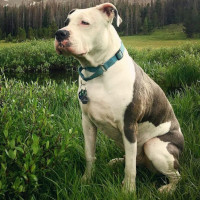
Great Danebull

He is not recognized by the F.C.I.

Origin
Germany <> U.S.A. -> U.S.A.
Translation
Francis Vandersteen

A brief presentation of the Great Danebull

When it comes to Great Danebulls, don't judge a book by its cover. These big, fierce dogs are gentle, affectionate pets. They are moderately active and love to be showered with attention. Great Danebulls can live up to 14 years and weigh between 27 and 41 kilos. At maturity, they can measure between 61 and 71 centimeters. Great Danebulls have a short, dense, smooth and glossy coat that comes in plain versions or multicolored combinations of black, white, blue, fawn, bronze, liver, red, white and brown with the possibility of harlequin, mantle, sable, merle or brindle patterns. In terms of specific large cross breeds, this one is well known but not very popular. Yet Great Danebulls can vary considerably in appearance and temperament. As a result, they are not yet recognized by the American Kennel Club (AKC).

History of the Great Danebull

The Great Danebull takes its name from its parent breeds: the Great Dane and the American Pit Bull Terrier, both of which have long and interesting histories. The mating of these two parent breeds has produced a large, affectionate dog that has probably been bred since the mid-to-late 1900s. It's important to note, however, that Great Danebulls are not recognized by the AKC and breeders should be thoroughly researched if you're considering buying a puppy from them.


A little of the Great Dane

        
The Great Dane is thought to have existed since 3000 BC. Historians speculate that its population spread as a result of Assyrian traders bringing the dog back and forth along the routes to Rome and Greece. Since then, the Great Dane has had many names. In the early days, the breed was rightly called the "Boar Hound" because of its talent for hunting wild boar. In the 16th century, Great Danes were known as English Dogges in England and Kammerhunde or "chamber dogs" in Germany. In the 17th century in Denmark and France, they became known as the "Great Dane", which later became the "Great Danish Dog", and even later the Great Dane. Despite its Danish namesake, the Great Dane was refined and stabilized through the efforts of German breeders. Great Danes finally gained popularity in North America in the 1800s, and the Great Dane Club of America was founded in 1889.
Standard of the Great Dane

A little of the American Pit Bull Terrier

The Great Danebull's other relative, the American Pit Bull Terrier, became popular in England in the early 1800s, where it was bred for dog fighting. Originally called the "Bull and Terrier", it was probably an Old English Bulldog and Terrier mix. Eventually, dogfighting was banned and the breed migrated to the USA, where American breeders sought to increase the weight and size of the dog's head. This variety became known as the Pit Bull Terrier and was recognized by the AKC in 1936. In 1972, it was renamed the American Shaffordshire Terrier, although the Pit Bull moniker remained.
Presentation of the American Pit Bull Terrier

Appearance of the Great Danebull

The Great Danebull is a fierce-looking animal that resembles a larger, longer American Pit Bull Terrier with Great Dane facial features. They are large, muscular dogs, weighing between 27 and 41 kilos. At maturity, Great Danebulls measure between 61 and 71 centimeters. Their coats are short, dense, smooth and glossy. There are many color varieties common to both parent breeds. These include a solid or combinations of black, white, blue, fawn, bronze, liver, red, white and brown with the possibility of harlequin, mantle, sable, merle or brindle patterns. They have rectangular heads and dark, deep-set eyes, like a Great Dane, and half-pricked or pink ears, like an American Pit Bull Terrier. This breed also has a broad, strong chest, and round, compact feet with high, arched toes.

Temperament of the Great Danebull

Despite the Great Danebull's intimidating appearance, it's a gentle, affectionate breed. It has even been known to snuggle up to people like a little companion dog. Likewise, the Great Danebull is extremely friendly to other animals and does well in multi-pet households. In fact, this breed is prone to separation anxiety if it doesn't receive enough attention and affection from those around it. What's more, its people-oriented disposition makes it eager to please. This trait, together with its high level of intelligence, makes Great Danebulls very easy to train. Yet this breed is no child's play. It has a strong protective instinct and will speak up if it perceives a threat. Great Danebulls need only a moderate amount of exercise, so it's not extremely important for them to have constant access to a large yard; frequent trips to the park or other outdoor spaces are sufficient. Because of their size, however, these dogs may do best in larger homes.

Needs and activities of the Great Danebull

Great Danebulls have an average amount of energy and require only moderate daily exercise. They enjoy short walks, romping in the park and play sessions with furry friends for 20 to 40 minutes a day. Beyond that, Great Danebulls love to lie around the house, stretched out in sunspots or close to their owners. This breed is suitable for all types of environment, although your hybrid shouldn't be over-exercised in extremely hot or cold conditions. What's more, the Great Danebull can adapt to any type of living environment as long as its needs for exercise and affection are diligently met.

Maintenance of the Great Danebull

Great Danebulls generally require only occasional light grooming. They shed moderately throughout the year and can benefit from weekly brushing, although this is not necessary. Grooming is a good way to bond with your pet, and your hybrid may enjoy the process. Great Danebulls are primarily domestic dogs, so they only need to be bathed once a month. They should, however, have their teeth cleaned daily. Beyond that, Great Danebulls should have their nails trimmed at least once a month and their ears checked regularly for wax build-up and debris to avoid infection. Note that this breed is not hypoallergenic and not suitable for owners of dogs with allergies.

Comments

Latest page updates

  • Telomian

    Telomian He is not recognized by the F.C.I. Origin Malaysia Translation Francis Vandersteen A brief presentation of the Telomian The Telomian is a very rare breed of dog, and the only one native to Malaysia to have been bred outside the country. They were originally bred by the indigenous people of Malaysia to combat parasites such as snakes, rats,...
  • King Wheaten -- Cavalier King Charles Spaniel X Irish Soft Coated Wheaten Terrier

    King Wheaten He is not recognized by the F.C.I. Origin Great Britain <> Ireland -> U.S.A. Translation Francis Vandersteen A brief presentation of the King Wheaten The King Wheaten is a small dog with a heart this big and a playful disposition. Borrowing the energy and soft-coated waves of the Irish Soft Coated Wheaten Terrier and the size and...
  • Spanierd -- English Springer Spaniel X German Shepherd

    Spanierd He is not recognized by the F.C.I. Origin Great Britain <> Germany -> U.S.A. Translation Francis Vandersteen A brief presentation of the Spanierd The Spanierd is a hybrid dog. Its parent breeds are the English Springer Spaniel and the German Shepherd. They have an affable personality. He's known for entertaining family and friends with his...
  • Alaskan Goldenmute -- Alaskan Malamute X Golden Retriever

    Alaskan Goldenmute He is not recognized by the F.C.I. Origin U.S.A. <> Great Britain -> U.S.A. Translation Francis Vandersteen This breed is also known as Alaskan GoldenGoldenmuteAlaskan Gold Retriever     A brief presentation of the Alaskan Goldenmute The Alaskan Goldenmute is a descendant of two great dog breeds: the Alaskan Malamute and the Golden...
  • French pointing dog Pyrenean type

    French pointing dog Pyrenean type FCI standard Nº 134 Origin France Translation Mrs. Peggy Davis Group Group 7 Pointing Dogs Section Section 1.1 Continental Pointing Dogs « Braque » Type Working With working trial Acceptance on a definitive basis by the FCI Tuesday 18 January 1955 Publication of the official valid standard Tuesday 01 August 2023 Last...
  • French pointing dog Gascogne type

    French pointing dog Gascogne type FCI standard Nº 133 Origin France Translation Mrs. Peggy Davis Group Group 7 Pointing Dogs Section Section 1.1 Continental Pointing Dogs « Braque » Type Working With working trial Acceptance on a definitive basis by the FCI Monday 17 January 1955 Publication of the official valid standard Tuesday 01 August 2023 Last...
  • Vucciriscu

    Vucciriscu He is not recognized by the F.C.I. Origin Sicily Translation Francis Vandersteen En français, cette race se dit Vucciriscu Diese Norm ist in deutscher Sprache sichtbar Vucciriscu En español, esta raza se dice Vucciriscu In het Nederlands, wordt dit ras gezegd Vucciriscu This breed is also known as Sicilian Vucciriscu Sicilian Butcher...

© 2026 Groupe Milouchouchou ASBL. Tous droits réservés. En savoir plus

Protected by Copyright01
We use cookies

We use cookies on our website. Some of them are essential for the operation of the site, while others help us to improve this site and the user experience (tracking cookies). You can decide for yourself whether you want to allow cookies or not. Please note that if you reject them, you may not be able to use all the functionalities of the site.

Ok