 |
Griffichon |
|
He is not recognized by the F.C.I. |
Origin |
Belgium <> France / Belgium -> U.S.A. | |
Translation |
Francis Vandersteen |
A brief presentation of the Griffichon |
| The Griffichon is a small, specific crossbreed that is a mixture of the Bichon frise and the Brussels Griffon. Their coat is generally soft and curly like the Bichon frise, but can be shaggy and rough if there's more Brussels Griffon in its blood. They generally weigh around 6 kilos and average around 28 centimeters in height. Although they can be energetic dogs, they're just as happy to stay at home with you and watch TV. They can be shy around big dogs, but they'll do just fine if socialized early. The Griffichon is intelligent and easy to train, even if it can sometimes be stubborn. |
History of the Griffichon |
| The Griffichon has a limited documented history as a new hybrid breed, and we need to look at its parental history: the Brussels Griffon and the Bichon frise. |
A little of the Brussels Griffon |
||
| The Brussels Griffon originated in Belgium in the 1800s and was used as a ratter to keep stables free of vermin. This breed comes in two varieties, which are the rough-coated and smooth-coated types. They take their name from the city where they were first born, namely Brussels, Belgium. Their ancestor, the Griffon d'Ecurie, was a stable dog in the early 19th century that was a favorite of cab drivers and farmers. Later in the century, they were bred with the English Toy Spaniel, Pug, Affenpinscher and Yorkshire Terrier. They are thought to have obtained their size and rough coat from the Affenpinscher, the facial quality of the Pug and the large eyes of the English Toy Spaniel. The Yorkshire Terrier contributed to the smooth coat of the Brussels Griffon. They have two other varieties, the Belgian Griffon and the Petit Brabancon, but they are not recognized by the American Kennel Club (AKC). The Brussels Griffon is the 97th most popular breed in the United States and was accepted by the AKC in 1910. | ||
 |
||
| Standard of the Brussels Griffon | ||
A little of the Bichon frise |
||
| The Bichon frise has existed in France since antiquity, and its name means "curly coat" because of its coat. They are related to the Barbet and the French Water Dog. There are four groups of Bichons, including the Tenerife Bichon, the Havanese Bichon, the Bolognese Bichon and the Maltese Bichon. The Coton de Tuléar is also thought to have links with these Bichons. They all originated in the Mediterranean and first arrived in Europe in the 14th century as royal companions to King Henri III. From the 1800s onwards, it was discovered that they had great intelligence and were charming performers. As a result, they were used in the circus as show dogs and companions for street performers. After the First World War, French breeders began to preserve the breed, and it was recognized by France's International Kennel Club (IKC) in 1933. For this reason, the Bichon Frise became popular in the United States and was accepted into the American Kennel Club. (AKC) in 1972. Today, the Bichon Frise is the 45th most popular dog in the United States. | ||
 |
||
| Standard of the Bichon frise |
Appearance of the Griffichon |
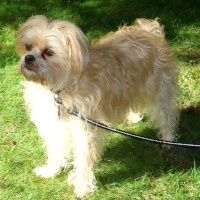
| The Griffichon derives most of its appearance from the Bichon frise, from the soft, curly coat to the hairy face, although they have an underbite like the Brussels Griffon. They have small heads with floppy, hairy ears, swollen tails, small brown eyes and black noses. They are always alert, happy and have a lively personality. Their dense coat is of medium length and is generally soft and curly, but can be shaggy and coarse if there is an abundance of Brussels Griffon in them. Their coat can be almost any color, including black, gray, brown, red, cream, fawn, blue, white or a mixture. |
Temperament of the Griffichon |
| This is a cheerful, energetic breed that loves to play with children and other pets. They can be excellent watchdogs, but tend to be a little too friendly with strangers, even if they are loyal to their family. They will protect their own if they feel threatened. Although they are easy to train in most cases, some can be difficult to train and you need to use positive reinforcement rather than physical punishment. With plenty of time and patience, you should be able to train them yourself without professional help. Griffichons like to be cuddled and will sleep curled up with you if allowed. They don't like to be left alone. |
Needs and activities of the Griffichon |
| The Griffichon is just as happy hanging around the house as running around the yard, but you need to make sure it gets at least 45 minutes to an hour of vigorous exercise every day. If your dog doesn't get enough activity, he can develop bad habits such as chewing on objects, barking excessively, scratching at doors and digging up the yard. Taking him for a walk twice a day and playing a long game of fetch is enough for most dogs. However, they also enjoy other sports such as Frisbee, jogging, swimming and hiking. |
Maintenance of the Griffichon |
| The coat of this hybrid requires a lot of maintenance and will tangle easily, so it needs to be brushed daily with a pin brush and a metal comb. Once a week, you should give it a thorough grooming and use a detangler and detangling spray. It's also common for Griffichon owners to have their dogs professionally groomed every few months to make them easier to care for. Once a week, you should clean his ears with cotton balls and a little water. Watch for redness or irritation, mites and wax build-up. You should also trim his nails if necessary and brush his teeth once a week with vet-approved toothpaste. |



 English (United Kingdom)

Comments