
 |
Irish Saint Terrier |
|
He is not recognized by the F.C.I. |
Origin |
Ireland <> Switzerland -> U.S.A. | |
Translation |
Francis Vandersteen | |
This breed is also known as |
Irish Bernard Terrier |
A brief presentation of the Irish Saint Terrier |
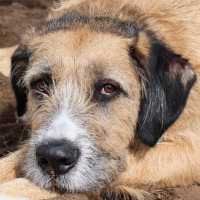
| The Irish Saint Terrier is a hybrid of the Irish Terrier and the Saint Bernard. Both parent breeds are excellent watchdogs, protecting both family and territory. The Irish Terrier has a reputation for not getting along with other dogs, and can transmit this trait. The Saint Bernard Dog is highly recognizable from films such as Beethoven, but it's important to remember that this dog is a giant-sized breed and, like the main character, has a propensity for clumsiness. While the Irish Saint Terrier won't be the exact size of the ST. Bernard, it will still be a large dog. It is likely to be gentle, but very protective. |
History of the Irish Saint Terrier |
| The origins of the Irish Saint Terrier are not fully known. To understand the history of the Irish Saint Terrier, a look at its parent breeds may shed some light on the history of the hybrid breed. |
A little of the Irish Terrier |
||
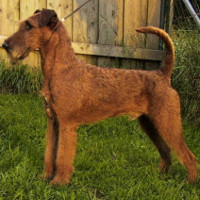
| The Irish Terrier is probably one of the oldest Terrier breeds. It can trace its roots back to Scotland and is thought to be the result of the breeding of a Black and Tan Terrier (a breed that is now extinct) and a larger, wheat-colored Terrier. In the 1880s, the Irish Terrier was one of the most popular breeds in the British Isles. It was introduced to America, where the breed was recognized by the American Kennel Club in 1885. During the First World War, the Irish Terrier was used as a messenger dog. Over time, the breed lost popularity. | ||
 |
||
| Standard of the Irish Terrier | ||
A little of the St. Bernard |
||
| The St. Bernard is a gentle giant bred for the cold of the Alps. Experts believe the breed was created when dogs native to Switzerland were crossed with Mastiff-type dogs brought to the region by the Romans. The dogs were first mentioned in the records of a monastery in 1703. It is thought that the dogs were guard dogs for the monastery estate. The dog was associated with the search and rescue of lost travelers near what is now the St. Bernard Pass, and this reputation has remained with the St. Bernard Dog. He has the physical characteristics that make him ideal for harsh winters and difficult mountain rescue missions. In fact, monastery records credit the St. Bernard with rescuing at least 2,000 travelers. Over time, the breed made its way to England, where in 1833, a man named Daniel Wilson suggested that the breed be called the St. Bernard. 1883 also saw the Saint Bernard Dog make its way to the USA, where Plinlimmon, a Saint Bernard Dog owned by an actor, became a leading show dog. The dog became very popular in the U.S.A. and is still a favorite breed today. | ||
 |
||
| Standard of the St. Bernard |
Appearance of the Irish Saint Terrier |
| The Irish Saint Terrier will be a large dog and its color will depend on the dominant parent breed. Most Saint Bernards are white with dark patches, but some have more red than white in their coat, so the Irish Saint Terrier may also have more red in its coat. There are two different coat types for Saint Bernards, a shorter, smooth but dense coat, and a longer, slightly wavy coat. This will also determine the appearance of the Irish Saint Terrier. The Irish Terrier parent has a double coat that helps protect it from various weather conditions. His hair is dense and stiff, but it grows so tightly together that you can't see his skin underneath. They come in a variety of colors: red, golden red, red wheaten or plain wheaten. Your Irish Saint Terrier should be quite unique in appearance, depending on the dominant parent breed. |
Temperament of the Irish Saint Terrier |
| The Irish Saint Terrier will probably be a blend of the personalities of its parent breeds. The Irish Terrier parent is not always known for getting along with other dogs. It is very protective of its family and tolerant of strangers. It's a good watchdog and barks. The same goes for the Saint Bernard Dog, which is not known for barking without reason. Because of these traits, the Irish Saint Terrier makes a good watchdog. The Irish Saint Terrier is normally good-natured and adaptable, however, it can also be curious and sometimes reckless. In addition, he has a propensity for clumsiness and is sometimes ill-advised for a family with young children, as he can inadvertently knock them over by moving his large body. However, he loves his family and would never intentionally hurt any of them. He is highly intelligent and easily trainable, although he can sometimes have a stubborn streak. Consistent training with positive reinforcement should take care of this. |
Needs and activities of the Irish Saint Terrier |
| The Irish Saint Terrier is a fairly active dog. It loves to play and will need daily exercise. This can take the form of outdoor play in a fenced yard or brisk walks with the owner. He could also benefit from a trip to the dog park where he can interact with other dogs and exhaust himself at the same time. Exercise is important for the Irish Saint Terrier, not only to keep him happy, but also to prevent weight gain. A home with a secure yard in which to play is ideal; he can adapt to an apartment, but will need plenty of time outdoors to be as happy as possible. |
Maintenance of the Irish Saint Terrier |
| Irish Saint Terriers have a tendency to shed, so they may require a good deal of maintenance. It should be brushed daily with a wire-bristle brush. Pay particular attention during the shedding season, when he may "blow" his coat (a trait he may inherit from the parent breed St. Bernard). Bathe him only when necessary. You should brush your Irish Saint Terrier's teeth at least three times a week, but if you want to prevent gum disease, brush every day. Periodically check his ears to make sure they're clean and free of moisture. He'll have strong nails, so trimming them regularly will keep him comfortable and make your job easier too. |



 English (United Kingdom)

Comments