
 |
Italian-Bichon |
|
He is not recognized by the F.C.I. |
Origin |
France / Belgium <> Italy -> U.S.A. | |
Translation |
Francis Vandersteen |
A brief presentation of the Italian-Bichon |
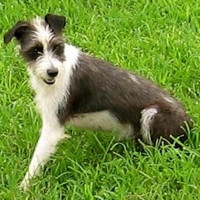
| A small guard dog, the Italian-Bichon is an alert, loyal and playful companion that can often be mistaken for a Jack Russell Terrier. Despite this misconception, the Italian-Bichon is in fact a cross between the Italian Sighthound and the Bichon frise. These small dogs have long, lean bodies, with sparsely distributed shaggy coats and may therefore require weekly brushing. Their origins are a bit of a mystery because, as with many creative breeds, these dogs have only recently appeared on the scene. They make excellent family companions and do well in all environments and climates. They will tolerate older children better than younger children who may not handle the dog well. |
History of the Italian-Bichon |
| The Italian-Bichon is a relatively new breed of specific crossbreed that bears almost a slight resemblance to a Jack Russell Terrier. These plucky little dogs were probably born in the early 2000s and the exact region of their origin is still unknown, but we can assume North America. |
A little of the Bichon frise |
||
| An ancient breed that has been around for over 2000 years, the Bichon frise is a small, fluffy breed of dog that probably originated in mainland Spain and the Canary Islands (particularly Tenerife), and was rediscovered in the 14th century. It is sometimes speculated that the breed we know today may also have a link to France, sharing common ancestors with the Barbet and Chiens d'eau. In the past, these dogs were the favorites of royalty and, when favor wore thin, they were the mascots of circus acts. Today, they are mainly considered pets. They were officially recognized by the American Kennel Club in 1972. | ||
 |
||
| Standard of the Bichon frise | ||
A little of the Italian Sighthound |
||
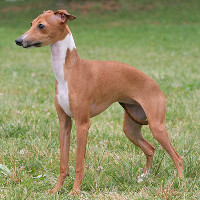
| Archaeological evidence suggests that the Italian Sighthound probably originated in Turkey and Greece over 2,000 years ago. It is thought that this lean little breed shared its ancestry with other breeds such as the Greyhound. They were originally bred and used to hunt small game and possibly vermin such as rats or mice. Today, they are mainly kept as pets. The Italian Sighthound was officially registered with the American Kennel Club in 1886. | ||
 |
||
| Standard of the Italian Sighthound |
Appearance of the Italian-Bichon |
| Slender, lean and compact best describe the Italian-Bichon's general appearance. These hybrids tend to have small but long, narrow faces, dark-brown eyes and ears that are mostly semi-floppy and thin. Their legs are long for a small dog, but are often straight and muscular. Their tails are long, smooth and sickle-shaped. Their coats can be a variety of colors, with markings such as apricot or red. They have sparse coats that are often shaggy or straight-looking. Their eyes are dark and express intelligence. |
Temperament of the Italian-Bichon |
| The Italian-Bichon is a quiet, shy dog when meeting new people, but is rather cheerful, playful and affectionate when surrounded by family members. These gentle dogs make good pets and do well with other pets such as other dogs and cats. They can be okay with children who respect their personal space and aren't too clingy. For the most part, however, these dogs are not aggressive, but may simply become irritated if disturbed by young children. These perceptive dogs are easy to train and highly intelligent. Always pleasant to be around, they love to be pampered and always want to be where you are. |
Needs and activities of the Italian-Bichon |
| The Italian-Bichon is a small, compact hybrid that can have bursts of energy throughout the day. These hybrids are best suited to temperate climates, but can do well in cooler climates if provided with a pet coat. The Italian-Bichon is a dog with average energy levels. They need to be walked at least 2-3 times a day for a minimum of 10-15 minutes each time. If your hybrid is young and more energetic, rolling it around for about 30 minutes should tire it out. These dogs are social and playful. To meet their energy needs, owners are advised to involve their dogs in play with toys and interaction with other dogs. These hybrids can become quite anxious and vicious if left alone for too long or if bored. Provide your pet with mental stimulation in the form of visits to dog parks, swimming and trick training. |
Maintenance of the Italian-Bichon |
| The Italian-Bichon is very different from having the long, dense coat of the Bichon frise. They are generally seen with finer coats, sparsely distributed over their entire bodies. If these dogs inherit more of a Bichon Frise coat and appearance, they may be hypoallergenic. Their coats can be brushed with a soft bristle brush at least once every 2 weeks, as they are not really prone to matting but can trap a lot of dirt in their fur. Their teeth should be cleaned weekly, ears monitored and cleaned regularly, and nails trimmed if not worn. Bathing should be done as needed, but more often than not, owners can choose to simply use a damp cloth to wipe off their dog's dirt. |



 English (United Kingdom)

Comments