Kerry Blue Schnauzer

He is not recognized by the F.C.I.

Origin
Ireland <> Germany -> U.S.A.
Translation
Francis Vandersteen

A brief presentation of the Kerry Blue Schnauzer

The Kerry Blue Schnauzer is a hybrid of a Kerry Blue Terrier and a Schnauzer. Energetic, intelligent and affectionate, this hybrid will make a wonderful addition to an active family. A dog of character, this compact hybrid is squarely built and sports a coat that requires moderate to high maintenance. Don't let that stop you, however, with proper training to allow the Kerry Blue Schnauzer to understand the rules of the house and know that he's not the boss, he's eager to learn all he needs to know. This high-energy dog will keep the whole family fit and happy to be included in yard work, hiking, errands and outings to the park.

History of the Kerry Blue Schnauzer

The Kerry Blue Schnauzer hybrid is a fairly new dog breed, the result of crossing the Kerry Blue Terrier and the Schnauzer. No information is available on the hybrid itself, but information is available on the parent breeds. The Kerry Blue Schnauzer hybrid itself is recognized by the American Canine Hybrid Club, Designer Breed Registry, Designer Dogs Kennel Club, Dog Registry of America and International Designer Canine Registry.


A little of the Kerry Blue Terrier

        
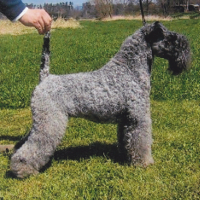
The Kerry Blue Terrier, also known as the Irish Blue Terrier, originated in Ireland and has a history shrouded in mystery, but it is thought to date back to the late 1700s or early 1800s, when this dog was bred for rat hunting, guarding livestock and guarding property and people. Today, it remains true to its breeding, excelling in obedience and agility, as an earth dog, hunting dog, retriever, shepherd and guard dog. It is accomplished in the show ring, in police and military duties as well as a loyal and protective companion and pet. The breed is thought to be descended from several other terrier breeds: Irish Terrier, Welsh Terrier, Bedlington Terrier and Soft Coated Wheaton Terrier. The breed was introduced to the show ring at the end of the 19th century, and rapidly grew in popularity around the world. The breed was first shown in America in 1922 when it appeared in the Westminster Kennel Club dog show at Madison Square Garden. The breed is recognized by the Kennel Club (England), the Irish Kennel Club, the American Kennel Club, the Kerry Blue Terrier Club of America and the United States Kerry Blue Terrier Club.
Standard of the Kerry Blue Terrier

A little of the Schnauzer

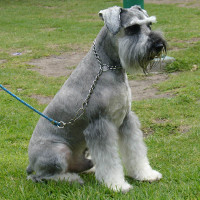
The Schnauzer originated in Germany and is thought to date back to the 1400s, being bred to be a working and hunting breed, specializing in killing rats and other vermin, guarding property and people, raising sheep and cattle and protecting market travelers. The breed arrived in North America in the early 1900s, but was not recognized until after the First World War. It was recognized by the American Kennel Club in 1904. Today, the Schnauzer is described as affectionate and spirited, and is often quite the clown in its family environment. Not only do they excel in obedience and agility, but also in conformation, search and rescue, therapy and as drug and bomb sniffers for law enforcement and military agencies.
Standard of the Schnauzer

Appearance of the Kerry Blue Schnauzer

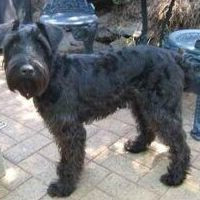
Since the Kerry Blue Schnauzer is a more recent hybrid, there's not much information available on the hybrid itself. Being a hybrid mix of the Kerry Blue Terrier and the Schnauzer, it can take on the appearance and traits of either of its parent breeds. As the Schnauzer parent breed is available in several sizes (miniature, standard and giant), the height of your hybrid can vary from 30.5 to 48 centimeters (height for miniature and standard versions) and weight from 5 to 18 kilos (based on miniature and standard version), depending on the size of the Schnauzer parent breed. As such, your hybrid will probably be a medium-sized dog with a muscular, robust body, sometimes described as squarely built, with a coat that could be medium or thick, wavy and blue-gray (from the Kerry Blue parent) or stiff (perhaps with the distinctive Schnauzer beard) and either black, black and silver or salt and pepper. Both parent breeds have distinctive bushy eyebrows, small dark eyes and sharp or even growling facial expressions at times. The Kerry Blue's long, well-balanced head or the Schnauzer's rectangular head will probably feature a strong muzzle, which can be blunt, with a large black nose with large nostrils. Your hybrid will probably have V-shaped ears set high on the forehead. The jaw is strong, the teeth will also be strong and the bite will be scissor-like or possibly overhanging. The tail is set high, carried straight and of moderate length, although tail docking can also be found. Your hybrid's feet are likely to be small, compact and round, with arched toes.

Temperament of the Kerry Blue Schnauzer

Your Kerry Blue Schnauzer hybrid is a mix of Kerry Blue Terrier and Schnauzer and may inherit some or all of the temperament and personality traits of one or both of the parent breeds. Your hybrid's parent breeds share many temperament traits: alertness, friendliness, intelligence, playful affection, gentleness, aggression, loyalty, protection, independence and liveliness. He'll be great with children but, because he has a strong hunting instinct, he may not be so friendly with the family cat. Early socialization with young children, older children and small animals will help modify this trait. They are excellent watchdogs, so expect them to be wary of strangers. To avoid inappropriate episodes of aggression with strangers, be sure to socialize them as early in life as possible. In addition, the Kerry Blue parent contributes a great deal of exuberance, while the Schnauzer is a little more laid-back in its energy levels. It's the Kerry Blue's exuberance that will prompt you to be more vigilant when your toddler plays with it, as your toddler can hurt it during normal, non-aggressive play. Both parent breeds contribute loyalty and affection to their human family, and they don't necessarily bond with one or two family members, but rather will be affectionate and loving with everyone.

Needs and activities of the Kerry Blue Schnauzer

The activity level of your Kerry Blue Schnauzer hybrid is moderate to high, meaning that if you're not interested in several long, brisk walks a day, this may not be the breed for you. He'll need brisk walks, jogging or playing and letting off steam in the yard to keep your hybrid in good physical shape. He's an intelligent dog who can be quite destructive if he's not also kept mentally active. Obedience and agility help in this area. Keeping your hybrid mentally challenged will also help modify canine hybrids that inherit the "edgy" tendencies that can be brought by the Schnauzer breed parent. The ability to train brought by both parent breeds falls into the difficult to fairly difficult category. Training problems have nothing to do with the animal's ability to be trained, but rather everything to do with the high intelligence levels of canines. Both parent breeds have the ability to read people and their environment and use this information to manipulate people and things as they wish. This trait becomes a huge stumbling block when training your Kerry Blue Schnauzer hybrid, but it can be overcome. Firm consistency combined with positive reinforcement, encouragement and tasty snacks will help determine who's in charge. Once this obstacle has been overcome, training will become easier.

Maintenance of the Kerry Blue Schnauzer

The Kerry Blue Schnauzer hybrid is the product of mixing the Kerry Blue Terrier with the Schnauzer and, as such, may inherit the coat of one or both parent breeds. This hybrid will probably require moderate to high maintenance to keep the coat clean and healthy. This means daily brushing with a stiff bristle brush and regular bathing every 4 to 6 weeks. Your Kerry Blue Schnauzer hybrid inherits a minimal shedding trait from both parent breeds, as well as a hypoallergenic component, making it an excellent family addition for families with members suffering from respiratory difficulties, allergies and asthma. His teeth and ears need to be checked and cleaned regularly to avoid ear infections and periodontal infections, which are known to cause tooth loss over time. Addressing these areas on a weekly basis should keep him in good health. Regular home assessments of the eyes and areas around the eyes, cleaning as necessary, will also help keep your hybrid healthy and beautiful.

Comments

Latest page updates

  • Telomian

    Telomian He is not recognized by the F.C.I. Origin Malaysia Translation Francis Vandersteen A brief presentation of the Telomian The Telomian is a very rare breed of dog, and the only one native to Malaysia to have been bred outside the country. They were originally bred by the indigenous people of Malaysia to combat parasites such as snakes, rats,...
  • King Wheaten -- Cavalier King Charles Spaniel X Irish Soft Coated Wheaten Terrier

    King Wheaten He is not recognized by the F.C.I. Origin Great Britain <> Ireland -> U.S.A. Translation Francis Vandersteen A brief presentation of the King Wheaten The King Wheaten is a small dog with a heart this big and a playful disposition. Borrowing the energy and soft-coated waves of the Irish Soft Coated Wheaten Terrier and the size and...
  • Spanierd -- English Springer Spaniel X German Shepherd

    Spanierd He is not recognized by the F.C.I. Origin Great Britain <> Germany -> U.S.A. Translation Francis Vandersteen A brief presentation of the Spanierd The Spanierd is a hybrid dog. Its parent breeds are the English Springer Spaniel and the German Shepherd. They have an affable personality. He's known for entertaining family and friends with his...
  • Alaskan Goldenmute -- Alaskan Malamute X Golden Retriever

    Alaskan Goldenmute He is not recognized by the F.C.I. Origin U.S.A. <> Great Britain -> U.S.A. Translation Francis Vandersteen This breed is also known as Alaskan GoldenGoldenmuteAlaskan Gold Retriever     A brief presentation of the Alaskan Goldenmute The Alaskan Goldenmute is a descendant of two great dog breeds: the Alaskan Malamute and the Golden...
  • French pointing dog Pyrenean type

    French pointing dog Pyrenean type FCI standard Nº 134 Origin France Translation Mrs. Peggy Davis Group Group 7 Pointing Dogs Section Section 1.1 Continental Pointing Dogs « Braque » Type Working With working trial Acceptance on a definitive basis by the FCI Tuesday 18 January 1955 Publication of the official valid standard Tuesday 01 August 2023 Last...
  • French pointing dog Gascogne type

    French pointing dog Gascogne type FCI standard Nº 133 Origin France Translation Mrs. Peggy Davis Group Group 7 Pointing Dogs Section Section 1.1 Continental Pointing Dogs « Braque » Type Working With working trial Acceptance on a definitive basis by the FCI Monday 17 January 1955 Publication of the official valid standard Tuesday 01 August 2023 Last...
  • Vucciriscu

    Vucciriscu He is not recognized by the F.C.I. Origin Sicily Translation Francis Vandersteen En français, cette race se dit Vucciriscu Diese Norm ist in deutscher Sprache sichtbar Vucciriscu En español, esta raza se dice Vucciriscu In het Nederlands, wordt dit ras gezegd Vucciriscu This breed is also known as Sicilian Vucciriscu Sicilian Butcher...

© 2026 Groupe Milouchouchou ASBL. Tous droits réservés. En savoir plus

Protected by Copyright01
We use cookies

We use cookies on our website. Some of them are essential for the operation of the site, while others help us to improve this site and the user experience (tracking cookies). You can decide for yourself whether you want to allow cookies or not. Please note that if you reject them, you may not be able to use all the functionalities of the site.

Ok