Mali-Dutchie

He is not recognized by the F.C.I.

Origin
Belgium <> Netherlands -> U.S.A.
Translation
Francis Vandersteen
This breed is also known as
Dutch Malinois

A brief presentation of the Mali-Dutchie

The Mali-Dutchie is a hybrid breed that combines the Belgian Malinois Shepherd and the Dutch Shepherd, this large breed descended from sheepdogs. Although their appearance can vary considerably, even within the same litter, the Mali-Dutchie is a beautiful blend of the Malinois and the Dutch Shepherd. With a short, weather-resistant coat and available in a wide variety of colors, Mali-Dutchies can live in all types of climate, but tend to prefer cooler weather. They shed often and require frequent brushing, but the overall maintenance level is quite low for this breed. With large ears, intelligent eyes and an athletic build, the Mali-Dutchie is an attractive dog. The important thing to remember about this breed is that their parents are working, no-frills types. They are used for police work, search and rescue, breeding and guide dogs. For this reason, the Mali-Dutchie is unlikely to be the type of cuddly companion who accepts a life in the slow lane. They are generally energetic, extremely intelligent, loyal and affectionate, making them an excellent watchdog or companion for the right kind of family.

History of the Mali-Dutchie

Because the Mali-Dutchie is a new hybrid breed that hasn't had much time to develop an origin story, we need to look at the backgrounds of the parent breeds: the Belgian Malinois and the Dutch Shepherd. These dogs have had many more years to develop a complete history, including why they were created and how they are used today. Such information can give us an idea of why the Mali-Dutchie breed was created and what traits it may possess.


A little of the Belgian Malinois Shepherd

        
Let's start with the Belgian Malinois Shepherd, a breed that had no clear vocation until the 19th century. They originated in Belgium, and more precisely, as their name suggests, in the town of Malines. It's thought that for centuries this breed was used to herd sheep throughout Europe, but today the Malinois is most often seen alongside European police officers. Their excellent tracking skills and herding abilities were the perfect tools to use in the police force, and the breed has made a name for itself as an intimidating and impressive asset to any team. In fact, some photos from a police dog trial in 1903 show the dogs scaling 3-meter ladders as if nothing had happened. Despite the Malinois' impressive agility and excellent breeding skills, the dogs completely disappeared from the USA in 1939 due to a lack of interest, probably because the average American was more interested in a pet than a police escort. Fortunately, the breed made a comeback after the Second World War when others were imported and they once again took their rightful place in the police force. Although not the most popular breed for a pet, in the right home their loving personality and high intelligence are truly appreciated.
Standard of the Belgian Malinois Shepherd

A little of the Dutch Shepherd

Like the Malinois, the Dutch Shepherd is a sheepdog ready to conquer the world. Originally from the Netherlands, the Dutch Shepherd was mainly used on farms as a sheepdog, guard dog and cart puller. Such skills made the breed irreplaceable for farmers and kept the Dutch Shepherd in high demand for many generations. Unfortunately, by the 1900s, the need for sheep breeding had all but disappeared in the Netherlands, making the need for a sheepdog obsolete. Although this may have seemed like the end of the Dutch Shepherd, the determined breed was not yet ready to go out of fashion. They were adapted for police work and even as guide dogs. Because of their great intelligence and ability to learn quickly, the Dutch Shepherd excelled in these jobs, as well as in breeding, so although their numbers are still far from what they once were, the Dutch Shepherd still thrives today, helping people in every way possible as a working breed.
Standard of the Dutch Shepherd

Appearance of the Mali-Dutchie

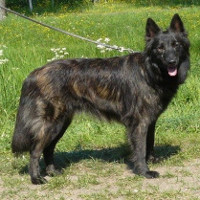
Tall and squarely built, the Mali-Dutchie is a proud, alert breed. Combining all the traits of the parent breeds, male Mali-Dutchies can reach up to 66 centimeters at the withers and weigh up to 36 kilos at maturity. Because they are a hybrid breed, it is difficult to determine an exact appearance, as it can change considerably even within the same litter. However, despite this, the typical appearance consists of a body built to work, with an athletic build and strong lines that make the Mali-Dutchie intimidating and graceful at the same time. Although this dog is not square and muscular like some other working-class breeds, its body is built for speed and makes Mali extremely agile, perfect for jobs such as search and rescue or breeding. Their coat is an all-weather coat, taking after both parents, which enables them to withstand different weather variations. Despite this fact, the Mali tends to prefer cooler weather above all else. This is a beautiful breed whose coat can come in a variety of colors, from a light fawn to a rich mahogany swirled with tan, black or silver. When combined with a long muzzle, strong jaw and athletic build, there's no doubt that Mali-Dutch turn heads wherever they go.

Temperament of the Mali-Dutchie

The Mali-Dutchie is not a normal pet. They are specifically designed to function as a guardian and faithful companion no matter what. Due to the high intelligence of both parent breeds, the Mali-Dutchie will not settle for a lazy-dog lifestyle. They need a lot of physical and mental stimulation, and will need work of some kind to keep them from being destructive and developing undesirable habits. This breed, though full of energy and hard work, is extremely loyal and very affectionate towards its humans. There should never be any aggression in this breed, but due to their highly protective nature, this can cause problems if proper training and socialization takes place. Although Mali are great with other dogs and children, it's important never to leave them unsupervised, especially when they're young or poorly socialized, as their herding tendencies can show. They are not barkers, but will alert their humans with a series of barks if anything suspicious is going on. Although the Mali is not your average companion dog, with the right family willing to work with them and provide the exercise they need, they can be an excellent companion for active people or those with disabilities, as long as they are well trained by a professional.

Needs and activities of the Mali-Dutchie

Because the Belgian Malinois and Dutch Shepherd are very active breeds that were designed to guard and work a farm, the Mali-Dutchie is going to need just as much physical and mental stimulation to keep them really happy and well-behaved. A short walk in the park won't be enough for this breed. Be prepared to take them for a long walk, a brisk jog, a thorough workout, and then a game of fetch afterwards. It's important to remember that, because Mali has vocational training, it will be essential to provide him with a job to keep him happy. Whether it's as simple as carrying a backpack or pulling a cart, or as important as helping a disabled person, Mali will be happier with a job to do. Careful training and socialization with a handler will be essential to ensure that your Mali is a happy, well-behaved dog, whether as a companion or a working animal.

Maintenance of the Mali-Dutchie

The Mali-Dutchie is a low-maintenance breed, with brushing only necessary to control shedding. Because they have a short coat, Mali-Dutchies don't require much effort to keep well groomed. Be sure to brush at least three times a week with a shedding tool and a regular pin brush, as this dog sheds a lot. This will help remove loose hair and dirt from the coat, keeping it shiny, while reducing the amount of hair that ends up on your floor and furniture. Bathing should only take place every two months or so, as Mali doesn't have a bad dog smell. Bear in mind that if your dog becomes particularly dirty, he'll need more frequent baths, but otherwise, bathing is a minimum requirement. Apart from brushing and bathing, the only other important grooming step is to make sure you trim your dog's nails every few weeks to ensure good paw health and reduce the amount of scratching that can occur if your dog jumps on objects or people.

Comments

Latest page updates

  • Telomian

    Telomian He is not recognized by the F.C.I. Origin Malaysia Translation Francis Vandersteen A brief presentation of the Telomian The Telomian is a very rare breed of dog, and the only one native to Malaysia to have been bred outside the country. They were originally bred by the indigenous people of Malaysia to combat parasites such as snakes, rats,...
  • King Wheaten -- Cavalier King Charles Spaniel X Irish Soft Coated Wheaten Terrier

    King Wheaten He is not recognized by the F.C.I. Origin Great Britain <> Ireland -> U.S.A. Translation Francis Vandersteen A brief presentation of the King Wheaten The King Wheaten is a small dog with a heart this big and a playful disposition. Borrowing the energy and soft-coated waves of the Irish Soft Coated Wheaten Terrier and the size and...
  • Spanierd -- English Springer Spaniel X German Shepherd

    Spanierd He is not recognized by the F.C.I. Origin Great Britain <> Germany -> U.S.A. Translation Francis Vandersteen A brief presentation of the Spanierd The Spanierd is a hybrid dog. Its parent breeds are the English Springer Spaniel and the German Shepherd. They have an affable personality. He's known for entertaining family and friends with his...
  • Alaskan Goldenmute -- Alaskan Malamute X Golden Retriever

    Alaskan Goldenmute He is not recognized by the F.C.I. Origin U.S.A. <> Great Britain -> U.S.A. Translation Francis Vandersteen This breed is also known as Alaskan GoldenGoldenmuteAlaskan Gold Retriever     A brief presentation of the Alaskan Goldenmute The Alaskan Goldenmute is a descendant of two great dog breeds: the Alaskan Malamute and the Golden...
  • French pointing dog Pyrenean type

    French pointing dog Pyrenean type FCI standard Nº 134 Origin France Translation Mrs. Peggy Davis Group Group 7 Pointing Dogs Section Section 1.1 Continental Pointing Dogs « Braque » Type Working With working trial Acceptance on a definitive basis by the FCI Tuesday 18 January 1955 Publication of the official valid standard Tuesday 01 August 2023 Last...
  • French pointing dog Gascogne type

    French pointing dog Gascogne type FCI standard Nº 133 Origin France Translation Mrs. Peggy Davis Group Group 7 Pointing Dogs Section Section 1.1 Continental Pointing Dogs « Braque » Type Working With working trial Acceptance on a definitive basis by the FCI Monday 17 January 1955 Publication of the official valid standard Tuesday 01 August 2023 Last...
  • Vucciriscu

    Vucciriscu He is not recognized by the F.C.I. Origin Sicily Translation Francis Vandersteen En français, cette race se dit Vucciriscu Diese Norm ist in deutscher Sprache sichtbar Vucciriscu En español, esta raza se dice Vucciriscu In het Nederlands, wordt dit ras gezegd Vucciriscu This breed is also known as Sicilian Vucciriscu Sicilian Butcher...

© 2026 Groupe Milouchouchou ASBL. Tous droits réservés. En savoir plus

Protected by Copyright01
We use cookies

We use cookies on our website. Some of them are essential for the operation of the site, while others help us to improve this site and the user experience (tracking cookies). You can decide for yourself whether you want to allow cookies or not. Please note that if you reject them, you may not be able to use all the functionalities of the site.

Ok