 |
Maltichon |
|
He is not recognized by the F.C.I. |
Origin |
Central Mediterranean <> France / Belgium -> U.S.A. | |
Translation |
Francis Vandersteen |
A brief presentation of the Maltichon |
| The Maltichon is a fairly well-known hybrid dog, a deliberate cross between two closely related breeds of small white pets, the Maltese and the Bichon frise. Both parent breeds are affectionate, lively and playful, with the Maltese a little more gentle and peaceful and the Bichon frise slightly more cheerful and outgoing. The mix of the two is generally sociable and pleasant with all ages and with other animals, but precautions must be taken to ensure that this somewhat delicate dog doesn't injure itself during interactions. This dog is adaptable due to its reduced exercise requirements, and does well in an apartment or larger home. |
History of the Maltichon |
| The Maltichon is a popular crossbreed, a specific cross between two extremely ancient companion breeds developed in the Mediterranean, the Bichon frise and the Bichon maltais. In fact, the two dogs share much of their ancestry, their earliest known ancestor being a local water dog that was also the ancestor of several bright and friendly breeds, including the Poodle, Havanese and Bolognese. Many of these breeds are predominantly white, and all have silky coats. |
A little of the Maltese |
||
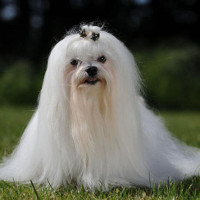
| The Maltese originated in Italy and Malta, where it was formerly known as the Ye Ancient Dogge of Malta. The Maltese has the dubious honor of being the oldest known pocket dog, with origins dating back to at least 3500 BC on the island of Malta, off the southern coast of Italy, and seems to have been purely for companionship, a purpose that continues today. It is entirely possible that this is the oldest known European toy breed. The breed's popularity waned as the popularity and need for hunting dogs increased. Interest was revived in the mid-1800s when meticulous breeding and record-keeping resulted in a purer Maltese breed. The Maltese first appeared in the show ring in England in 1859 and in America in 1877. The Maltese breed was finally recognized by the American Kennel Club in 1963. | ||
 |
||
| Standard of the Maltese | ||
A little of the Bichon frise |
||
| The Bichon frise, like many of these dogs, is a small white dog with a pleasant disposition. Originally employed as vermin hunters on ships, their lively, entertaining nature and pleasing appearance made them a favorite of royal families of one kind or another from the 1300s to the 1800s. When they fell out of favor in the 1800s, their courageous nature and ease of training earned them success as circus dogs, organ grinder trick dogs and fair dogs. The first Bichon frise dogs were introduced to the USA by French immigrants in 1956, and the Bichon frise was recognized as a breed in the non-sporting group by the American Kennel Club in 1972. | ||
 |
||
| Standard of the Bichon frise |
Appearance of the Maltichon |
| The Maltichon is a tiny but well-built dog with soft white fur that can be silky or velvety. They have small, slightly rounded heads with medium-length square muzzles that can be tapered if the cross takes more after the Maltese than the Bichon frise. This hybrid has dark, round eyes that have black lids that amplify their gentle yet alert expressions, as well as floppy ears that are set moderately high on the head and can be covered with copious amounts of hair. Although the color of the parent breed is generally a fairly uniform white, the Maltichon can sometimes have apricot, buff and cream markings, and coat length and texture can vary considerably from dog to dog, even within the same family. same litter. The coat of the Maltese is a long, straight, single-layered coat that can become quite long, and the Bichon frise has a double-layered coat made up of a short, dense undercoat covered by a layer of medium-length wavy or curly hair that has a texture more akin to plush or velvet. Crosses can inherit qualities from either of the parent breeds. |
Temperament of the Maltichon |
| Both parent breeds were bred for companionship and are generally bright, lively and inquisitive canines, just like the Maltichon. In most cases, they are outgoing and engage with all ages as well as other animals, although interactions between this small dog and young or boisterous children or larger animals must be closely supervised to avoid rough, clumsy or inattentive behavior that could result in hurt feelings or even injury on the part of the child or dog. They are fairly easy to train, although short, stimulating training sessions are most effective, and they can have a stubborn streak, especially when trained at home. Early training and socialization are particularly important in preventing the formation of traits such as shyness, insecurity and yapping in toy-sized dogs like the Maltichon. They are a very people-oriented hybrid and may be slightly more prone to developing separation anxiety than most breeds. |
Needs and activities of the Maltichon |
| Although this dog is a lively animal, its small size means it can generally expend quite a lot of energy without you having to exert much effort. While Maltichons will certainly enjoy short walks around the block, they will appreciate frequent breaks, every twenty minutes or so. Hybrids that inherit the Maltese's characteristic single-ply coat may be a little more sensitive to the cold than other dogs, and if you live in a colder climate, sweaters and jackets designed for your canine companion may be a good investment. These dogs are also highly intelligent, and boredom can lead to anxiety, destructive behavior and excessive barking. Puzzles and toys designed for dogs and games of hide-and-seek are appropriate methods of preventing mischief by keeping their quick little minds occupied. |
Maintenance of the Maltichon |
| This dog requires more effort than most when it comes to grooming. Both parent breeds need fairly frequent baths, every three to four weeks, and this is also true for the Maltichon dog. Conditioner formulated for dogs should also be applied to the coat after bathing to help keep this dog's hair healthy and supple, and brushing and combing should take place daily to remove tangles and prevent matting. Both the Bichon frise and the Maltese are low-loss dogs that have been classified as hypoallergenic, and Maltichons dogs share this classification. |



 English (United Kingdom)

Comments