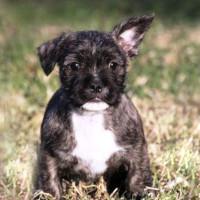
Miniature French Schnauzer

He is not recognized by the F.C.I.

Origin
France <> Germany -> U.S.A.
Translation
Francis Vandersteen

A brief presentation of the Miniature French Schnauzer

The Miniature French Schnauzer is a specific cross between the French Bulldog, a friendly, entertaining little pet descended from the English Bulldog, and the Miniature Schnauzer, a determined Terrier-type dog developed to hunt rats in Germany. This particular cross can vary considerably from dog to dog, but will generally be a playful, family dog with moderate to low exercise requirements that can adapt quite well to a larger home or smaller space, such as an apartment. Grooming can vary from dog to dog, and some of these hybrids will only require brushing once a week or so, while others may require daily brushing and regular clipping or scissoring.

History of the Miniature French Schnauzer

The Miniature French Schnauzer is a deliberate hybrid between the Miniature Schnauzer, a competent German Terrier, and the French Bulldog, a small pet descended from the English Bulldog and favored by craftsmen and lacemakers in England and France.


A little of the French Bulldog

        
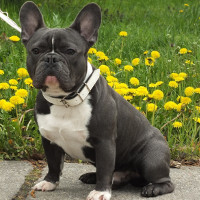
The French Bulldog was originally developed in England sometime in the 1800s, a descendant of the English Bulldog that was intended as a pet and guard dog. It was a smaller, lighter dog that found a niche as a pet for the craftsmen of the day, particularly lace makers. When many of the craftsmen who owned these small dogs moved to northern France, they brought their dogs with them, and enthusiasts began to unify the breed's appearance and temperament, characterizing them by a compact body, straight, sturdy legs, and a large, square head with a lower jaw. Until the French Bulldog Club of America drew up a new breed standard around the one that specified that this breed was characterized as having bat-like ears in the late 1800s, pink ears and bat-like ears were common.
Standard of the French Bulldog

A little of the Miniature Schnauzer

The original Standard Schnauzer can be traced back in one form or another to the Middle Ages, but the distinctive stiff coat that characterizes the breed didn't come about until the mid-1800s, when German breeders added genetic stock from both the Standard Poodle and the Keeshond, then known as the Grey Wolfspitz. The Dwarf Schnauzer is genetically quite different from the Standard and Giant Schnauzer varieties, as additional dog types were used to create the different sizes. Whereas Standard Schnauzers were mixed with larger dogs such as the Great Dane to create the Giant Schnauzer, the Miniature was developed by including genetic contributions from other small German Terriers and Pinschers, such as the Affenpinscher and Wire Fox Terrier, giving them a similar appearance, but very different temperaments and medical susceptibilities. In 1888, the first official Miniature Schnauzer was registered in a German herd book, and they were accepted as a separate breed by the American Kennel Club in 1926.
Standard of the Miniature Schnauzer

Appearance of the Miniature French Schnauzer

The Miniature French Schnauzer is a small to medium-sized dog with compact muscles, straight legs, dark brown eyes and a square outline. Beyond that, however, there can be a wide range of characteristics, as the French Bulldog and Miniature French Schnauzer are often quite different in structure, appearance and temperament. The Miniature French Schnauzer may take on some or all of the traits of the French Bulldog, a sturdy little dog with a large, square head, round eyes, a short, broad muzzle and large, upright ears known as bat ears, or the Miniature Schnauzer, a sturdy Terrier-type dog with a more rectangular head shape, a strong, blunt muzzle of medium length, oval eyes and small, V-shaped ears that fold back close to the skull. While many of these hybrids will inherit the wiry, double-coated coat of the Miniature Schnauzer, inheriting the shiny, single-coated coat of the French Bulldog is just as possible.

Temperament of the Miniature French Schnauzer

The temperament of this hybrid can also vary considerably from dog to dog, often even within the same litter. The traits that the French Bulldog can pass on to the Miniature French Schnauzer are generally fairly consistent. This breed is generally a comical animal that tends to be friendly with almost everyone, although rodents can be unsafe and quarrels can occur between males. However, the inherited personality traits of the Miniature Schnauzer can be more erratic, as there can be great variation in the temperaments of individual Miniature Schnauzers. Within this breed, you can find individuals who are clownish, serious, nervous, sweet, rambunctious or even suspicious, and it can be difficult to determine what an adult dog's personality will look like from puppyhood. The way any Miniature French Schnauzer will react to new experiences, people and other animals can be as varied as its personality. The best way to ensure a stable, good-tempered dog is to provide plenty of opportunities for positive socialization, especially when your dog is young.

Needs and activities of the Miniature French Schnauzer

The Miniature French Schnauzer is a Terrier breed and, as such, they are generally rather active and energetic dogs, however, this is counterbalanced by the more peaceful and calm behavior of the French Bulldog. Between 45 minutes and an hour of vigorous exercise spread throughout the day, each day will generally meet the exercise requirements for this crossbreed. The Miniature French Schnauzer is a highly trainable animal and most of these dogs will also do very well in obedience training, perhaps enjoying and even excelling in advanced obedience and rally or agility sports for dogs. In many cases, this hybrid will work quite well in a larger house or apartment, although some may be a little too noisy for an apartment.

Maintenance of the Miniature French Schnauzer

The grooming regime for this dog can vary considerably, depending on the coat the Miniature French Schnauzer has inherited. Those who have inherited the short, single-ply coat of the French Bulldog will only really need brushing once a week or so to remove dead hairs and ensure it retains its glossy sheen. Those with the wirey, double-layered coat of the Miniature Schnauzer will need daily brushing to prevent matting in the dense, soft fur that makes up the first layer of their coat. They may also require regular clipping or trimming, perhaps as often as every five to eight weeks. Hybrids' teeth and nails should also be cared for, brushing several times a week and checking nail length every two weeks, taking care not to let them become too long.

Comments

Latest page updates

  • Telomian

    Telomian He is not recognized by the F.C.I. Origin Malaysia Translation Francis Vandersteen A brief presentation of the Telomian The Telomian is a very rare breed of dog, and the only one native to Malaysia to have been bred outside the country. They were originally bred by the indigenous people of Malaysia to combat parasites such as snakes, rats,...
  • King Wheaten -- Cavalier King Charles Spaniel X Irish Soft Coated Wheaten Terrier

    King Wheaten He is not recognized by the F.C.I. Origin Great Britain <> Ireland -> U.S.A. Translation Francis Vandersteen A brief presentation of the King Wheaten The King Wheaten is a small dog with a heart this big and a playful disposition. Borrowing the energy and soft-coated waves of the Irish Soft Coated Wheaten Terrier and the size and...
  • Spanierd -- English Springer Spaniel X German Shepherd

    Spanierd He is not recognized by the F.C.I. Origin Great Britain <> Germany -> U.S.A. Translation Francis Vandersteen A brief presentation of the Spanierd The Spanierd is a hybrid dog. Its parent breeds are the English Springer Spaniel and the German Shepherd. They have an affable personality. He's known for entertaining family and friends with his...
  • Alaskan Goldenmute -- Alaskan Malamute X Golden Retriever

    Alaskan Goldenmute He is not recognized by the F.C.I. Origin U.S.A. <> Great Britain -> U.S.A. Translation Francis Vandersteen This breed is also known as Alaskan GoldenGoldenmuteAlaskan Gold Retriever     A brief presentation of the Alaskan Goldenmute The Alaskan Goldenmute is a descendant of two great dog breeds: the Alaskan Malamute and the Golden...
  • French pointing dog Pyrenean type

    French pointing dog Pyrenean type FCI standard Nº 134 Origin France Translation Mrs. Peggy Davis Group Group 7 Pointing Dogs Section Section 1.1 Continental Pointing Dogs « Braque » Type Working With working trial Acceptance on a definitive basis by the FCI Tuesday 18 January 1955 Publication of the official valid standard Tuesday 01 August 2023 Last...
  • French pointing dog Gascogne type

    French pointing dog Gascogne type FCI standard Nº 133 Origin France Translation Mrs. Peggy Davis Group Group 7 Pointing Dogs Section Section 1.1 Continental Pointing Dogs « Braque » Type Working With working trial Acceptance on a definitive basis by the FCI Monday 17 January 1955 Publication of the official valid standard Tuesday 01 August 2023 Last...
  • Vucciriscu

    Vucciriscu He is not recognized by the F.C.I. Origin Sicily Translation Francis Vandersteen En français, cette race se dit Vucciriscu Diese Norm ist in deutscher Sprache sichtbar Vucciriscu En español, esta raza se dice Vucciriscu In het Nederlands, wordt dit ras gezegd Vucciriscu This breed is also known as Sicilian Vucciriscu Sicilian Butcher...

© 2026 Groupe Milouchouchou ASBL. Tous droits réservés. En savoir plus

Protected by Copyright01
We use cookies

We use cookies on our website. Some of them are essential for the operation of the site, while others help us to improve this site and the user experience (tracking cookies). You can decide for yourself whether you want to allow cookies or not. Please note that if you reject them, you may not be able to use all the functionalities of the site.

Ok