
 |
Min Pin Frise |
|
He is not recognized by the F.C.I. |
Origin |
Germany <> France / Belgium -> U.S.A. | |
Translation |
Francis Vandersteen |
A brief presentation of the Min Pin Frise |
| The Min Pin Frise is an unusual crossbreed, a cross between a small, intrepid ratter dog, the Miniature Pinscher, and a small, white Mediterranean companion dog, the Bichon frise. This crossbreed is a combination of dogs with very different appearances, behaviors and even medical conditions, and individual dogs can differ considerably even within the same litter. They are energetic, playful and affectionate little animals that require only a moderate amount of exercise, and if properly trained and socialized, they can make pleasant and entertaining housemates in any size space. While the coat of the Bichon frise may be hypoallergenic, the short coat of the Miniature Pinscher is decidedly not, and the allergenic potential of an individual dog's coat may not be apparent until it reaches maturity. |
History of the Min Pin Frise |
| The Min Pin Frise is a specific cross between an elegant little ratter dog from Germany known as the Dwarf Pinscher and the Bichon frise, an entertaining and affectionate pet developed in the Mediterranean. |
A little of the Miniature Pinscher |
||
| There's a prevailing misconception that the Miniature Pinscher is the miniaturized version of the Dobermann Pinscher, however, despite their similarity in coat, color and confirmation, these dogs are not closely related. The Miniature Pinscher is, in fact, an older breed by at least a century or two, as documentation indicates that they were employed as rakers and vermin hunters in Germany on farms and in homes for several centuries. They remained virtually unknown outside Germany until the Pinscher Klub, now known as the Pinscher-Schnauzer Klub, was developed in 1895 and the first breed standard written. It was only after the end of the First World War that Miniature Pinschers were imported to the United States. They were first recognized in the AKC Terrier group under the name Min Pin in 1929, then reclassified in the Toy category under the title Miniature Pinscher, and it wasn't until 1972 that they received the nickname they're still classified under today, the Miniature Pinscher. | ||
 |
||
| Standard of the Miniature Pinscher | ||
A little of the Bichon frise |
||
| The Bichon frise, a small white companion dog, is even older than the Miniature Pinscher, playing the role of royal companion as early as the 1300s. This little white dog is descended from an Italian Water Spaniel, the same Italian Water Spaniel that gave rise to the Maltese and Poodle breeds, among others. These little companion dogs were known as Bichon Tenerife before being renamed Bichon frise, and were prized for their cheerful, affectionate dispositions. They were frequently used as trade items, traveling to other countries with sailors, and from the 1300s to the 1800s they were favored by the royal families of many countries. When the Bichon frise fell out of favor with the Royals in the late 1800s and early 1900s, these plucky little dogs found homes working the streets with organ grinders and performing tricks in circuses and fairs. It wasn't until after the First World War that the first breed standard for the Bichon frise was developed in 1933, and nearly 40 years until they were recognized by the American Kennel Club in 1972. | ||
 |
||
| Standard of the Bichon frise |
Appearance of the Min Pin Frise |
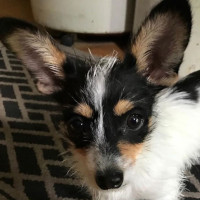
| The Min Pin Frise comes from two parent breeds that have different coats, temperaments and even body types, so the offspring of the Miniature Pinscher and Bichon frise can vary considerably in these areas, even differing a little between dogs from the same litter. They will be small dogs, with even the largest specimens reaching only around 30.5 centimeters in height and weighing less than 9 kilos. Like the two parent breeds, they are small, well-built, robust dogs with dark eyes and black noses. From there, they can take on different traits from the Bichon frise, a white powder puff with a square muzzle of a dog with a slightly rounded head, round eyes, heavily furred ears that drop and hang close to the head, and a layered double coat of soft, dense undercoat protected by a layer of coarse, curly hair, or the Dwarf Pinscher, an elegant, vigorous animal with a wedge-shaped head, tapered muzzle, oval eyes, triangular ears set high on the head, and a single, easy-care layer for a glossy coat. |
Temperament of the Min Pin Frise |
| The Min Pin Frise is not yet a common hybrid, but you can usually get a good idea of a crossbreed's temperament by looking at the parent breeds. In this case, the Min Pin Frise would be an energetic, quick-witted dog, a cuddly, affectionate animal with an independent streak that can sometimes get it into trouble. Although they tend to get on quite well with all members of the family, they can easily be overwhelmed by very young, fast-moving or boisterous children or pets. All interactions with children and other animals must be closely supervised, not only to avoid misunderstandings or bites directed at the child, but also to prevent the damage that accidental mishandling can do to a small dog like this. Some Miniature Pinschers have a possessive or territorial side, but early training and socialization can often curb these troublesome traits. |
Needs and activities of the Min Pin Frise |
| This little dog may not need as much exercise as the intense, athletic Miniature Pinscher, but it tends to be happier with more exercise than the average Bichon frise needs. This dog will settle for around 45 minutes of vigorous activity every day, in the form of short walks around the neighborhood, indoor play and even agility training. If this crossbreed is trained and socialized early and given adequate mental stimulation, they can make suitable housemates even in small living spaces, but without proper training they can become anxious, overly vocal and destructive. |
Maintenance of the Min Pin Frise |
| Maintenance of this crossbreed can vary considerably between Min Pin Frise, as the two parent breeds have very different coat types. If your dog inherits the Min Pin's coat, grooming should be an easy chore, simply bathing him every few months and brushing him with a bristle brush, smooth brush or rubber grooming glove, depending on your preference. If your dog's coat is more like that of a Bichon frise, you'll need more time, as he tends to need baths every three to four weeks and brushing with a pin brush or comb several times a week. The Bichon frise's coarse, curly coat often needs trimming and grooming, and this trait can also be passed on to the Min Pin Frise. |



 English (United Kingdom)

Comments