
 |
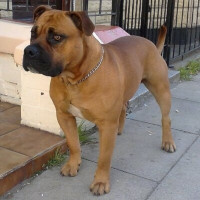
Old Anglican Bulldogge |
|
He is not recognized by the F.C.I. |
Origin |
U.S.A. <> Great Britain -> U.S.A. | |
Translation |
Francis Vandersteen |
A brief presentation of the Old Anglican Bulldogge |
| The Old Anglican Bulldogge is a specific cross between the American Pit Bull Terrier and the English Bulldog. Taking after the Pit Bull, the Old Anglican Bulldogge is a medium-sized breed with a lean, well-built body and broad shoulders. The face, though not as flat as that of the English Bulldog, is square with loose flaps of skin on the muzzle that give the breed that classic, lovable awkwardness that is a main trait of the English Bulldog. Although the Old Anglican Bulldogge's parents give it a rather intimidating history and appearance, this breed is a total lover that gets along well with everyone if given the chance. |
History of the Old Anglican Bulldogge |
| Because the Old Anglican Bulldogge is a more recent hybrid breed, we need to turn to the history of the parent breeds to find out more about how the Old Anglican Bulldogge came to be. Although an origin story may seem rather understated, in the long run it's an important factor to consider as it helps clarify which traits may be most important in the hybrid. For example, many people may have a bad taste in their mouth when they hear about the American Pit Bull Terrier due to their history of dog fighting. But this wasn't always the case. |
A little of the American Pit Bull Terrier |
||
| Originally, the Pitbull was created to be a farm dog with tasks such as hunting rats, wild pigs and even bears. Despite these dangerous jobs requiring great aggression, Pitbulls were also very good with people of all ages. They are highly intelligent dogs with extreme loyalty to their humans, a sense of fearlessness and determination that made them perfect for tasks ranging from protecting the family to working in the army, such as being a U.S. representative in WWI. It was because of this loyalty and determination that people decided to use this wonderful breed for their own guilty pleasures. Dog fighting became legal for a time in the USA, and people everywhere took part. Such activities gave the Pitbull a bad reputation, but thanks to determined breeders who believed in the breed, a comeback has been taking place for years. Although some places still don't accept the breed, such as the American Kennel Club, some know and love the breed for what it really is, an affectionate, loyal dog that was always meant to be a wonderful companion. The American Pit Bull Terrier has been accepted as an official breed since 1898 by the United Kennel Club. | ||
 |
||
| Presentation of the American Pit Bull Terrier | ||
A little of the English Bulldog |
||
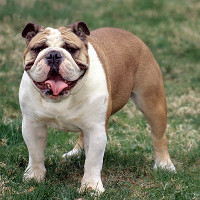
| The English Bulldog has been around for at least 500 years, and the original breed was larger and extremely ferocious. This was important because the English Bulldog was destined to catch a bull by the nose and hold it in place, a sport known as “bull baiting”. It was a very dangerous sport that people really enjoyed at a time when television and video games didn't exist, but it also had a purpose. English Bulldog helped to bait bulls in order to bring in large animals for castration or breeding, so they had an extremely important role to play. Over the years, the English Bulldog generally remained the same, until dog fighting was banned in England and shows became the new form of entertainment. From then on, English Bulldogs were bred to be shorter and very well built, with a big head and a square with a barrel chest. But not only was the appearance altered, so was the personality. No longer aggressive and extremely hard-nosed, dedicated breeders worked hard to turn the English Bulldog into a loving, gentle and courageous breed that was a wonderful companion for people all over the world. Eventually, the English Bulldog made its way to the United States and was registered by the American Kennel Club in 1886. From there, he became a show dog, a popular companion and the mascot of many groups, such as the Marines and some universities, like Yale. | ||
 |
||
| Standard of the English Bulldog |
Appearance of the Old Anglican Bulldogge |
| The Old Anglican Bulldogge is an impressive blend of the sturdy build of the English Bulldog and the athletic posture of the American Pit Bull Terrier. With high legs, a full-length tail and a slightly wrinkled face, the Old Anglican Bulldogge tends to resemble the Pitbull a little more than the English Bulldog. Although this hybrid breed tends to look more like one parent than the other, it will always have folded ears, as do both parent breeds, and almond-shaped eyes of a beautiful golden-brown color. As a short-haired breed, the Old Anglican Bulldogge has a very smooth, soft coat that tends to shed quite often. Because of its short coat, the Old Anglican Bulldogge is no friend of the cold, and will be much happier in a warmer climate. |
Temperament of the Old Anglican Bulldogge |
| Despite what many people may choose to believe about the Pitbull and the English Bulldog, the Old Anglican Bulldogge is a perfect example of all their good traits combined. Although it can sometimes become a little exuberant and, if not properly socialized, can act out with other dogs or humans, the typical temperament of the Old Anglican Bulldogge is a loyal, loving, affectionate and playful breed that is easy to train. What's more, the breed does wonderfully well with children and other dogs, making it an excellent choice for families. The important thing to remember, with any dog, is that proper socialization and training are what make the dog. If you take the time to properly socialize the Old Anglican Bulldog when it's very young, there should be no need to worry about the stray aggressive nature that appears from time to time. The Old Anglican Bulldogge is active but not overly so, barking only when necessary. |
Needs and activities of the Old Anglican Bulldogge |
| Although the English Bulldog and Pitbull were originally bred to be hard-working dogs, over time this energetic, tenacious nature has been slightly removed from the breed. So, while it may seem that an offspring of these two breeds would always be on the move and ready for the next big thing, you might be surprised to discover that the Old Anglican Bulldogge tires rather quickly, like the English Bulldog, and don't have a great tendency to beg for exercise. However, even if they don't beg for it, Old Anglican Bulldogs need exercise to stay fit and well behaved. A short jog, a long walk, a workout and a spirited game of fetch in the yard are all excellent examples of how you can interact with your dog and tire him out. Make sure you spend time training him, as this is very important to keep your dog mentally and physically exhausted. Because this breed has a moderate energy level, he can do well in a smaller home as long as he's taken to a place where he can wriggle daily. |
Maintenance of the Old Anglican Bulldogge |
| The Old Anglican Bulldogge's maintenance needs are rather modest, as their short coat requires very little upkeep. A good brushing with a smooth brush a few times a week should be enough to remove dead hairs and any dirt that may be on the body. As for bathing, your Old Anglican Bulldogge will only need a good bath every few months or so, with occasional cleanings in between if he becomes particularly dirty. Because this breed folds over its ears, frequent cleaning and thorough drying will be necessary after bathing or swimming. This is necessary to avoid any ear infections that may occur due to remaining moisture trapped in the ear canal. In addition to basic bathing and brushing, be sure to trim your dog's nails every few weeks to keep paws healthy and snag-free. |



 English (United Kingdom)

Comments