Norwich de Tuléar

He is not recognized by the F.C.I.

Origin
Great Britain <> Madagascar -> U.S.A.
Translation
Francis Vandersteen

A brief presentation of the Norwich de Tuléar

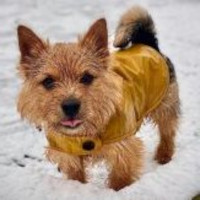
The Norwich de Tuléar is a rather sophisticated gentleman's dog and a hybrid breed between the Coton de Tuléar and the Norwich Terrier. As you can imagine, although this dog is quite small, it has a very big personality. With the Terrier's combined determination and the Coton de Tuléar's bright, carefree attitude, there's no doubt that the Norwich de Tuléar is a dog that will keep any owner on his toes while offering endless smiles to everyone who sees him. It's an easy breed to train and, because of its small size, it does extremely well in any size home, even small apartments or houses. The appearance of the Norwich de Tuléar generally consists of a small body with long, stiff hair that can appear in a number of different colors. The ears can be erect or small and folded, hidden in the fur, while the eyes are always large and very dark brown. Because of their thick fur, this breed can cope very well with cold weather, but tends to prefer milder climates. Finally, although they often shed, the Norwich de Tuléar can be hypoallergenic thanks to the Coton de Tuléar genes, but this will vary depending on whether the predominant coat type is Coton or Norwich.

History of the Norwich de Tuléar

Like many other hybrid breeds, the Norwich de Tuléar doesn't have a very detailed history. This is mainly because it's a more recent breed that hasn't had enough time to become as well known as, say, its parent breeds. For this reason, we'll have to turn to the Coton de Tuléar and the Norwich Terrier to find out more about how this particular hybrid breed came to be, and what traits it may have as a result of its ancestry.


A little of the Norwich Terrier

        
The Norwich Terrier was originally bred in East Anglia, England, home to Cambridge University. While Cambridge is full of highly intellectual and learned souls, it was always a case of students getting bored from time to time. So, to entertain themselves, students liked to place bets on sporting events, particularly bets on a Terrier's ability to ratter. Because of this love of competition, Terriers were crossed with other breeds to develop small red, black or tan dogs with a sporting spirit. Thus, the Norwich Terrier was born, initially known as the Trumpington Terrier. One of these Trumpington Terriers had a very big part to play in the development of the breed we know and love today. His name was Rags and he lived very close to the city of Norwich. With his huge reputation as an expert ratter, Rags became a staple for the new breed of Terrier that came out of Norwich, Terriers that were excellent at chasing foxes from their dens. Eventually, the Norwich Terrier was brought to the USA after a Terrier, named Willum, was purchased by a Philadelphia dog lover. Willum went on to sire a number of Norwich Terriers, and eventually the breed became popular enough to be officially recognized by the American Kennel Club in 1936. Since then, the Norwich has been a popular companion and show dog.
Standard of the Norwich Terrier

A little of the Coton de Tuléar

The Coton de Tuléar has been used as a pet for over 2,000 years, and although we don't know exactly where they came from, we do know that this particular breed of Bichon takes its name from Tuléar, Madagascar. Slowly, due to the Coton de Tuléar's portability and adorable personality, it traveled the world and eventually landed in the United States. In 1976, the Coton de Tuléar Club of America was formed, and a few years later, the American Kennel Club accepted the Coton de Tuléar as an official breed. Since then, these fluffy little white dogs have been favorites for companionship and events around the world.
Standard of the Coton de Tuléar

Appearance of the Norwich de Tuléar

Since the Norwich de Tuléar is a mix of two different breeds, its appearance can vary considerably. As a general rule, it is a small breed with a light body and long, wiry coat. Its ears can be either high and set in perfect little triangles, like the Norwich Terrier, or folded back and framing its face, like the Coton de Tuléar. If you're someone who suffers from allergies, the Norwich de Tuléar may actually have a coat that can be hypoallergenic if it resembles the Coton de Tuléar's fur. However, if it has the fur of the Norwich Terrier, this is not the case, so be sure to consider this carefully before choosing your own Norwich de Tuléar. This breed tends to shed often, but with weekly grooming and a good vacuum cleaner, shedding can be kept to a very manageable level. Thanks to this thicker coat, the Norwich de Tuléar does very well in cooler climates, but can become overheated quite easily. The appearance of this beautiful breed is completed by a black button nose and cheerful brown eyes that perfectly complement its personality.

Temperament of the Norwich de Tuléar

Due to the fact that Norwich de Tuléar's parents are both extreme dogs, it won't come as a surprise that he's also a great lover of people. This breed is cheerful, affectionate, friendly, gentle, outgoing and responds very well to what its master asks of it. They get on wonderfully with children of all ages and have no problems with other pets. In fact, the Norwich de Tuléar has no problems with anyone. Whatever your age, this cheerful little breed is the ultimate companion dog. He'll stay by your side and offer love, cuddles and quality playtime whenever you need it. This makes him an excellent dog for old and young alike, and he won't be a difficult dog to train, whatever your level of experience. When it comes to barking, the Norwich de Tuléar isn't very talkative and only seems to bark often when necessary. If he's excited by something or notices an activity he considers suspicious, the little Terrier mix will undoubtedly alert you. However, because it doesn't bark often and is very small in size, the Norwich de Tuléar is an excellent choice for homes of all sizes, and if neighbors are nearby, they shouldn't have to worry about being annoyed by constant barking. All in all, if you're looking for a wonderful companion dog that loves and gets on well with everyone, big or small, then the Norwich de Tuléar may be the ideal solution for you.

Needs and activities of the Norwich de Tuléar

When considering the activity level of the Norwich de Tuléar, we need to take a look at its parents' energy ranges. The Coton de Tuléar is a very laid-back breed whose favorite activities consist mainly of following its owner around the house and having sporadic bursts of energy where it rushes around the house, only to become calm again. On the other hand, the Norwich Terrier, like many Terriers, is full of energy and ready to conquer the world at any moment. Because of this combination, it's safe to assume that the Norwich de Tuléar is a well-balanced combination of high and low energy, making it a moderately active dog. The best way to burn off this breed's energy will be training sessions and activities such as a long walk or a visit to a dog park so it can play with other dog friends. It's important to remember that this is an intelligent breed, so physical activity alone won't exhaust him. Use training to your advantage and teach your dog to behave well, while giving him a good mental workout to give him a calm demeanor for the rest of the day.

Maintenance of the Norwich de Tuléar

The Norwich de Tuléar is a low-maintenance breed, requiring only brushing to remove tangles and manage shedding. Brushing should take place at least three times a week to keep the coat shiny and clean, as well as to eliminate the knots that can occur along the legs and belly. Bathing, although really necessary every few weeks or so, may occur more often if you have a white or very light-colored Norwich de Tuléar. Regular bathing will be necessary to keep the light-colored coat clean, but there's no bad dog smell, so it's not a necessity. In addition to bathing and brushing, be sure to clean your dog's ears, especially if they're folded like the Coton de Tulear's. Moisture can become trapped very easily in the ears. Moisture can be trapped very easily inside folded ears, making them the ideal environment for ear infection. By carefully cleaning and drying the ears, such problems can be avoided. Finally, trim your dog's nails every few weeks, or whenever you hear them start clicking against the floor.

Comments

Latest page updates

  • Telomian

    Telomian He is not recognized by the F.C.I. Origin Malaysia Translation Francis Vandersteen A brief presentation of the Telomian The Telomian is a very rare breed of dog, and the only one native to Malaysia to have been bred outside the country. They were originally bred by the indigenous people of Malaysia to combat parasites such as snakes, rats,...
  • King Wheaten -- Cavalier King Charles Spaniel X Irish Soft Coated Wheaten Terrier

    King Wheaten He is not recognized by the F.C.I. Origin Great Britain <> Ireland -> U.S.A. Translation Francis Vandersteen A brief presentation of the King Wheaten The King Wheaten is a small dog with a heart this big and a playful disposition. Borrowing the energy and soft-coated waves of the Irish Soft Coated Wheaten Terrier and the size and...
  • Spanierd -- English Springer Spaniel X German Shepherd

    Spanierd He is not recognized by the F.C.I. Origin Great Britain <> Germany -> U.S.A. Translation Francis Vandersteen A brief presentation of the Spanierd The Spanierd is a hybrid dog. Its parent breeds are the English Springer Spaniel and the German Shepherd. They have an affable personality. He's known for entertaining family and friends with his...
  • Alaskan Goldenmute -- Alaskan Malamute X Golden Retriever

    Alaskan Goldenmute He is not recognized by the F.C.I. Origin U.S.A. <> Great Britain -> U.S.A. Translation Francis Vandersteen This breed is also known as Alaskan GoldenGoldenmuteAlaskan Gold Retriever     A brief presentation of the Alaskan Goldenmute The Alaskan Goldenmute is a descendant of two great dog breeds: the Alaskan Malamute and the Golden...
  • French pointing dog Pyrenean type

    French pointing dog Pyrenean type FCI standard Nº 134 Origin France Translation Mrs. Peggy Davis Group Group 7 Pointing Dogs Section Section 1.1 Continental Pointing Dogs « Braque » Type Working With working trial Acceptance on a definitive basis by the FCI Tuesday 18 January 1955 Publication of the official valid standard Tuesday 01 August 2023 Last...
  • French pointing dog Gascogne type

    French pointing dog Gascogne type FCI standard Nº 133 Origin France Translation Mrs. Peggy Davis Group Group 7 Pointing Dogs Section Section 1.1 Continental Pointing Dogs « Braque » Type Working With working trial Acceptance on a definitive basis by the FCI Monday 17 January 1955 Publication of the official valid standard Tuesday 01 August 2023 Last...
  • Vucciriscu

    Vucciriscu He is not recognized by the F.C.I. Origin Sicily Translation Francis Vandersteen En français, cette race se dit Vucciriscu Diese Norm ist in deutscher Sprache sichtbar Vucciriscu En español, esta raza se dice Vucciriscu In het Nederlands, wordt dit ras gezegd Vucciriscu This breed is also known as Sicilian Vucciriscu Sicilian Butcher...

© 2026 Groupe Milouchouchou ASBL. Tous droits réservés. En savoir plus

Protected by Copyright01
We use cookies

We use cookies on our website. Some of them are essential for the operation of the site, while others help us to improve this site and the user experience (tracking cookies). You can decide for yourself whether you want to allow cookies or not. Please note that if you reject them, you may not be able to use all the functionalities of the site.

Ok