Papi-Inu

He is not recognized by the F.C.I.

Origin
France and Belgium <> Japan -> U.S.A.
Translation
Francis Vandersteen

A brief presentation of the Papi-Inu

The Papi-Inu is a hybrid of the Continental Toy Spaniel and the Shiba. There is little or no information available on the hybrid itself, so we really only know what we know from examining the parent breeds. The hybrid mix of these two parent breeds offers a pleasing blend resulting in an excellent family dog, having as some of its personality traits courage without overt aggression, intelligence, courage and love. Although both parent breeds bring higher energy levels to the biological mix, your dog will probably be more active than its Shiba parent.

History of the Papi-Inu

The Papi-Inu hybrid is a mix of the Continental Toy Spaniel and the Shiba. There is little or no information available on the hybrid itself, as it is a relatively new hybrid. Historical information on the hybrid will have to be gathered from the histories of the parent breeds.


A little of the Continental Toy Spaniel

        
The Continental Toy Spaniel parent breed is an ancient one, dating back at least to the Renaissance period in Italy, when a dog resembling the Continental Toy Spaniel was depicted by many artistic masters on the laps of rich and famous royal females. The breed was also very popular in Belgium, France and England, Marie-Antoinette being one of the famous royals who became very fond of the Toy Spaniel breed. Bred purely for companionship, this little treasure, sporting his distinctive set of “butterfly” ears, finally arrived in the United States, where he was officially recognized by the American Kennel Club in 1935. Since then, the breed has gone from strength to strength.
Standard of the Continental Toy Spaniel

A little of the Shiba

The Shiba originated in Japan, and is said to be one of the oldest and smallest of the few dog breeds that can trace its origins to Japan. While the actual date of origin and the region of Japan from which the breed emanated are unknown, we do know that it was created to hunt and explore through the thick, brushy terrain of Japan. It's from these activities that the breed takes its name in Japanese, Shiba meaning brush and Inu meaning dog. Although the Shiba is a small dog, measuring from 33 to 43 centimeters and weighing from 7 to 11 kilos, it is quite effective in the hunting arena, exuding a confidence all its own. Shiba breeding creates a dog that can go over any type of terrain, however rugged and difficult, and explore and hunt with confidence and willingness, making it an excellent choice for hunting as well as companionship. While the breed was almost extinct during the Second World War, it has made an incredible comeback, with further development making the dog we know and love today. The Shiba was recognized by the American Kennel Club in 1992 in the non-sporting group.
Standard of the Shiba

Appearance of the Papi-Inu

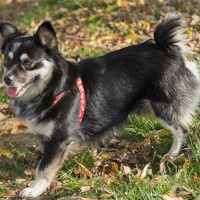
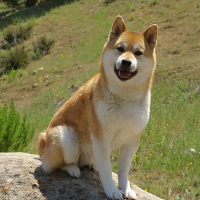
The Papi-Inu hybrid is a mixture of the Continental Toy Spaniel and the Shiba and, as such, may inherit appearance traits from one or both parent breeds. As a result, your Papi-Inu hybrid may take on the appearance of a small Akita, probably measuring 20 to 43 centimeters in height at the withers, weighing between 2.5 and 11 kilos and having a long, fine, silky coat or resembling a teddy bear with its thick double coat of straight, stiff outer coat and soft, thick undercoat. This teddy bear-like appearance will be complemented by a fluffy tail that curls over the hindquarters, a contribution from the parent breeds Shiba and Continental Toy Spaniel. A compact, athletic and muscular body with small feline feet, a small to medium-sized head with a fine, tapering or medium-wide, rounded muzzle, a scissor bite, round or oblique dark eyes, squinting, black nose and ears that can be erect and fringed, resembling the Continental Toy Spaniel's set of butterfly ears, or triangular, erect and pointing forward can be expected in this hybrid. Coat colors are particolored with white as the dominant color and patches of black, brown or red, or they can be orange-red, urajiro (cream to white ventrally), sesame (black-tipped hairs on a dark red background) and white markings on the tips of the tail and legs.

Temperament of the Papi-Inu

Your Papi-Inu hybrid will make an incredible family dog. Being a hybrid mix of the Continental Toy Spaniel and the Shiba, it can inherit some or all of the temperament traits of one or both of its parent breeds. The temperament traits your furry family member could inherit are: alertness, affectionate, cheerful, friendly, gentle, energetic, intelligent, lively, playful, loyal, outgoing, social, reactive, territorial and independent. It can inherit the frequent barking tendency of the Continental Toy Spaniel or the occasional barking tendency of the Shiba parent. With appropriate early socialization, he'll be great with children but probably not so great with the family cat, his hunting instincts probably being widespread in the Shiba parent. Because of the strong hunting instinct he's likely to have, he'll have a strong tendency to follow his oh-so-sensitive nose, studying that interesting or unusual scent in whatever environment or terrain he leads. So unless you enjoy hunting with your beloved furry family member in the heather and brambles in search of those scents, you'd be well advised to keep him on a leash when he's outside the house, a fenced yard or other enclosed space. He will initially resist the application of a leash, but firm leash training is a requirement to keep him safe. He will be easily trained using positive, firm training and encouragement methods. He gets high energy from both sides of the biological mix which will need to be expended.

Needs and activities of the Papi-Inu

Your Papi-Inu is a hybrid that is likely to have large amounts of energy that will need to be expended daily. Because he's small, you might mistakenly think he'd be a perfect apartment or condo companion, but be aware that this will only work if he has the opportunity to walk and run several times a day, which is not usually an activity available in apartment or condo life. He's better suited to life in a home with a large fenced-in yard in which he can run and play for hours on end. As mentioned, several long daily walks or jogs, combined with interactive games of fetch, Frisbee and searching for and retrieving hidden toys are excellent ways to exercise your furry family member. Because he's an intelligent dog, getting high levels of intelligence from both sides of the biological mix, it's very important to keep him mentally and physically exercised. Obedience training and earth dog activities can help achieve this goal. It's important to remember that a bored dog with this level of intelligence can develop annoying and destructive behaviors. It can tolerate moderate temperatures, depending on which parent breed has coat dominance in the biological pool. They can live in urban or rural environments, provided they have adequate and appropriate exercise opportunities.

Maintenance of the Papi-Inu

Your Papi-Inu is a hybrid that is considered to be in the moderate maintenance category. Brushing will be required at least once a week, depending on which parent breed contributed most to the biological mix. Also, depending on the coat inherited by your pet, the coat is not hypoallergenic and shedding will range from minimal to constant with seasonal increases. Neither of the two parent breeds brings an odor propensity to the biological mix, making it unnecessary to bathe it frequently, rather than only as needed or every few months. Toenails should be trimmed several times a month, unless they're worn down by daily physical activity. Ears should be checked and cleaned weekly, using a cotton ball and an approved canine ear cleaning solution as needed. Dental examinations and cleanings are strongly recommended, as is brushing at least twice a week to prevent periodontal disease and accompanying tooth loss. The drool level of this hybrid is considered low.

Comments

Latest page updates

  • Telomian

    Telomian He is not recognized by the F.C.I. Origin Malaysia Translation Francis Vandersteen A brief presentation of the Telomian The Telomian is a very rare breed of dog, and the only one native to Malaysia to have been bred outside the country. They were originally bred by the indigenous people of Malaysia to combat parasites such as snakes, rats,...
  • King Wheaten -- Cavalier King Charles Spaniel X Irish Soft Coated Wheaten Terrier

    King Wheaten He is not recognized by the F.C.I. Origin Great Britain <> Ireland -> U.S.A. Translation Francis Vandersteen A brief presentation of the King Wheaten The King Wheaten is a small dog with a heart this big and a playful disposition. Borrowing the energy and soft-coated waves of the Irish Soft Coated Wheaten Terrier and the size and...
  • Spanierd -- English Springer Spaniel X German Shepherd

    Spanierd He is not recognized by the F.C.I. Origin Great Britain <> Germany -> U.S.A. Translation Francis Vandersteen A brief presentation of the Spanierd The Spanierd is a hybrid dog. Its parent breeds are the English Springer Spaniel and the German Shepherd. They have an affable personality. He's known for entertaining family and friends with his...
  • Alaskan Goldenmute -- Alaskan Malamute X Golden Retriever

    Alaskan Goldenmute He is not recognized by the F.C.I. Origin U.S.A. <> Great Britain -> U.S.A. Translation Francis Vandersteen This breed is also known as Alaskan GoldenGoldenmuteAlaskan Gold Retriever     A brief presentation of the Alaskan Goldenmute The Alaskan Goldenmute is a descendant of two great dog breeds: the Alaskan Malamute and the Golden...
  • French pointing dog Pyrenean type

    French pointing dog Pyrenean type FCI standard Nº 134 Origin France Translation Mrs. Peggy Davis Group Group 7 Pointing Dogs Section Section 1.1 Continental Pointing Dogs « Braque » Type Working With working trial Acceptance on a definitive basis by the FCI Tuesday 18 January 1955 Publication of the official valid standard Tuesday 01 August 2023 Last...
  • French pointing dog Gascogne type

    French pointing dog Gascogne type FCI standard Nº 133 Origin France Translation Mrs. Peggy Davis Group Group 7 Pointing Dogs Section Section 1.1 Continental Pointing Dogs « Braque » Type Working With working trial Acceptance on a definitive basis by the FCI Monday 17 January 1955 Publication of the official valid standard Tuesday 01 August 2023 Last...
  • Vucciriscu

    Vucciriscu He is not recognized by the F.C.I. Origin Sicily Translation Francis Vandersteen En français, cette race se dit Vucciriscu Diese Norm ist in deutscher Sprache sichtbar Vucciriscu En español, esta raza se dice Vucciriscu In het Nederlands, wordt dit ras gezegd Vucciriscu This breed is also known as Sicilian Vucciriscu Sicilian Butcher...

© 2026 Groupe Milouchouchou ASBL. Tous droits réservés. En savoir plus

Protected by Copyright01
We use cookies

We use cookies on our website. Some of them are essential for the operation of the site, while others help us to improve this site and the user experience (tracking cookies). You can decide for yourself whether you want to allow cookies or not. Please note that if you reject them, you may not be able to use all the functionalities of the site.

Ok