
 |
Peek-A-Pom |
|
He is not recognized by the F.C.I. |
Origin |
China <> Germany -> U.S.A. | |
Translation |
Francis Vandersteen |
A brief presentation of the Peek-A-Pom |
| The Peek-A-Pom is a hybrid breed. Its parents are the Pekingese and the German Toy Spitz / Pomeranian. It's a hypoallergenic breed that sheds very little. However, it will need regular grooming to keep its coat in good health. He is fairly easy to train, although it may take a little longer to train him completely compared with other breeds. Perseverance and patience are essential when working with the Peek-A-Pom. It's not an overly active dog, and it's not prone to separation anxiety. However, the Peek-A-Pom may not be suitable for families with young children due to its small size. If the Peek-A-Pom is allowed to grow up with children, however, they learn to handle the Peek-A-Pom and enjoy its company as much as the older members of its family. |
History of the Peek-A-Pom |
| The Peek-A-Pom is a fairly popular breed, yet little is known about the origins of the hybrid breed. To find out more about the Peek-A-Pom, you need to look at the history of its parent breeds. |
A little of the Pekingese |
||
| The Pekingese is said to be the descendant of a marmoset and a lion who fell in love. The lion asked Buddha to make him smaller so that he could marry his love, but to enable him to retain his courage and power. Buddha granted the lion's request and the pair produced a pair of dogs known as Fu Lin dogs. These dogs were said to be the empress's favorites. During the Opium Wars of the 1800s, British soldiers stormed the imperial palace, where they found several Pekingese dogs. They took the dogs home to England, where they also became favorites of the British nobility. Queen Victoria owned a Pekingese, which was a favorite among her many dogs. Although experts don't know exactly how the Pekingese was introduced to the United States, we do know that the first Pekingese was registered by the American Kennel Club in 1906. It remains a popular breed today. | ||
 |
||
| Standard of the Pekingese | ||
A little of the German Toy Spitz / Pomeranian |
||
| The German Toy Spitz / Pomeranian is related to the old northern Spitz breeds. It originated in the province of Pomerania. Poms have always been a popular breed. Notables such as Martin Luther, Issac Newton, Michelangelo and Mozart are all said to have owned German Toy Spitz / Pomeranians. Queen Victoria also strongly favored the breed. She is thought to have been responsible for helping to raise the dog to the small size it is today. At one time, the German Toy Spitz / Pomeranian weighed around 13.5 kilos. The Pomeranian was first registered in the USA in 1909. By the 1950s, the breed was one of the most popular in the USA, and today ranks 14th out of 155 AKC-registered breeds. | ||
 |
||
| Standard of the German Toy Spitz / Pomeranian |
Appearance of the Peek-A-Pom |
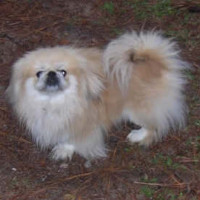
| The Peek-A-Pom will be a very small dog. Although quite small, it is a strong, sturdy dog. His ears will be pricked, possibly with feathers. His eyes can be described as button eyes. His muzzle will be black and may or may not be short, depending on the dominant parent breed. It will have a fluffy tail with lots of feathers. Colors vary. It may be lightly tanned, cream-colored or tricolored. They can also be quite red. Some Peek-A-Pom may also be brindle, black or brown. Sometimes, a Peek-A-Pom will be black and tan. It usually has longer, silky, fine hair. |
Temperament of the Peek-A-Pom |
| The Peek-A-Pom is a cheerful, alert little dog. He's very affectionate. He loves all members of the family and rarely meets a stranger he can't befriend. He loves to play, and toys that stimulate mental activity are highly recommended for the Peek-A-Pom. This breed also does well with children, although it's best recommended for families with older children simply because of the Peek-A-Pom's size. Young children often don't know how to handle a small dog, and even if the child means no harm, the dog can nip a small child who squeezes too hard or pulls the dog's fur. Peek-A-Pom will do anything to make his family laugh. He's not prone to separation anxiety and isn't overly destructive, provided he gets enough exercise throughout the day. |
Needs and activities of the Peek-A-Pom |
| Peek-A-Pom needs a moderate amount of activity every day. Short, brisk walks throughout the day provide a sufficient amount of exercise for the Peek-A-Pom. Plus, you'll love taking this little guy to the dog park. He loves playing with other dogs and people. However, it's important to remember that Peek-A-Pom can inherit a brachycephalic muzzle. If this is the case, he'll need to have plenty of water nearby during playtime. And he should never be allowed to get too hot or overexert himself. Peek-A-Pom will be happy in an apartment or house with a fenced-in area. If you live in an apartment, remember to keep toys on hand to stimulate his little brain, and take him for short walks around the neighborhood. If you place your Peek-A-Pom in an enclosed play area, always keep an eye on it to avoid overheating. |
Maintenance of the Peek-A-Pom |
| The Peek-A-Pom requires moderate maintenance. It should be brushed daily to keep its coat healthy and clean. Only bathe him when necessary. Some owners take him to the groomer every six to eight weeks. If you must wash him at home, remember that his skin can be sensitive. Use all-natural shampoos that won't dry out his skin. Brush his teeth two or three times a week to prevent tartar build-up and bad breath. However, if you want to prevent tooth decay, which is common in small dogs, brush his teeth every day. Trim his nails every two to three weeks, unless they tend to wear naturally. |



 English (United Kingdom)

Comments